



Amazon and Temu Require ANSI/UL 4200A-2023 Report
In recent years, regulatory oversight of product safety compliance in the U.S. market has intensified, particularly for products involving child safety and battery hazards.
According to the latest requirements of the U.S. Consumer Product Safety Commission (CPSC), all consumer products containing button batteries exported to the U.S. must pass gcc certification and comply with the UL 4200a standard.
- gcc certification (General Certificate of Conformity): Mandated by CPSC, this certificate proves that products comply with U.S. federal safety regulations. It applies to non-children’s consumer products (such as electronic devices and household items containing button batteries).
- UL 4200A Standard: Specifies child-resistant design requirements for button battery products. Since 2023, CPSC has listed this as a mandatory standard, requiring products to pass structural safety and abuse tests, among others.
Products that fail certification or lack proper labeling risk removal from platforms such as Amazon and Temu, hefty fines, or even legal action.
Applicable Product Scope
Products that must comply with both GCC and UL 4200A certifications include:
1. Household products containing button batteries: Such as electronic watches, remote controls, small lighting fixtures, and electronic toys (not covered under ASTM F963).
2. Products with removable battery compartments: These must pass child-resistant opening tests (e.g., requiring tools to open or at least two independent actions to access the battery).
3. Exceptions: Button batteries sold separately must additionally comply with ANSI C18.3M safety standards and 16 CFR 1700.15/20 poison prevention packaging requirements.
Certification Process & Core Requirements
1. GCC Certification Process
- Step 1: Determine the applicable CPSC safety standards (e.g., UL 4200A, 16 CFR 1610).
- Step 2: Select a CPSC-recognized laboratory with ISO 17025 accreditation for testing. Costs range from $800 to $1,400, with a testing period of approximately two weeks (if no modifications are required).
- Step 3: Generate the gcc certificate, which must include product details, manufacturer/importer information, test results, and laboratory details. It must be signed and stamped by the company for validity.
2. UL 4200A Key Testing Areas
- Structural Safety Test: Battery compartments must pass IEC 61032 probe testing to prevent child access.
- Abuse Test: Simulates drops, compression, and other conditions to ensure the battery does not dislodge or leak.
- Labels and Manuals: Must include bilingual (English and Chinese) warning statements, poison control center contact information, battery model (e.g., LR44, CR2032), voltage details, and for non-replaceable battery products, a label indicating “Contains a Non-Removable Battery.”
Warning Labels & Packaging Requirements
Failure to include proper labels, as required by UL 4200A and the “Reese’s Law,” will result in product recalls.
1. Outer Packaging Labels
- The main display panel must include a ⚠️ symbol and the warning statement “DANGER: CONTAINS BUTTON BATTERY.”
- If space permits, the product packaging must display one of the following labels (Label 1 or Label 2):
- Label 1: The icon on the right must be at least 7mm wide and 9mm high.
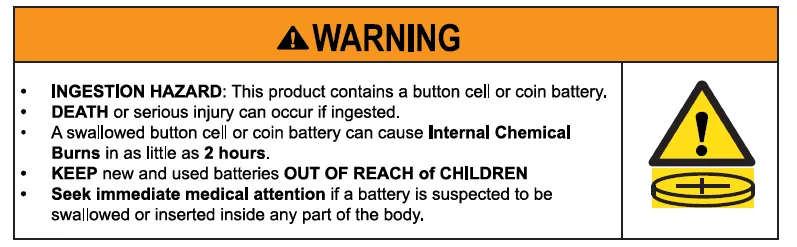
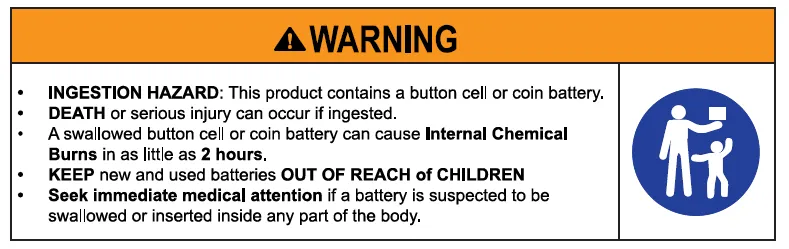
- Label 2: The icon on the right must be at least 8mm in diameter.
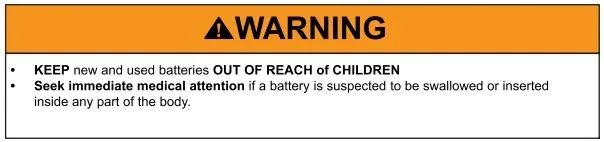
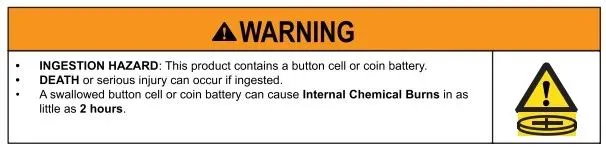
- If space is insufficient to display the full warning information in Label 1 or Label 2, then:

- Label 3 must be placed on the main display panel. (Icon width ≥7mm, height ≥9mm).
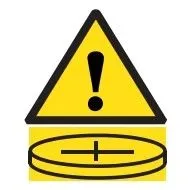
- Label 4 must be placed on other display panels (such as the instruction manual, inserts, or tags).
2. Product Body Labels
- Products containing button batteries must also bear the following warning labels on the product itself:
- Label 5 (if space allows).
- Label 6 (if space is limited; icon width ≥7mm, height ≥9mm).
- If the product is too small to display Labels 5 or 6, the alternative is to comply with the outer packaging label requirements.
3. Instruction Manual Content
- Must explicitly prohibit mixing new and old batteries, incorrect installation, and burning.
- Must provide guidance on safe disposal methods and include all warning label information.
Compliance Recommendations for Businesses
1. Plan Certification Timelines in Advance: ul 4200a testing requires a two-week window (including potential modifications). GCC certification must accompany each shipment.
2. Choose Accredited Laboratories: Prioritize ISO 17025-certified third-party testing agencies.
3. Update Compliance Documents Regularly: CPSC recommends annual retesting and re-certification following design changes.
4. Prepare for Market Inspections: Maintain test reports, GCC certificates, and related records for at least five years. Ensure clear and traceable labeling.
By 2025, the U.S. has entered a “zero-tolerance” phase regarding products containing button batteries. Businesses must integrate GCC and UL 4200A compliance into their design process to avoid commercial losses due to certification laPSEs.
Email:hello@jjrlab.com
Write your message here and send it to us
 How to get an EN 301 893 test report?
 What is EN 301 893 Certification Compliance
 What is the CSA 62368-1 Standard?
 Canadian Pacifier Compliance SOR/2016-184
 US Agent for FCC & EC REP for CE: Compliance R
 What is Recycling of WEEE
 What is PPWR Packaging Compliance
What is Extended Producer Responsibility
What is PPWR Packaging Compliance
What is Extended Producer Responsibility
Leave us a message
24-hour online customer service at any time to respond, so that you worry!