



EU LVD 2014/35/EU Certification Process
In the global electrical product export market, the European Union is known for its strict safety standards and regulatory framework. The low voltage directive (LVD) 2014/35/EU is a critical threshold for entering this market. Whether dealing with power adapters, home appliances, or other electronic devices rated between 50V–1000V (AC) or 75V–1500V (DC), compliance with LVD's core safety requirements is mandatory.
This article breaks down the LVD 2014/35/EU certification process from start to finish, providing specific safety interpretations for power adapters and common home appliances. For manufacturers, exporters, and quality managers, a thorough understanding of this process will not only accelerate time-to-market but also significantly reduce compliance risks.
Core Framework and Scope of LVD 2014/35/EU
The 2014/35/EU directive officially replaced the older 2006/95/EC directive on April 20, 2016. Rather than a detailed technical standard, it is a framework "New Approach Directive" designed to ensure that low-voltage equipment poses no danger to humans, pets, or property under normal use and foreseeable misuse.
Its core concept is "self-declaration based on risk assessment," meaning the manufacturer bears ultimate responsibility. Notably, LVD dictates safety objectives, not technical specifics; the actual test methods are provided by harmonized standards (e.g., EN standards).
Scope of Application:
LVD applies to electrical equipment rated between 50V–1000V AC and 75V–1500V DC. This covers most common power adapters (220V AC input to 5V–48V DC output), microwaves, washing machines, refrigerators, and vacuum cleaners. However, it explicitly excludes medical devices, equipment for explosive atmospheres (ATEX), elevators, and electricity meters.
Key Safety and Compliance Points for Power Adapters
Power adapters are heavily regulated under the LVD. Because they directly connect to the mains and users frequently touch the output ends, the safety risks are high. The following elements are critical:
Clearance and Creepage Distances: Sufficient safety distances must be maintained between primary (high voltage) and secondary (low voltage) circuits, as well as between live parts and accessible enclosures. For standard <75W adapters with 220V AC input, EN 61558 or EN 62368-1 typically requires clearances of 3mm to 6mm, depending on the pollution degree and material group.
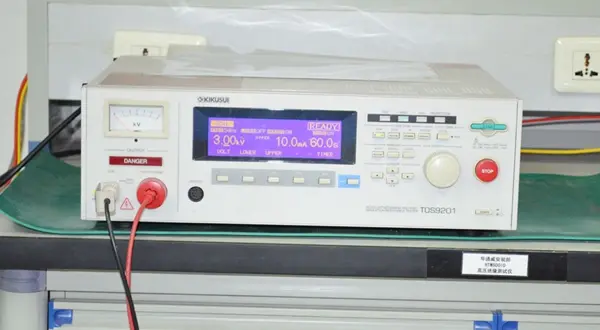
Insulation and Withstand Voltage: Adapters generally use double or reinforced insulation. Manufacturers must provide withstand voltage test reports (usually applying 3000V–4000V AC for 1 minute with no breakdown). Insulation resistance testing (>100 MΩ) is also mandatory.
Grounding and Leakage Current: For Class I equipment (metal enclosure, requiring grounding), continuity resistance must be <0.1 ohms. For Class II equipment (plastic enclosure, double insulation), leakage current must be restricted to <0.25 mA. Most adapters are Class II, making leakage current control vital.
Mechanical Strength and Drop Tests: Enclosures must withstand normal impact. Tests usually require dropping the adapter from a 1-meter height onto a hard surface three times (on different faces). The enclosure must not crack and expose live parts.
Abnormal Operation and Fault Conditions: Adapters must remain safe under single-fault conditions (e.g., short circuits, overloads). They should feature overcurrent protection (fuses) or thermal cutoffs to automatically disconnect the circuit and prevent fire or overheating.
Safety Standards and Testing for Home Appliances
Unlike adapters, home appliances often involve moving parts, heating elements, and wet environments. Consequently, LVD requires additional functional safety evaluations:
Protection Against Electric Shock: Live parts must be fully enclosed and inaccessible during normal operation. Small mobile appliances (like kettles and hair dryers) usually require an IPX4 rating (splash-proof) or higher. Dangerous internal parts must only be accessible with tools, even during routine maintenance.
Heating and Temperature Rise: Under rated loads, the temperature of enclosures, handles, and internal parts must stay within safe limits. Under EN 60335-1, handheld appliance enclosures cannot exceed a 30K rise (40K for metal parts). Insulation near heating elements must withstand high heat without causing combustion.
Mechanical Hazards: Appliances with rotating parts (e.g., washing machine drums, blender blades) must have interlocks or guards. LVD often mandates a standardized "finger test" to ensure users cannot touch hazardous moving parts.
Moisture Resistance: Kitchen and bathroom appliances undergo damp heat testing (48 hours at 40°C and 93% humidity), followed immediately by insulation and withstand voltage tests to ensure moisture does not compromise safety.
Component and Structure Checks: Cords, plugs, switches, and fuses must match the appliance's overall rating. For example, a 10A current requires at least a 1.5mm² copper power cord and must use certified components (e.g., 3C, VDE).
Complete LVD 2014/35/EU Certification Process
Unlike mandatory third-party certifications (like GS or UL), the core LVD pathway is "Manufacturer Self-Declaration." However, to strengthen their legal compliance evidence, manufacturers often use third-party labs. The standard workflow is:
Define Scope and Standards: Confirm if the product falls under LVD and locate the correct, updated harmonized standard (e.g., EN 62368-1 for adapters, EN 60335-2-25 for microwaves).
Compile Technical Documentation: This is the most crucial step. Files must include product descriptions, circuit diagrams, component lists, design principles, risk assessments, applied standard versions, test reports, labels, and manuals. Documents must be retained for 10 years.
Internal Assessment and Testing: Manufacturers can test in-house (if properly equipped) or hire an ISO 17025 accredited lab. Testing must cover all relevant hazards (electrical, mechanical, thermal, chemical, etc.).
Draft the Declaration of Conformity (DoC): Upon passing assessments, the manufacturer signs a DoC detailing the product model, manufacturer info, applied standards, date, and location. Providing an English version is recommended for customs clearance.
Affix the ce mark: The CE mark can only be applied legally after completing all prior steps. It must be at least 5mm high, clear, indelible, and typically placed near the product nameplate.
Appoint an eu authorized representative: Non-EU manufacturers must appoint a representative within the EU to hold technical documents for market surveillance authorities.
Common Pitfalls and How to Avoid Them
Firms new to LVD often fall into these traps:
Confusing EMC and LVD: LVD handles safety, whereas the EMC Directive (2014/30/EU) handles electromagnetic compatibility. Most products entering the EU require both.
Ignoring Risk Assessment Documents: A third-party test report alone is not enough. The LVD legally mandates a written risk assessment ("identifying the highest risks and how they are mitigated") within the technical file.
Using Outdated Standards: The Official Journal of the EU (OJEU) updates harmonized standards monthly. Testing products against old standards can lead to non-compliance penalties.
Neglecting Safety Warnings in Manuals: Manuals must detail usage restrictions, safety warnings, and maintenance instructions, translated into the official language of the target country.
Best Practices for Document Management
Because lvd certification relies heavily on documentation, establishing a structured technical file template early saves time. Key files include:
Product Overview (appearance, exploded views, schematics).
Critical Components List (models, suppliers, and UL/VDE certificate numbers).
Declaration of Conformity (scanned original with signature/seal).
Risk Assessment (preferably formatted as FMEA or HAZOP).
Test Reports (categorized by standard and test item).
Final Labels and Manuals (displaying the CE mark and local warnings).
European importers often request technical file summaries during contract negotiations. Organizing these into version-controlled PDFs (e.g., V1.0) ensures smooth traceability.
Conclusion and Future Outlook
The LVD 2014/35/EU establishes a rigorous, legally binding safety framework. Its self-declaration nature forces manufacturers to enhance their internal capabilities and embed safety from the initial design phase. By methodically identifying standards, compiling technical files, executing tests, and appointing EU representatives, the certification timeline becomes highly manageable.
Currently, the EU is tightening market surveillance, with frequent spot-checks on e-commerce platforms like Amazon and AliExpress. Non-compliant products face immediate recalls, fines, or bans. Mastering the LVD process is no longer optional—it is a prerequisite for global expansion. We advise manufacturers to integrate compliance early into the R&D stage and partner with experienced testing labs to shorten time-to-market and secure a smooth entry into Europe.
Email:hello@jjrlab.com
Write your message here and send it to us
 Australia RCM Certification for Radio Devices
 RED Cybersecurity EN 18031 Standard
 Compliance Testing for EMC
 What is Amazon Toy Compliance?
 What is Cytotoxicity ISO 10993-5
 What is Hemocompatibility Testing ISO 10993?
 What is ISO 10993-5 Tests for In Vitro Cytotoxicit
Electronic Product IEC 62368-1 Safety Testing
What is ISO 10993-5 Tests for In Vitro Cytotoxicit
Electronic Product IEC 62368-1 Safety Testing
Leave us a message
24-hour online customer service at any time to respond, so that you worry!