


What is the EN IEC 60335-1 Standard?
For home appliance companies planning to enter the EU market, the EN 60335 standard is an unavoidable core threshold. Formulated by the European Committee for Electrotechnical Standardization (CENELEC), this set of safety regulations is not only the "golden key" for products to obtain CE certification and legally enter the European market, but it also directly determines a product's consumer trust and market competitiveness. From basic electrical safety to cutting-edge network protection, the EN 60335 standard is continuously updated to comprehensively cover the safety requirements of home appliances throughout their entire life cycle.
What is the EN 60335 Standard?
The EN 60335 standard is not a single document, but a safety system that continuously evolves alongside technological development. Its birth and iteration have always revolved around the core mission of "safeguarding consumer safety and regulating market order."
1. Origin of the Standard
Since its first publication in the 1970s, the EN 60335 standard has undergone dozens of revisions aimed at adapting to the innovation of home appliance technology (such as the leap from traditional to smart appliances) and the upgrading of market demands (such as higher requirements for environmental protection and safety). Today, it has become the core basis for the low voltage directive (LVD) concerning "Safety of Machinery and Electrical Equipment" in eu ce certification. Any household and similar electrical appliance with a rated voltage not exceeding 250V (single-phase) or 480V (three-phase) must pass the inspection of this standard to enter the EU market.
2. System Structure
The EN 60335 standard adopts a logic of "basic coverage + sub-segment adaptation," which ensures the uniformity of safety requirements while taking into account the characteristic differences of various home appliances. The specific structure is as follows:
EN 60335-1 (General Requirements): The "safety baseline" that all home appliances must meet. It covers basic safety dimensions such as electrical, thermal, mechanical, and material aspects, serving as the core framework of the entire standard system.
EN 60335-2-XX (Particular Requirements): "Special supplements" targeted at specific categories of home appliances, for example:
EN 60335-2-1: Electric irons
EN 60335-2-15: Microwave ovens
EN 60335-2-23: Electric kettles
EN 60335-2-75: Vacuum cleaners
These standards add targeted requirements based on the product's usage scenarios and working principles (e.g., dry-boil protection design for electric kettles, electromagnetic leakage limits for microwave ovens).
Safety Requirements
The EN 60335 standard puts forward strict requirements for home appliances across multiple dimensions. Each requirement corresponds to a potential risk during actual use, aiming to avoid safety hazards right from the design source.
1. Electrical Safety: Eliminating Electric Shock and Circuit Faults
Electrical safety is the core of home appliance safety. The standard prevents risks such as leakage, short circuits, and overload through several mandatory requirements:
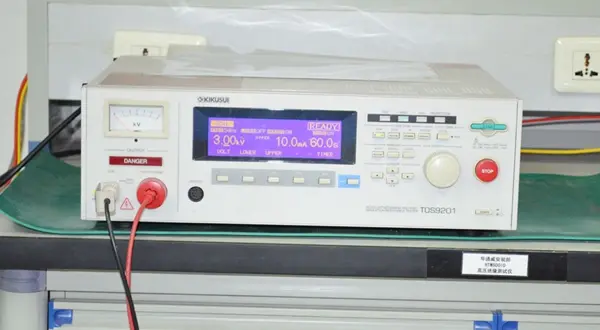
Insulation Performance: Products must pass an "electrical strength test"—applying a 1000V high voltage between live parts and accessible metals for 1 minute, during which no breakdown or flashover phenomena occur, ensuring the insulation layer is reliable.
Grounding Protection: Home appliances with metal enclosures must have effective grounding devices. The resistance between the grounding terminal and the enclosure must be ≤0.5Ω, ensuring that current can be quickly conducted away in the event of an accidental leak.
Overload and Short-Circuit Protection: Must be equipped with protection components such as fuses and circuit breakers. When an overload or short circuit occurs, the power supply must be cut off within a specified time to avoid burning components or causing fires.
2. Thermal Safety: Preventing Risks Caused by High Temperatures
If the heat generated during the operation of home appliances gets out of control, it can easily lead to enclosure burns and material spontaneous combustion. The standard strictly limits this:
Temperature Rise Control: Different components have clear temperature rise limits. For example, the surface temperature rise of liquid heaters (like electric kettles) must not exceed 60°C to prevent users from getting burned upon contact; motor winding temperature rise must meet the corresponding insulation class requirements (e.g., Class A insulation ≤60K).
Overheat Protection: Key components must be equipped with overheat protection devices (such as thermal fuses, thermostats). For example, an electric iron's thermostat must automatically cut off power when the temperature exceeds limits, preventing prolonged high temperatures from causing fires.
3. Mechanical Safety: Avoiding Injuries Caused by Structural Defects
Addressing mechanical risks during the use of home appliances, the standard sets requirements from two aspects: structural design and protective measures:
Enclosure Strength: The enclosure must pass an "impact resistance test" (such as dropping a steel ball of a specified weight from a specific height to strike it). After the impact, there must be no cracking or component detachment, and internal live parts must not be exposed.
Moving Parts Protection: Home appliances with rotating or reciprocating moving parts (such as blenders, vacuum cleaner motors) must be equipped with protective covers or nets. The mesh/gap size must meet the requirement that "fingers cannot be inserted" to prevent pinching or entanglement.
IP Protection Degree: The protection rating is determined based on the use environment. For example, home appliances used in bathrooms must achieve IPX4 (splash-proof), and kitchen range hoods must achieve IPX1 (protection against vertically falling water drops), preventing dust and liquid from entering the interior and causing faults.
4. Material Safety: Controlling Combustion Risks from the Source
The flame-retardant performance of home appliance materials is directly related to fire hazards. The standard lays out clear flame-retardant requirements for materials:
Plastic Enclosures: Must pass the "glow-wire test"—touching the material surface with an 850°C glow wire for 30 seconds. The material must not ignite, or if it does, it must self-extinguish within 2 seconds, with no molten drops igniting the bedding layer below.
Insulating Materials: Must meet the corresponding temperature resistance class (such as Class E, Class B) to ensure they do not age or fail in long-term high-temperature environments.
5. Environmental Adaptability
Environmental conditions (such as temperature and humidity) vary across different regions of the EU. The standard requires home appliances to have certain environmental adaptability capabilities:
Low-Temperature Adaptability: In a -5°C environment, home appliances must be able to start and operate normally, without any component freezing, cracking, or functional failure.
Humid Environment Adaptability: Bathroom and kitchen appliances must pass a "humidity treatment test" (such as being placed in an environment with 93% relative humidity for 48 hours). After treatment, the electrical performance must still meet the requirements, avoiding insulation degradation caused by moisture.
Applicable Product Scope
The application scope of the EN 60335 standard is broad, covering a wide variety of common home appliances in daily life. As long as the rated voltage meets the criteria of "single-phase ≤250V, three-phase ≤480V" and the product is used in a "household or similar environment" (such as offices, hotels), it must comply with this standard. It primarily includes:
Kitchen Appliances: Electric kettles, rice cookers, microwave ovens, ovens, dishwashers, juicers;
Cleaning Equipment: Vacuum cleaners, robot vacuums, washing machines, dryers;
Personal Care Appliances: Hair dryers, electric shavers, electric toothbrushes, curling irons;
Home Equipment: Electric fans, humidifiers, heaters, air conditioners (indoor units), electric irons;
Other Equipment: Projectors, small refrigerators, electric space heaters.
EN 60335 Certification Process
To pass EN 60335 certification, companies must advance according to the procedural steps, ensuring every stage meets requirements to avoid delaying certification progress due to omissions.
Step 1: Product Design Phase — Benchmarking Standard Requirements
During the early stages of product development, the general requirements of EN 60335-1 and the particular requirements of the corresponding category EN 60335-2-XX must be integrated into the design:
For example, when developing an electric kettle, it must simultaneously satisfy the electrical safety requirements of EN 60335-1, as well as the special requirements of EN 60335-2-23 such as "dry-boil protection and spout spill prevention."
Design documents must clearly specify material selection (e.g., flame-retardant plastic models) and protection component parameters (e.g., fuse specifications), ensuring compliance right from the source.
Step 2: Sample Testing — Passing Laboratory Verification
Completed design samples must be sent to an EU-recognized third-party laboratory (such as a lab with CNAS and CMA qualifications that is recognized by an EU Notified Body) for full-item testing, mainly including:
Electrical strength, insulation resistance, and grounding continuity tests;
Temperature rise tests and overheat protection function tests;
Mechanical impact and IP protection degree tests;
Glow-wire, needle-flame, and other flame-retardant tests.
Note: The laboratory will issue a detailed test report. If the test fails, the sample must be rectified according to the report and retested.
Step 3: Document Review — Submission for Certification Body Assessment
After passing the tests, submit the following materials to an EU Notified Body (such as TÜV, SGS, Intertek):
Test reports and laboratory qualification certificates;
Product technical documents (design drawings, BOMs, user manuals, circuit diagrams);
Declaration of Conformity (DoC), declaring that the product complies with the EN 60335 standard requirements.
Note: The certification body will review the completeness and consistency of the documents to confirm the product has no compliance loopholes.
Step 4: Obtaining the Certificate and ce mark
If the document review is passed, the certification body will issue the EN 60335 certification certificate. The enterprise must then affix the CE mark on the product enclosure and packaging (the mark height must be ≥5mm, clear, and not easily worn off) and attach other documents required for EU market access (e.g., user manuals must include official EU languages). At this point, the product can legally enter the EU market.
The EN 60335 standard is not merely an "entry threshold" for the EU home appliance market, but also a crucial tool for companies to enhance product safety quality and win international trust.
Email:hello@jjrlab.com
Write your message here and send it to us
 RoHS Compliance Testing Services
 Amazon Toy Seller Exporting to Europe Compliance
US Jewelry Compliance Guide
Amazon Toy Seller Exporting to Europe Compliance
US Jewelry Compliance Guide
 FCC Certification Requirements and Costs for Consu
 EMC Testing Lab IEC 60601 Medical Electrical Safet
 What are the FCC Testing Requirements for Bluetoot
 Australia RCM Certification for Radio Devices
 RED Cybersecurity EN 18031 Standard
Leave us a message
24-hour online customer service at any time to respond, so that you worry!