



EU Regulations 2023/1670 & 1669: Phones & Tablets
On August 31, 2023, the European Union published the Ecodesign Regulation (EU) 2023/1670 and the Energy Labelling Regulation (EU) 2023/1669. Both regulations came into force 20 days after publication and will become mandatory from June 20, 2025.
Scope of the Regulations
- Ecodesign Regulation (EU) 2023/1670: Applies to smartphones, feature phones, tablets, and cordless phones.
- Energy Labelling Regulation (EU) 2023/1669: Applies to smartphones and tablets.
Key Requirements of Ecodesign Regulation (EU) 2023/1670
1. Replaceable Parts: Spare parts such as batteries, displays, back covers, cameras, terminals, and buttons must be removable, repairable, and replaceable.
2. User-Replaceable Components: Common spare parts like batteries, back covers, chargers, and SIM slots must be removable and replaceable by ordinary users. If only professional repairers can replace the battery, higher durability and dust/water protection standards are required.
3. Professional Repair Access: All listed spare parts must also be serviceable by authorized professional repairers.
4. Access to Information: Suppliers (manufacturers, importers, or authorized representatives) must make necessary disassembly, repair, and replacement information available—either publicly or conditionally—on the product's webpage for both users and professionals.
5. Spare Parts Availability: Suppliers must offer clear and accessible channels for purchasing spare parts on the product's official webpage.
6. Product Reliability: Products must be robustly designed to withstand drops, scratches, dust, and water, and must support sufficient battery charge-discharge cycles, with efficient battery management systems.
7. Software Updates: Suppliers must provide free OS upgrades and updates for at least 5 years after the product is no longer marketed.
8. Substance Disclosure:
- Plastic materials over 50g must be labeled with polymer types.
- Materials like cobalt, tantalum, neodymium, and gold must have declared weight ranges on the product webpage.
9. Recycling Information: Product webpages must disclose the recycling rate (Rcyc) and basic information on recycled materials.
10. Cordless Phone Power Limits:
- Base station standby power must not exceed 1W.
- Non-base charging docks must not exceed 0.6W (handset docked) or 0.3W (handset undocked).
Key Requirements of Energy Labelling Regulation (EU) 2023/1669
1. Energy Label Provision: Suppliers must provide both physical and digital versions of the energy label upon request to dealers.
2. Product Information Sheet: Suppliers must prepare and provide digital and printed versions of the product information sheet upon request.
3. Technical Documentation: Suppliers are responsible for compiling and retaining the product's technical documentation in accordance with the regulation.
4. Registration in EPREL: Suppliers must submit registration information to the European Product Registry for Energy Labelling (EPREL).
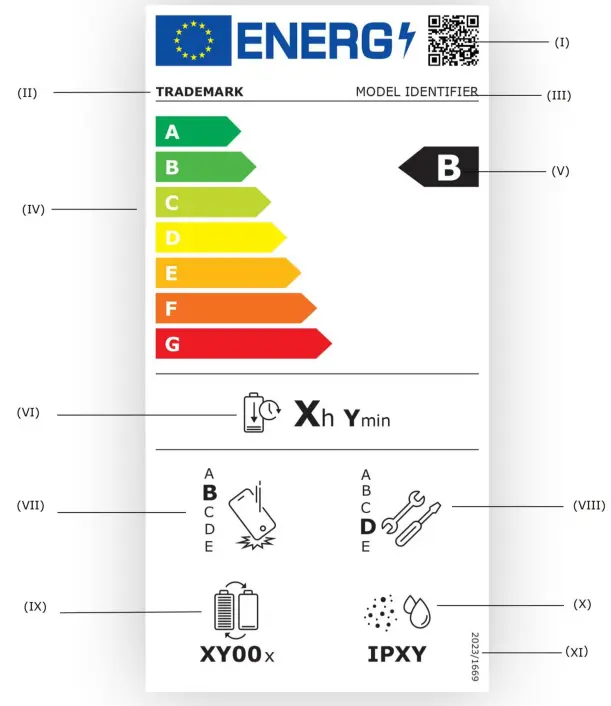
5. Energy Label Format Includes:
- I. QR Code
- II. Brand Logo
- III. Model
- IV. Energy efficiency scale from A (most efficient) to G (least efficient)
- V. The product's energy efficiency rating
- VI. Battery life
- VII. Drop reliability rating
- VIII. Repairability index rating
- IX. Battery cycle durability
- X. Dust and water protection rating
- XI. Regulation number
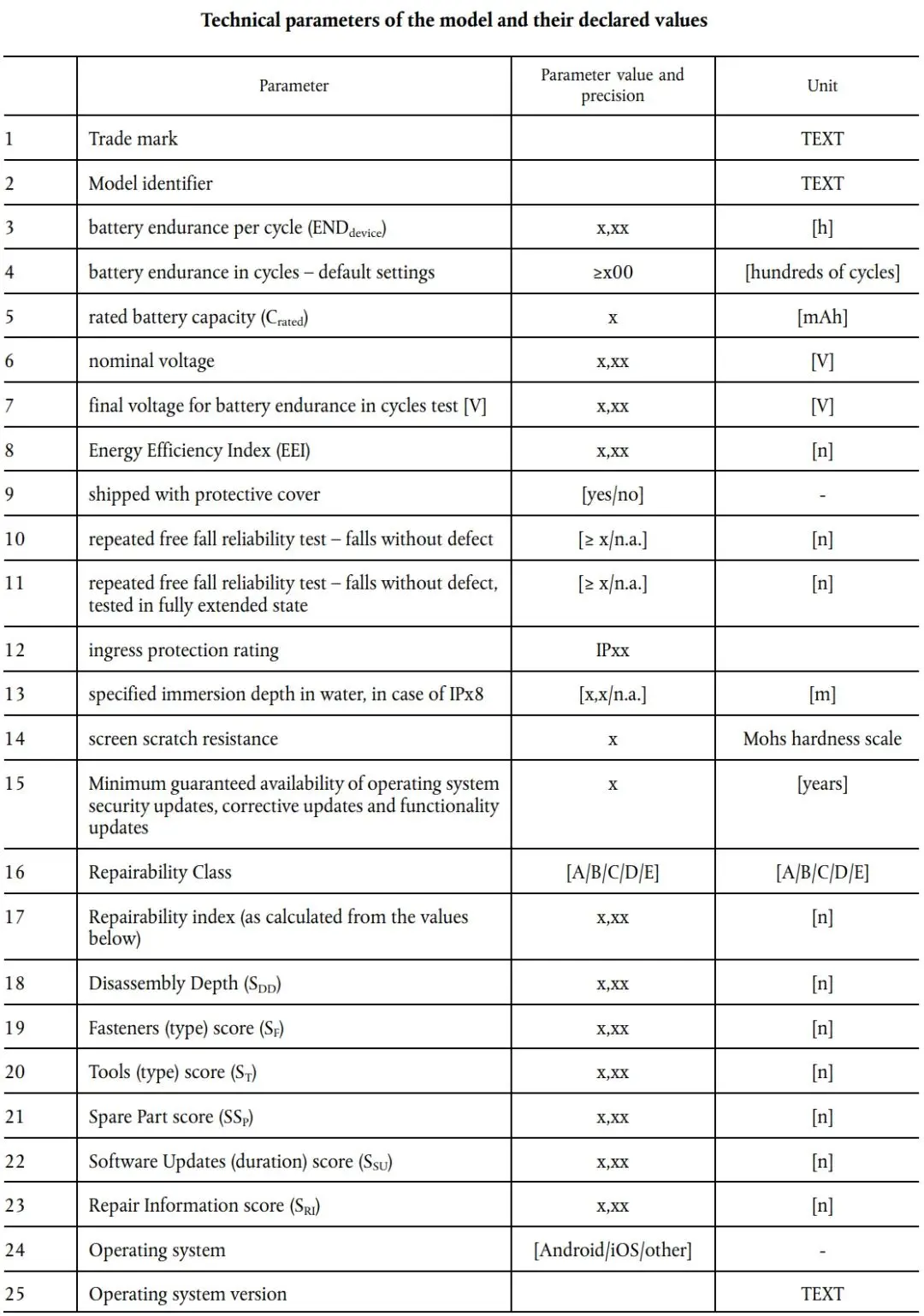
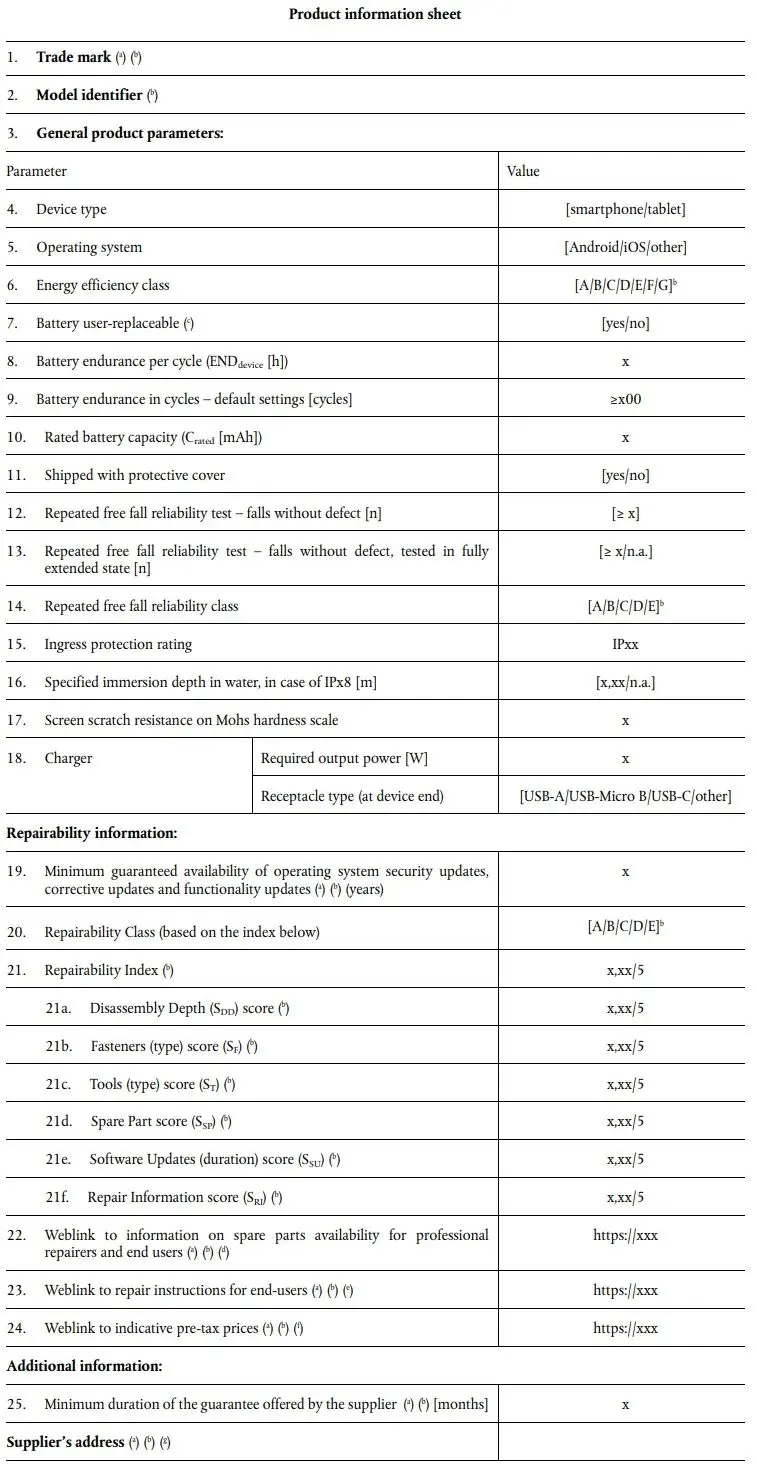
6. Product Information Sheet Format:
*(Specific format not provided in the source, but must follow the regulation's structure.)*
7. Contents of Technical Documentation:
*(Specific contents must include all required data proving compliance with the energy label and product performance claims.)*
Overview of EU Market Surveillance testing Procedures
1. Execution: Conducted by authorities authorized by EU member states.
2. Tolerance Use: Tolerances apply only for verification tests, not for compliance assessments.
3. Declared Values: Published values on labels and sheets must not be more favorable than those in the technical file.
4. No Test Detection: Products must not be designed to detect testing and alter performance accordingly.
5. Battery Cycle Test: Battery cycle durability is tested using the device’s OS.
6. Testing Scope: Includes performance tests and documentation checks.
7. Test Items:
- Network and idle power consumption (cordless phones)
- Battery life
- Battery durability (cycle count)
- Rated capacity and voltage
- Voltage after cycle test
- Dust and water resistance
- Repairability index
- Drop test performance
8. Pass Criteria: Based on comparison with declared values considering allowed tolerances.
9. Documentation Check: Energy label, product information sheet, and technical documentation are reviewed to ensure consistency with declared values.
Official Sources and Registration Portals
- Regulation Texts:
- [EU 2023/1670 - Ecodesign Regulation](https://eur-lex.europa.eu/eli/reg/2023/1670/oj/eng)
- [EU 2023/1669 - Energy Labelling Regulation](https://eur-lex.europa.eu/eli/reg_del/2023/1669/oj/eng)
- Energy Label Registration Portals:
- [EPREL Homepage](https://eprel.ec.europa.eu/screen/home)
- [Supplier User Guide](https://energy-efficient-products.ec.europa.eu/suppliers_en#user-guide-for-suppliers)
Email:hello@jjrlab.com
Write your message here and send it to us
 What is the Difference Between EU PPWR and EPR?
 What is Japanese METI Registration
 Exporting to Saudi Arabia Saber Certification: PCo
 How to get a Saudi Arabia MSDS?
 Do I Still Need PPWR Compliance if I Have RoHS?
 Amazon Children's Toys Direct Validation Mandatory
 UL 4200A-2026 Compliance Standard for Button/Coin
 Guide to the EN18031 Testing Standard
Leave us a message
24-hour online customer service at any time to respond, so that you worry!