



Singapore IMDA Label Requirements
Singapore IMDA Certification
The Info-Communications Media Development Authority (IMDA) of Singapore requires that all radio communication and telecommunication equipment sold or used in Singapore must obtain IMDA Certification approval.
Types of Applications
Depending on the registration scheme and device type, there are five types of applications:
1. Enhanced Simplified Equipment Registration (ESER):
For Bluetooth devices, RFID, wireless microphones, DVB-T2 set-top boxes, etc.
2. Simplified Equipment Registration (SER):
For mobile phones, routers, etc.
3. General Equipment Registration (GER):
For base stations, walkie-talkies, etc.
4. General Equipment Registration by Certification Body (GER-CB)
5. Confirmation of Conformity (COFC):
Voluntary registration, applicable to exempted equipment such as fax machines.
Most consumer electronic products fall under ESER and SER schemes. Except for COFC, which is valid indefinitely, other types of registrations are valid for 5 years.
Basic Information on IMDA Certification
1. Nature of certification: Mandatory
2. Processing time: 1–2 weeks
3. Local representative: Required (certificate must be held by a Singapore-based company)
4. Application scope: Each IMDA Certificate covers a single model only
Certification Documents
1. Complete ce red documentation
2. English user manual
3. Label (must show trademark)
4. Information of Singapore local representative (not required if using our company’s representation)
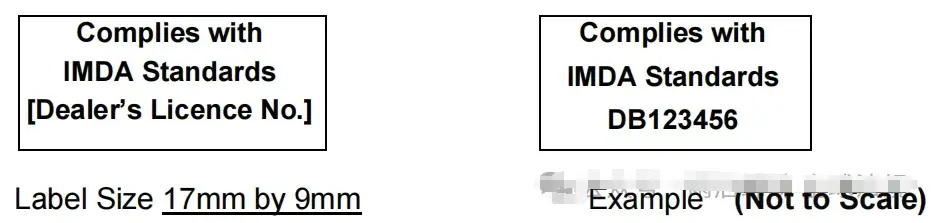
IMDA Label Requirements
1. Label size: 17 mm by 9 mm
2. Dealer's Licence No.: This is the importer’s code, not the certificate number
3. The label can be affixed to the product, user manual, or packaging
Email:hello@jjrlab.com
Write your message here and send it to us
 RoHS Compliance Testing Services
 Amazon Toy Seller Exporting to Europe Compliance
US Jewelry Compliance Guide
Amazon Toy Seller Exporting to Europe Compliance
US Jewelry Compliance Guide
 FCC Certification Requirements and Costs for Consu
 EMC Testing Lab IEC 60601 Medical Electrical Safet
 What are the FCC Testing Requirements for Bluetoot
 Australia RCM Certification for Radio Devices
 RED Cybersecurity EN 18031 Standard
Leave us a message
24-hour online customer service at any time to respond, so that you worry!