



UL 1017 Electric Vacuum Cleaner Testing Items
The ul 1017 standard, formally titled "UL 1017 Standard for Vacuum Cleaners, Blower Cleaners, and Household Floor Finishing Machines," is an important certification standard regarding the safety of household vacuum cleaners and related products.
This standard contains highly comprehensive and detailed testing items to ensure that the product will not pose risks of electric shock, fire, or mechanical injury to users under normal use and foreseeable misuse.
Structural Safety Inspection
Before the testing begins, the product's structure is first reviewed to ensure its design complies with the basic requirements of the standard, such as:
Material Requirements: Flame retardant ratings of the enclosure materials (e.g., ul 94 V-0, V-1, 5VA, etc.).
Mechanical Structure: The robustness of the enclosure and the guarding of moving parts to prevent user access to hazardous components.
Clearances and Creepage Distances: The distances between live parts, and between live parts and accessible metal parts, must be sufficient to prevent short circuits and electric shock.
Electrical Safety Testing
This is the core section of the standard, primarily aimed at preventing electric shock and fire.
Input Test: Measures the current and power of the product during normal operation to ensure they do not exceed the rated values.
Leakage Current Test: Measures the leakage current flowing from accessible parts of the product to the ground under normal and single-fault conditions; the value must be below the standard limits to prevent electric shock.
Dielectric Voltage-Withstand Test (Hipot Test): Tests the insulation performance of the product under high voltage. For example, applying a high voltage (such as 1000V AC + 2 times the operating voltage) between live parts and the enclosure for 1 minute without any breakdown occurring.
Grounding Continuity Test: For Class I appliances (products with a grounding wire), tests the resistance of the grounding path to ensure that in the event of an insulation fault, the current can be smoothly conducted to the ground, triggering the protective device.
Abnormal Operation Tests
Simulates various abnormal conditions to verify whether the product's protective measures are effective:
Motor Blocked Inlet Test: Completely blocking the air inlet of the vacuum cleaner, allowing the motor to run at maximum load until the protective device operates or a steady state is reached. During and after the test, the product must not catch fire, emit toxic gases, or cause a risk of electric shock.
Motor Overload Test: Applying an excessive mechanical load to the motor.
Component Short-Circuit / Open-Circuit Test: Simulating the failure of critical electronic components (such as capacitors).
Mechanical Safety Testing
Stability Test: For upright vacuum cleaners, etc., testing their stability at various tilt angles to ensure they do not easily tip over.
Protection Against Moving Parts: Ensuring that moving parts such as brush rolls and fans are properly guarded to prevent users' (especially children's) fingers and other body parts from getting caught.
Mechanical Strength Tests
Impact Test: Using a specified impact hammer to strike the enclosure, checking if the enclosure cracks or exposes hazardous components.
Drop Test: For handheld or portable vacuum cleaners, conducting tests where they are dropped from a specific height.
Temperature Rise Testing
Under normal and abnormal working conditions (such as the latter half of the blocked inlet test), the temperature rise of various parts of the product (e.g., motor enclosure, power cord, switches, external surfaces) is monitored. The temperature rise must not exceed the limits specified by the standard to prevent insulation aging, material deformation, or burns to the user.
Fire Resistance testing
This is a very prominent feature of UL standards, focusing heavily on the flame retardancy of materials.
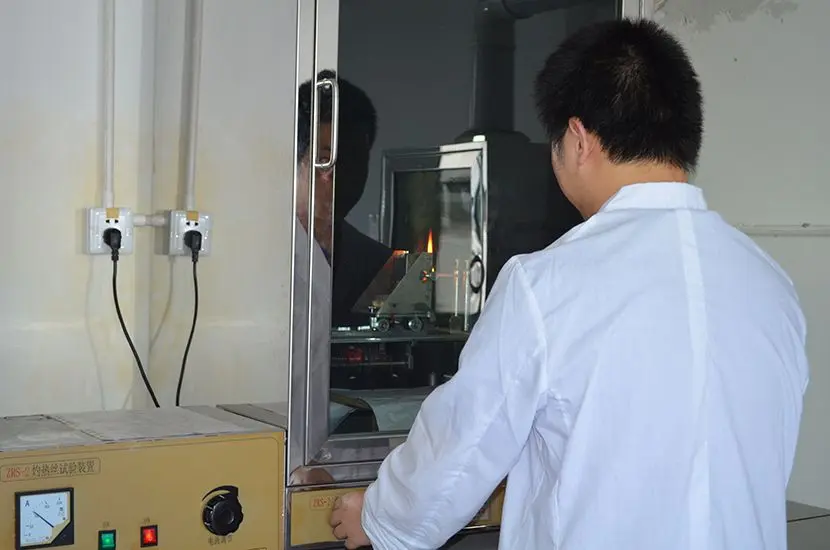
Glow-Wire Test: Using a glow wire heated to a specific temperature to simulate an overheated component coming into contact with non-metallic parts, evaluating their resistance to ignition and flame propagation.
Needle-Flame Test: Using a small flame to simulate a minor flame generated under fault conditions, testing whether the components can resist the flame or limit its spread.
Abnormal Heating Test: Directly observing whether there is a risk of fire during tests such as the motor locked-rotor test.
Other Important Tests
Power Cord Test: Includes pull and torsion tests on the power cord to ensure the cable connection is secure and cannot be easily pulled out, which would cause a hazard.
Hose and Tube Test: Testing the durability, kink resistance, and strength of the vacuum cleaner hose.
Accessory Test: Conducting mechanical strength and durability tests on accessories like nozzles and brush heads.
Label Durability Test: Testing warning labels and electrical parameter labels on the product with wiping solvents to ensure they remain legible and do not easily peel off throughout their service life.
The testing items of UL 1017 form a comprehensive, strict, and interconnected system. Its ultimate goal is not just to pass a single test, but to ensure that the product minimizes risks throughout its entire lifecycle, even under extremely abnormal conditions. Manufacturers need to consider these requirements from the very beginning of the design phase to pass successfully.
Email:hello@jjrlab.com
Write your message here and send it to us
 What is LFGB Certification Meaning
 EU Food Contact Materials (FCM) EC 1935/2004 Stand
 LFGB Germany Food Contact Materials Official
 Australia & New Zealand RCM Registration Requi
 Japan MIC Wireless Certification Testing
 Canada RSS-247 Testing Lab
 LVD and EMC Testing for Power Adapters
 IEC 62133-2 Lithium Battery Testing Laboratory
Leave us a message
24-hour online customer service at any time to respond, so that you worry!