



What are the Compliance Requirements for Home Appliance Exports
Product Scope
Household appliances, electric tools, regulating controls using semiconductor devices, motor-driven electrical and medical equipment, electric toys, automatic vending machines, and cinematographic or slide projectors.
Out of scope:
Equipment with all emission requirements in the radio frequency range explicitly specified in other standards, such as luminaires, mains communication devices, etc.
Regulating controls incorporating semiconductor devices with a rated input current greater than 25A per phase and equipment containing such regulating controls.
Power supplies used independently, etc.
EU CE certification
Electromagnetic Compatibility (EMC) Directive: 2004/108/EC
Testing Standards: EN 55014-1 (EMI), EN 55014-2 (EMS), en 61000-3-2 (Harmonic), EN 61000-3-3 (Flicker)
Note: The above EN 61000-3-2 and EN 61000-3-3 apply to equipment with an input current of less than 16A per phase. If the current is greater than 16A, EN 61000-3-12 and EN 61000-3-11 apply.
EMI Section
Continuous Disturbance
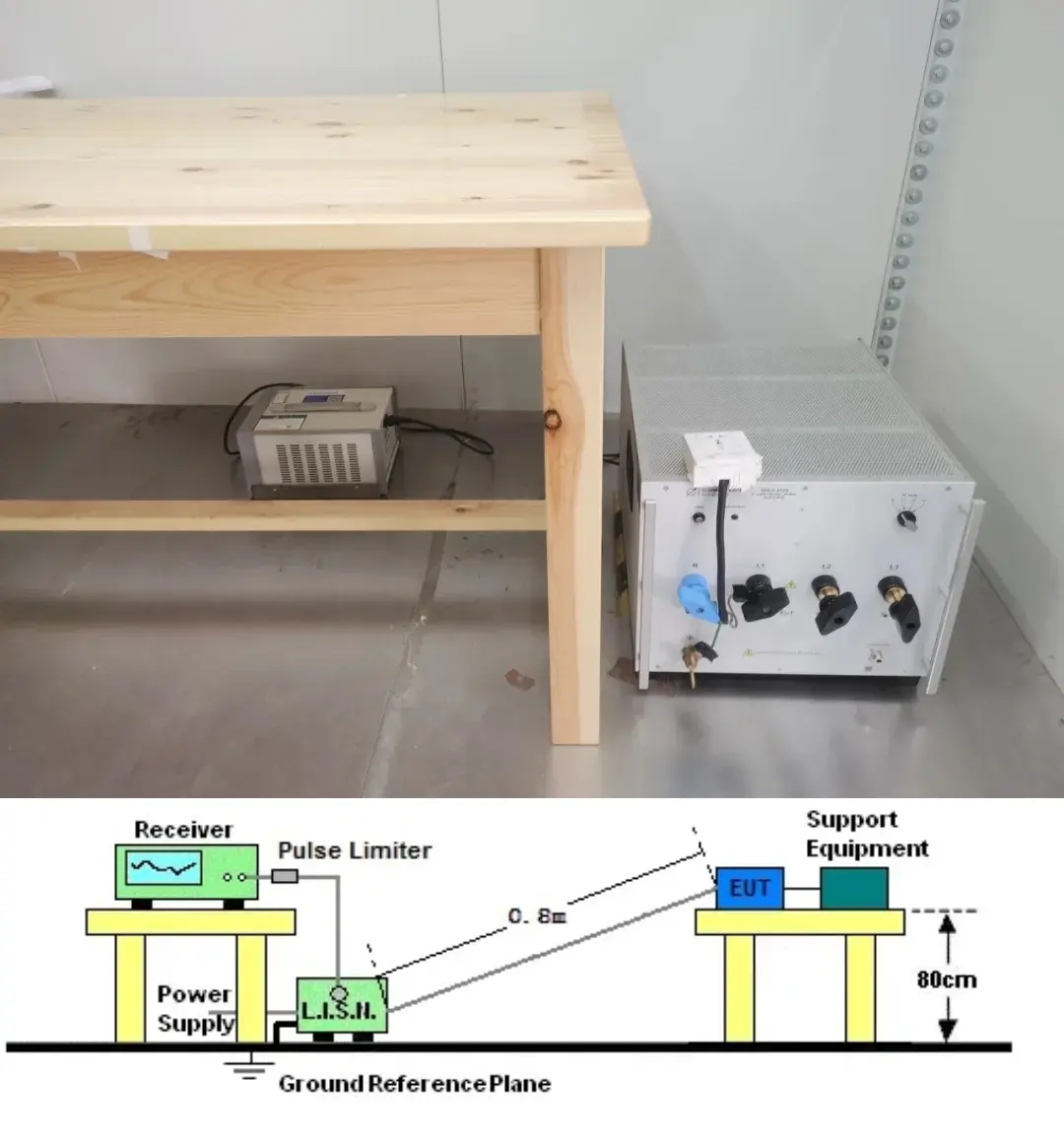
Terminal Voltage:
a. Power terminals, frequency range: 0.15~30MHz; further divided into two types of limits for household appliances/similar equipment and electric tools.
b. Load terminals and additional terminals.Disturbance Power:
Frequency range 30MHz~300MHz limits and 30MHz~300MHz frequency range "Margin" limits (this limit is one of the bases for determining whether to measure radiated disturbance).Radiated Disturbance:
Frequency range 30MHz~1GHz; this item does not need to be tested when the following two conditions are met simultaneously:
a. The measured value of disturbance power is less than the above frequency range 30MHz~300MHz limit minus the "Margin" of the 30MHz~300MHz frequency range.
b. The maximum clock frequency is less than 30MHz.
(Otherwise, this item must be tested.)
Discontinuous Disturbance
Clicks:
Four frequency points: 150KHz, 500KHz, 1.4MHz, and 30MHz, evaluated using the upper quartile method.
Harmonic Current
Standard: EN 61000-3-2
Products with a rated voltage range of AC 220~240V need to undergo this test.
Products with a rated power of 75W and below have no limit requirements and do not need to be tested.
Voltage Fluctuations and Flicker
Standard: EN 61000-3-3
Products with a rated voltage range of AC 220~240V need to undergo this test.
Limit Requirements:
Short-term flicker indicator Pst ≤ 1.0
Long-term flicker indicator Plt ≤ 0.65
The time d(t) during which the voltage change exceeds 3.3% ≤ 500ms
Relative steady-state voltage change dc ≤ 3.3%
Maximum relative voltage change dmax limits are divided into three types: 4%, 6%, and 7%
EMS Section
Product Classification
Category 1: Appliances with no electronic control circuitry.
Category 2: Transformer toys, dual-supply toys, mains-powered motor appliances, electric tools, heating appliances, and similar electrical appliances (e.g., UV radiators, IR radiators, and microwave ovens) containing electronic control circuitry with an internal clock frequency or oscillator frequency not exceeding 15MHz.
Category 3: Appliances containing electronic control circuitry and powered by a battery (built-in or external battery). Under normal conditions of use, this type of appliance is not connected to the mains, and its electronic control circuitry has an internal clock frequency or oscillator frequency not exceeding 15MHz.
Category 4: All other appliances within the scope of this standard.
EMS Performance Criteria
Performance Criterion A:
During the test, the appliance shall continue to operate as intended. When the appliance is used as intended, no degradation of performance or loss of function is allowed below a performance level (or permissible loss of performance) specified by the manufacturer. If the manufacturer does not specify the minimum performance level or the permissible performance loss, it can be derived from the product manual, documentation, and what the user may reasonably expect from the appliance if used as intended.Performance Criterion B:
After the test, the appliance shall continue to operate as intended. When the appliance is used as intended, no degradation of performance or loss of function is allowed below a performance level (or permissible loss of performance) specified by the manufacturer. During the test, degradation of performance is allowed, but no change in the actual operating state or stored data is allowed. If the manufacturer does not specify the minimum performance level or the permissible performance loss, it can be derived from the product manual, documentation, and what the user may reasonably expect from the appliance if used as intended.Performance Criterion C:
Temporary loss of function is allowed, provided this function is self-recoverable or can be restored by operating the controls or following the operations specified in the instructions for use.
US FCC Certification
Certification Form: FCC Verification
Testing Standard: fcc 47 cfr part 15B
Testing Items (EMI section only):
Note: Under FCC certification, some household appliances may be exempt.
China ccc certification
Testing Standards: GB4343.1, GB17625.1
Testing Items:
Terminal Voltage: Frequency range: 0.15~30MHz
Disturbance Power: Frequency range: 30MHz~300MHz
Radiated Disturbance: Frequency range: 30MHz~1GHz (Applies to toys only; different from CE certification)
Clicks: Four frequency points: 150KHz, 500KHz, 1.4MHz, 30MHz
Harmonic Current: Standard: GB17625.1
Products with a rated voltage range of AC 220~240V need to undergo this test; products with a rated power of 75W and below have no limit requirements and do not need to be tested.
Australia rcm certification
Testing Standard: AS/NZS CISPR 14.1
Testing Items:
Terminal Voltage: Frequency range: 0.15~30MHz
Disturbance Power: Frequency range: 30MHz~300MHz
Radiated Disturbance: Frequency range: 30MHz~1GHz (Whether radiation testing is required is the same as CE certification)
Clicks: Four frequency points: 150KHz, 500KHz, 1.4MHz, 30MHz
Japan pse certification
japan pse Certification: Divided into Diamond and Circular PSE
Testing Standard: J55014-1
Testing Items (EMI section only):
Terminal Voltage: Frequency range: 0.15~30MHz
Disturbance Power: Frequency range: 30MHz~300MHz
Clicks: Four frequency points: 150KHz, 500KHz, 1.4MHz, 30MHz
Taiwan bsmi Certification
Testing Standard: CNS13783-1
Testing Items (EMI section only):
Terminal Voltage: Frequency range: 0.15~30MHz
Disturbance Power: Frequency range: 30MHz~300MHz
Radiated Disturbance: Frequency range: 30MHz~1GHz (Whether radiation testing is required is the same as CE certification)
Clicks: Four frequency points: 150KHz, 500KHz, 1.4MHz, 30MHz
Email:hello@jjrlab.com
Write your message here and send it to us
 What is an EU SDS (Safety Data Sheet)?
 What is the CA Prop 65 Warning Label?
 2026 Amazon TIC Mandatory Audit Catalog
 Australian Electrical EESS and RCM Compliance
 How to get Vietnam CR Certification
 What is a UN 38.3 Battery Test Report
 What is the UN38.3 Certification Test?
 What is a Lithium Ion Battery Certification
Leave us a message
24-hour online customer service at any time to respond, so that you worry!