



What is ASTM F3363-19 for Portable Stoves?
Recently, many sellers of portable alcohol stoves have reported that their products were delisted or they received warning emails from Amazon. These emails require submission of relevant safety test reports before products can be listed again.
Amazon Policy for Portable Stoves
According to Amazon's policy, all portable stoves must be tested and comply with specific regulations and standards.
Portable Stoves Covered by This Policy
This policy applies to portable decorative light sources that generate hanging flames using alcohol-based fuels in open-cup containers. These products generally consist of a basin or base, often made of ceramic or other heat-resistant materials. They may also be referred to as portable fire pits, fireplaces, stoves, fire bowls, patio stoves, flame bowls, flame lamps, or tabletop stoves.
Required Information
Amazon may request the following information at any time, so it is advisable to have it ready for submission:
1. Company Information: Your company name (if applicable) and seller ID.
2. Contact Information: Your email address and phone number.
3. Product Listings: All portable stove listings you have posted.
4. Product and Packaging Images: Images of all portable stoves and their packaging. Images must show all sides of the product and packaging for review.
5. Compliance Evidence: Images or test reports demonstrating compliance with:
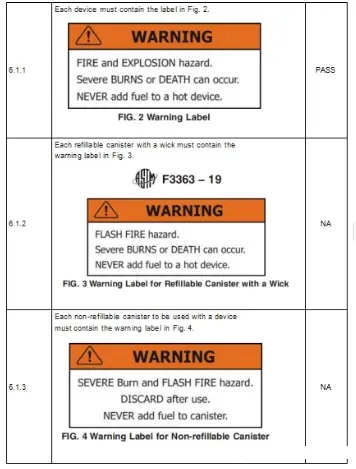
- Warning Label Requirements: Section 6.1 of astm f3363-19.
- Instruction Manual Requirements: Section 6.1.9 of astm f3363-19.
6. Testing Reports: Test reports from an ISO 17025-certified lab confirming that all items have been tested and meet the applicable requirements.
Note: Test reports must include images of the tested product, and the images should clearly show that the tested product matches the product listed on the detail page.
Scope of ASTM F3363-19
1. Scope
1.1 These requirements apply to:
- 1.1.1 Devices that burn fuel and sustain flames on the surface of an open reservoir.
- 1.1.2 Devices that sustain flames without requiring external ventilation for combustion exhaust.
- 1.1.3 Devices using liquid fuels, gel fuels (e.g., solid alcohol), or other non-solid fuels in open or non-refillable containers.
- 1.1.4 Devices with a fuel capacity of no more than 2.5 liters (0.67 gallons).
- 1.1.5 Devices with an output of 1.47 kW (5000 BTU/h) or less.
- 1.1.6 Portable or manually movable devices.
- 1.1.7 Devices suitable for indoor, outdoor, or both environments.
1.2 These requirements do not apply to:
- 1.2.1 Candles.
- 1.2.2 Devices used for cooking or heating food.
- 1.2.3 Devices burning solid fuels as defined by ASTM D4359.
- 1.2.4 Devices without open reservoirs, such as oil lamps that use wicks or garden torches.
1.3 This specification establishes minimum safety requirements for devices to help ensure reasonable safety during normal use, reducing risks of fire, injury, or death.
1.4 This specification does not replace other safety measures, such as adult supervision, close monitoring of products during use, and fire detection, alarm, or suppression systems.
1.5 Values are presented in SI units as standard. Values in parentheses are explanatory or approximate.
1.6 This specification measures material, product, or component responses to heat, flames, and forces under controlled conditions. It does not account for all factors required for fire hazard or risk assessment under actual fire conditions.
1.7 Users of this standard are responsible for establishing safety, health, and environmental practices and determining regulatory applicability before use.
ASTM F3363-19 Testing Items and Requirements
ASTM F3363-19 is a standard for unvented liquid or gel-fueled portable combustion devices. Below are the key testing requirements:
1. Structural Tests
- Overall Construction: Products must be sturdy, without loose or deformed components, and withstand normal use and accidental impacts without breaking or disassembling.
- Material Performance: Materials must be strong, heat-resistant, and safe. For example:
- Casings must withstand high temperatures without melting or deforming.
- Fuel containers must be corrosion-resistant and leak-proof.
2. Fire Prevention Tests
- Flame Spread Test: Assess whether flames quickly spread to other components. Products must have effective fire isolation to minimize fire risks.
- High-Temperature Resistance Test: Test the product's stability under high temperatures.
3. Electrical Safety Tests (if applicable)
- Insulation Test: Ensure electrical insulation between components prevents electric shocks.
- Grounding Test: Verify the grounding is effective to direct electrical faults safely.
- Leakage Test: Detect and limit electrical leakage risks.
4. Drop Test
- Impact Resistance: Simulate accidental drops to ensure no damage, such as cracks or fuel leaks, occurs.
- Structural Integrity: Ensure the product remains functional and safe after being dropped.
5. Simulated Use Tests
- Flame Stability: Ensure flames remain stable under different conditions (e.g., varying wind speeds and temperatures).
- Combustion Efficiency: Evaluate fuel-to-heat conversion efficiency.
- Heat Output: Measure heat output to meet product specifications.
- Environmental Adaptability: Test the product under different environmental conditions (e.g., high/low temperature or humidity).
Application Process
1. Sample Submission: Typically, two samples are required.
2. Application Form: Provide the platform seller’s name, address, product name, and manufacturer details.
3. Quotation and Contract: Sign the contract and pay upfront before testing begins.
4. Testing: Testing takes seven working days from sample arrival.
5. Draft Report: Review the draft report for accuracy.
6. Final Report: Receive the final official report.
Timeline: Reports are typically issued in five working days (expedited service available).
Email:hello@jjrlab.com
Write your message here and send it to us
 What is the ASTM F2167 Certification Test?
 What is the ASTM F2050 Certification Test?
 What is ASTM F1967 Certification Testing? How to g
 What is the ASTM F1917 Certification Test?
 How to get ASTM F1821 Certification
 What is the ASTM F1821 Testing Standard?
 Electronic Products Safety Testing Laboratory
 HAC Hearing Aid Compatibility Testing
Leave us a message
24-hour online customer service at any time to respond, so that you worry!