



What is FCC Electrical Certification?
Introduction to fcc Certification in the USA
The FCC (Federal Communications Commission) is an independent agency of the United States government that is directly accountable to Congress. It is responsible for regulating radio broadcasting, television, telecommunications, satellite, and cable communications to coordinate domestic and international communication. The FCC's duties include authorizing and managing radio frequency transmission devices and equipment not used by the federal government.
According to the relevant parts of the U.S. Federal Communications Regulations (CFR 47), all electronic products entering the United States must undergo electromagnetic compatibility certification (fcc certification). In recent years, the U.S. has become China's second-largest trading partner, and the trade volume between the two countries has been increasing year by year. Thus, understanding the market entry rules for the U.S. is crucial for Chinese exports.
FCC Certification Methods
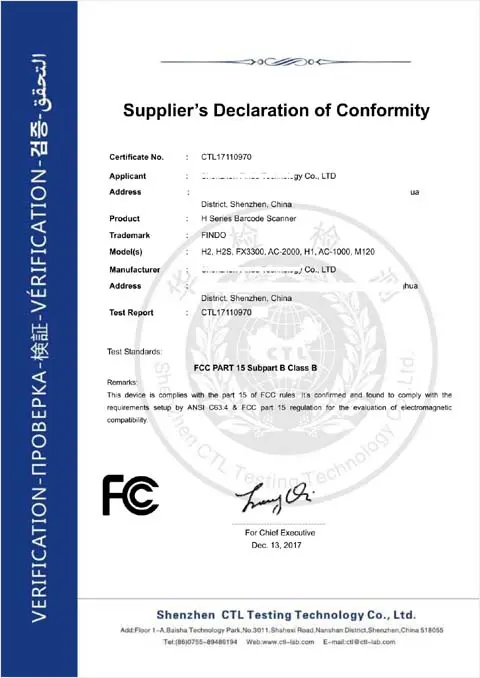
Historically, the FCC used different certification methods based on product type, including Verification, DoC (Declaration of Conformity), and Certification. However, starting from November 2, 2017, the FCC merged DoC and Verification into sdoc (Supplier’s Declaration of Conformity) and modified the relevant FCC regulations, with a transition period of one year.
Transition Period Details:
- From 11/2/2017 to 11/2/2018: Companies could continue to use the FCC VOC and DoC certification processes or adopt the new fcc sdoc certification process.
- Simplification of SDoC Certification: The new process reduces burdensome import declaration requirements and allows the use of electronic labels.
Main Requirements for SDoC Certification:
- Testing Reports: Testing must be conducted in FCC-recognized laboratories. The Hua Jian Laboratory, for example, operates in accordance with ISO 17025 accredited lab recognized by the FCC.
- Part 15 Product Requirements:
1. For products subject to fcc part 15, such as stand-alone cable input selector switches, a statement must be placed prominently on the product: “This device complies with Part 15 of the FCC Rules for use with cable television service.”
2. If the product is too small to display the FCC statement directly, the information must be included in the user manual or on the product packaging.
- Part 18 Product Requirements:
1. Commercial industrial, scientific, and medical products must be certified through SDoC or Certification.
2. Commercial ultrasonic products (less than 500 watts and operating at frequencies below 90 kHz) and non-commercial industrial, scientific, and medical products must be certified through SDoC.
3. Electronic screens can be used to present regulatory statements.
Certification Requirements:
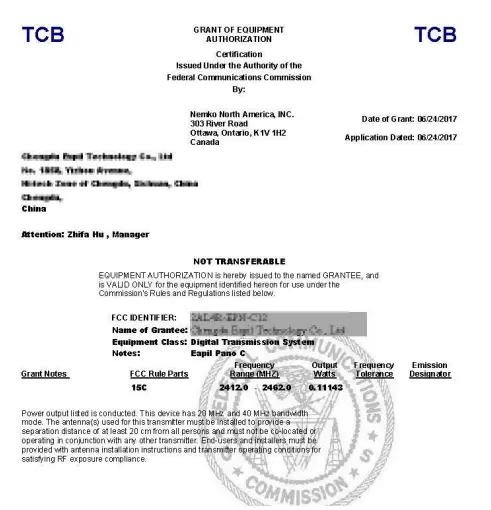
1. For products under Certification, the fcc id can be displayed electronically; if the product is too small and lacks an electronic screen, the FCC ID must be included in the user manual.
2. Certification testing must be conducted in FCC-accredited laboratories.
FCC-ID Certification
1. Description: FCC-ID is one of the mandatory FCC certification models, applicable to technically complex wireless products such as Bluetooth devices, WiFi devices, and wireless alarm systems. Certification for wireless products is directly approved by the FCC TCB (Telecommunication Certification Body), and the certification status can be queried on the FCC's official website.
2. Process: Businesses applying for an FCC-ID must first register with the FCC to establish a company profile using an FCC FRN (FCC Registration Number) before submitting their FCC-ID application. All reports are reviewed by the FCC-TCB, and once submitted, they are published on the FCC management center's website, allowing users to find product information using the ID number.
Types of Products Requiring FCC Certification
1. Power Supply FCC Certification: Communication power supplies, switch power supplies, chargers, display power supplies, LED power supplies, LCD power supplies, uninterruptible power supplies (UPS), etc.
2. Lighting FCC Certification: Chandeliers, track lights, courtyard lights, portable lights, recessed lights, LED street lights, string lights, table lamps, LED spotlights, LED bulbs, grilles, aquarium lights, street lights, LED tubes, LED fixtures, energy-saving lamps, T8 tubes, etc.
3. Home Appliance fcc certification: Fans, electric kettles, speakers, televisions, mice, vacuum cleaners, etc.
4. Electronic Product FCC Certification: Earphones, routers, mobile phone batteries, laser pointers, vibrators, etc.
5. Communication Product FCC Certification: Telephones, cordless main and auxiliary phones, fax machines, answering machines, modems, data interface cards, and other communication products.
6. Wireless Product FCC Certification: Bluetooth products, tablets, wireless keyboards, wireless mice, wireless readers, wireless transceivers, walkie-talkies, wireless microphones, remote controls, wireless networking devices, wireless video transmission systems, and other low-power wireless products.
7. Wireless Communication Product FCC Certification: 2G phones, 3G phones, 3.5G phones, DECT phones (1.8G, 1.9G frequency bands), walkie-talkies, etc.
8. Mechanical Product FCC Certification: Gasoline engines, electric welding machines, CNC drilling machines, tool grinding machines, lawnmowers, washing equipment, bulldozers, elevators, drilling machines, dishwashers, water treatment equipment, gas welding machines, printing machinery, woodworking machinery, rotary drilling rigs, grass cutters, snow blowers, excavators, printers, cutting machines, road rollers, leveling machines, hedge trimmers, hair straighteners, food machinery, lawnmowers, etc.
Email:hello@jjrlab.com
Write your message here and send it to us
 What is the ASTM F2167 Certification Test?
 What is the ASTM F2050 Certification Test?
 What is ASTM F1967 Certification Testing? How to g
 What is the ASTM F1917 Certification Test?
 How to get ASTM F1821 Certification
 What is the ASTM F1821 Testing Standard?
 Electronic Products Safety Testing Laboratory
 HAC Hearing Aid Compatibility Testing
Leave us a message
24-hour online customer service at any time to respond, so that you worry!