



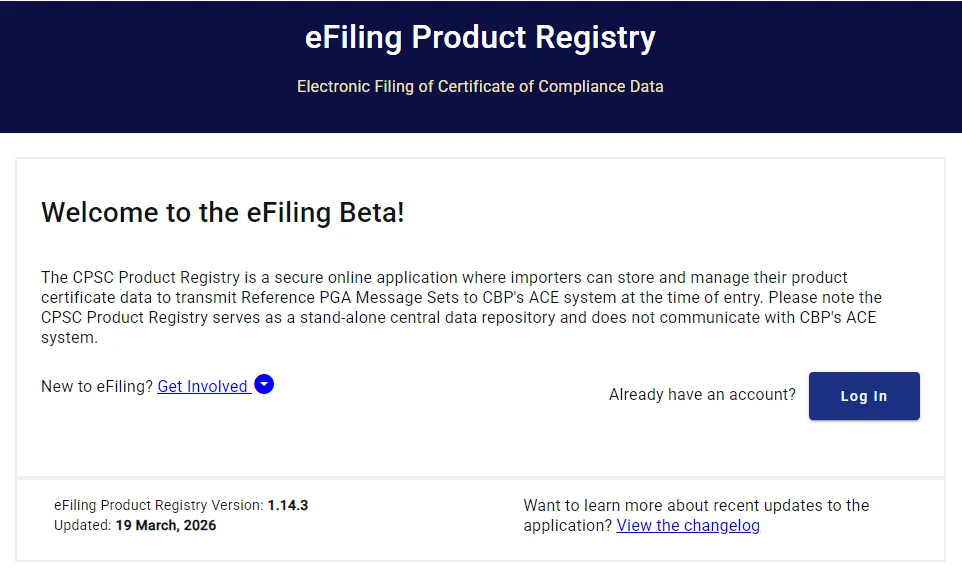
What is the U.S. CPSC eFiling System?
eFiling is an electronic filing system for certificates of compliance required by the U.S. Consumer Product Safety Commission (CPSC). When importing regulated products, certificate of compliance data must be submitted to the U.S. Customs and Border Protection (CBP) ACE system via the Partner Government Agency (PGA) Message Set. This replaces traditional paper certificates, realizing full-process digital traceability and risk control.
Mandatory Effective Dates
January 8, 2025: CPSC publishes the final rule, and the system opens for the voluntary filing period.
January 8, 2025 - July 7, 2026: Voluntary filing period (errors in filing will not result in cargo detention or fines; strictly for data validation).
July 8, 2026: Full mandatory eFiling for all categories of imported consumer products. Goods with incomplete filings will be directly detained or refused entry by CBP.
January 8, 2027: Mandatory enforcement for products imported from U.S. Foreign Trade Zones (FTZ).
No Value Exemption: Regardless of order size or cargo value, as long as it falls under CPSC-regulated categories, eFiling must be completed.
Only Applies to Imports, Excludes U.S. Domestic Production: eFiling submission is mandatory for imported products on July 8, 2026; mandatory for entries from FTZs into the U.S. on January 8, 2027. U.S. domestically manufactured products only need to update certificate content and do not require electronic filing.
Certificates Must Be Submitted Prior to Arrival: eFiling must be completed before the goods arrive at a U.S. port. It is recommended to complete this at least 3-5 business days in advance to avoid customs clearance delays.
7 Core Data Elements for eFiling Declaration
The documents you provided specify the 7 compliance certificate data elements that must be submitted during filing. These are the core standards for the CPSC to determine the validity of the certificate, and also the key thresholds for customs release. The following is an item-by-item breakdown of the practical requirements:
Official Definition of the Seven Core Elements
Product Identifier
GTIN, UPC, SKU, or other unique identifiers used to identify the specific product. The identifier used to uniquely identify the product must match the customs declaration information.Certificate Type
Products designed or intended primarily for children 12 years of age or younger (including toys, baby products, children's clothing, etc.). A CPC (Children's Product Certificate) is mandatory for children's products.Certifier Information
The certifier's CPSC ID number, name, physical address, and contact information.Citation to Applicable Regulations
Children's products must include the standard CPC statement: "Citation to each CPSC children’s product safety rule to which this product is being certified."Date and Place of Manufacture
The date the product was manufactured (must include at least the month and year) and the place of manufacture (City + Province/State + Country).Date and Place of Testing
This must match the testing report, including the date of the test(s), the location of the laboratory, and the full address of the CPSC-accepted laboratory.Contact Information for the Maintainer of Test Records
Merchants must provide the contact information (name, phone number, email address, etc.) of a designated person who can be reached at any time. It must be ensured that this contact person is responsive 24 hours a day. During CPSC spot checks, the original test report must be provided within the specified timeframe. Failure to reach the contact person will trigger a high-risk inspection.
Note: Certificates and supporting documentation must be retained for at least 5 years and must be provided within 24 hours upon request by the CPSC or CBP.
(Note: The original text implies a list follows, though it was not included in the source prompt).
Key Benefits of the CPSC's Electronic Filing Program
Benefits to the Trade
Reduced hold times for compliant products
Fewer examinations
Lower costs for importers
Lowered risk scores in the CPSC system
Enhanced certificate data management processes
Benefits to the CPSC
Improved focus and targeting on high-risk products
Reduced examination delays
Enhanced allocation of agency resources
Maximized review efficiency
Better interception of non-compliant products before they reach consumers
eFiling Frequently Asked Questions (FAQ)
Will participating in the voluntary phase of eFiling or making errors in the voluntary submission of certificate data affect my risk score, or will it cause shipment delays?
A1: Although goods are still subject to standard CPSC examination procedures, participating in the eFiling voluntary phase and making errors when voluntarily submitting certificate data will not affect the importer's risk score, nor will it cause delays in shipping. The eFiling voluntary phase is designed to provide learning and testing opportunities without penalizing participants for mistakes.
If an importer fails to comply with electronic filing (eFiling), will U.S. Customs and Border Protection (CBP) refuse the product entry into the United States?
A2: Currently, the U.S. Consumer Product Safety Commission (CPSC) does not intend to require U.S. Customs and Border Protection (CBP) to refuse entry solely due to the failure to submit electronic certificate files via a Full PGA Message Set or a Reference PGA Message Set. The CPSC system will utilize the certificate data provided through the PGA Message Set to adjust and evaluate the risk scores of incoming products. This action should reduce the detention and inspection of compliant products, thereby focusing more resources on handling non-compliant products.
What Product ID types are acceptable in electronic filing (eFiling)?
A3: The Product ID is used to uniquely identify the certified product. The Product ID must be one of seven possible alphanumeric id types:
GTIN (Global Trade Item Number)
SKU (Stock Keeping Unit)
UPC (Universal Product Code)
Model Number
Serial Number
Registration Number
Alternate ID
(An Alternate ID can be any alphanumeric ID not covered by the other six provided Product ID types.)
Users should not store any data in the product identifier field that does not directly correspond to the selected identifier type. Although the "Alternate ID" type is provided to allow users to store product identification information not covered by the other six options, this field should still strictly contain identification information for a single product.
How does the CPSC use the Product ID?
A4: The Product ID is an essential certificate identifier required to identify a specific product certificate within the Product Registry. It is utilized through the Automated Commercial Environment (ACE) of U.S. Customs and Border Protection (CBP).
The CPSC strongly recommends that users provide at least one product identifier that can be found on the product packaging, product packing slip, and/or product invoice, ensuring that the product can be identified by CPSC personnel.
If I am a consumer sending a non-commercial product to another consumer, do I need to eFile?
A5: The eFiling Final Rule does not require electronic filing for commercial products sent from an overseas consumer to another consumer within the U.S. (such as gifts). Brokers or carriers facilitating the transport of these goods can submit a Disclaimer Message Set based on CPSC guidance to inform the CPSC that a certificate is not required for the shipment, but this action is not a mandatory requirement.
Does electronic filing apply to used or resold products?
A6: Generally, regulated finished consumer products circulating in commerce must meet cpsc testing and certification import requirements, which includes regulations covering overstock products intended for resale.
Products that are of a single variety and not intended for retail sale do not require the submission of electronic certificate data; a disclaimer may be used. For further guidance on disclaimers, please refer here.
The CPSC notes that this is a general guiding principle, and importers should work with their trade partners to ensure individual compliance.
What is the difference between a Primary Product ID and additional product identifiers?
A7: A Primary Product ID is a product identifier used as the "Product ID" certificate identifier when submitting a Reference PGA Message Set. It also acts as a "key," allowing users to update existing certificate entries stored in the "Product Registry" by combining it with a "Version ID." When a Primary Product ID is provided for a product certificate, if other Product IDs are of a different type than the Primary Product ID, it is possible to add additional Product IDs. Users can optionally provide additional Product IDs to support product tracking functions within a specific product collection in the CPSC Product Registry.
What are the options when we are ready to transmit the message set to the Customs and Border Protection (CBP) Automated Commercial Environment (ACE) system?
A8: Once participants enter Phase 3 of the voluntary stage and are ready to transmit the Partner Government Agency (PGA) Message Set, they can transmit via one of two methods:
Full PGA Message Set: Importers need to provide their broker with the seven required product certification data elements related to the imported product, and the broker will compile and incorporate them into the CPSC PGA Message Set. These necessary data elements include the product identification, citation code, date of manufacture, place of manufacture, date of product testing, testing laboratory, and contact person information.
Reference PGA Message Set: Importers must pre-enter product certificate data into the CPSC Product Registry system, and subsequently provide the certificate identifiers to their broker. These identifiers include the Certifier ID and the Product ID.
Does the CPSC's Product Registry system allow users to control who can view the reusable trade partner details added to a business account?
A9 (labeled B10): Yes, the Product Registry system has a "Trade Party Privacy Setting" that business account administrators can enable to restrict the visibility of trade party data stored in their account. In the context of the "Product Registry System," a "Trade Party" refers to manufacturers, testing laboratories, and contact points, all of which must provide valid and confirmed certificates of compliance.
To enable the Trade Party Privacy feature, business account administrators must turn this privacy setting to "On" when creating a new product collection. When the Trade Party Privacy feature is applied to a collection, all trade party data added to that collection will only be visible to users granted corresponding roles within that specific collection. This ensures trade party data visibility aligns with their own business needs.
Product collections with the Trade Party Privacy setting adjusted to "Off" all share the same "shared" trade party list. Business account administrators should carefully consider how they wish to structure their product collections to secure their trade data.
Other considerations related to Trade Party Privacy include:
Once a product collection is created, the Trade Party Privacy setting cannot be toggled on or off.
When the Trade Party Privacy feature is enabled, product certificates cannot be copied into or out of the collection.
Only business account administrators can add new trade parties to multiple private product collections simultaneously.
For collections with privacy protection enabled, the uniqueness of the Alternate ID and Global Location Number (GLN) is validated only against the trade partners stored in that specific collection.
What are the benefits of using the Product Registry and submitting a Reference PGA Message Set?
A11: If an importer repeatedly imports products covered by a single certificate, it is highly recommended to preferentially choose the Reference Message Set by utilizing the Product Registry system. Importers can utilize automated or bulk upload features to make the process more streamlined and efficient.
If my importing company only plans to submit the Full PGA Message Set, do we need to use the Product Registry?
A12: No, the CPSC Product Registry system is not required to submit a Full PGA Message Set.
Is there an option for bulk uploading product certificate data in the Product Registry system?
A13: Users have two options to bulk upload product certificate data into the Product Registry system. Users can perform bulk uploads via Comma-Separated Values (CSV) files or Application Programming Interface (API) integration. For further guidance, users can access our provided CSV bulk upload template, CSV upload user guide, and API specification documents, all of which can be found in the document library on our webpage.
Where can I find the Harmonized Tariff Schedule (HTS) codes and/or Citation and Testing Exclusion codes applicable to eFiling?
A14: We encourage participants to review the HTS, Citation, and Testing Exclusion codes in the document library to better understand which codes require product certification and/or whether disclaimers are permitted. The HTS, Citation, and Testing Exclusion codes provided in our document library serve as reference materials for the trade.
During the eFiling voluntary phase, will the CPSC identify and flag specific CBP HTS codes for CPSC data review? What happens after the full implementation date?
A15: During the eFiling voluntary phase, the CPSC will not flag HTS codes for CPSC data review. After the full implementation of eFiling, the CPSC will flag HTS codes for CPSC data review.
What if my product qualifies for a testing exclusion?
A16: If the product requires product certification and qualifies for a testing exemption, the corresponding testing exemption code must be provided in the product certificate. The Product Registry system has a feature that allows users to add a testing exemption code.
Are importers required to transmit a Disclaimer PGA Message Set as part of the new eFiling requirements?
A17: No, it is not required to submit a PGA Message Set. However, the CPSC encourages importers to submit a Disclaimer PGA Message Set, as it may help improve their risk scores.
When will the full implementation of eFiling occur?
A18: The U.S. Consumer Product Safety Commission (CPSC) has approved a final rule aimed at implementing an electronic filing system for certificate information of imported, regulated consumer products. Under this final rule, requirements affecting most imported consumer products will take effect on July 8, 2026. Requirements affecting consumer products imported into Foreign Trade Zones (FTZ) and subsequently intended for consumption or warehousing will take effect on January 8, 2027.
Has the CPSC decided how eFiling will apply to U.S. Foreign Trade Zones?
A19: Importers must submit certificate data related to all goods withdrawn from a Foreign Trade Zone (FTZ) for consumption or warehousing when submitting entry documentation to the Customs and Border Protection (CBP) Automated Commercial Environment (ACE). Additionally, the CPSC final rule provides a 24-month implementation period, with an effective date of January 8, 2027, for goods imported from FTZs. This extended timeframe gives the trade ample time to apply necessary software updates or business operational adjustments to comply with the CPSC's latest requirements for FTZ imports.
ACE is now equipped to receive required certification data via the CPSC Message Set. This Message Set is applicable to Type 06 consumption entries involving goods withdrawn from a Foreign Trade Zone. The CPSC Message Set can also be transmitted as part of a weekly submission.
Do eFiling requirements apply to Section 321 (also known as De Minimis Value) shipments? Do importers of Section 321 shipments need to transmit a Disclaimer PGA Message Set?
A20: Any product requiring certification must hold an electronic filing certificate, regardless of the value of the imported goods. For eFiling, there is no Section 321 (De Minimis) cargo exemption. Please note that for any imported goods (including goods under Section 321 De Minimis), a Disclaim PGA Message Set is not required. However, the CPSC encourages importers to submit a Disclaim PGA Message Set for their own benefit, as this action is expected to help improve their risk score.
Can a Reference PGA Message Set be attached to a CBP ACE import manifest document?
A21: A CPSC Reference PGA Message Set requires an entry and therefore cannot be attached to a CBP manifest.
How will the trade be notified of HTS code updates?
A22: The U.S. Consumer Product Safety Commission (CPSC) will not notify the trade community of HTS code updates. The CPSC recommends that the trade community visit the U.S. International Trade Commission (ITC) website to obtain the latest information on HTS codes.
What are the benefits of participating in the eFiling voluntary phase?
A23: The CPSC strongly encourages importers to consider participating in the eFiling voluntary phase to better prepare for full implementation. For importers and their trade partners, the eFiling voluntary phase aims to kickstart the learning process, assess project readiness, and gradually increase eFiling testing efforts. We anticipate encountering a learning curve initially, but as the implementation phases progress, importers and their trade partners will be able to minimize errors and gradually file eFiling declarations for more products over time, fully preparing for the comprehensive implementation of eFiling.
Is there a minimum number of products required to be submitted during the eFiling voluntary phase?
A24: Participants can electronically file for any products of their choosing. Participants can start small and gradually expand their eFiling product portfolio.
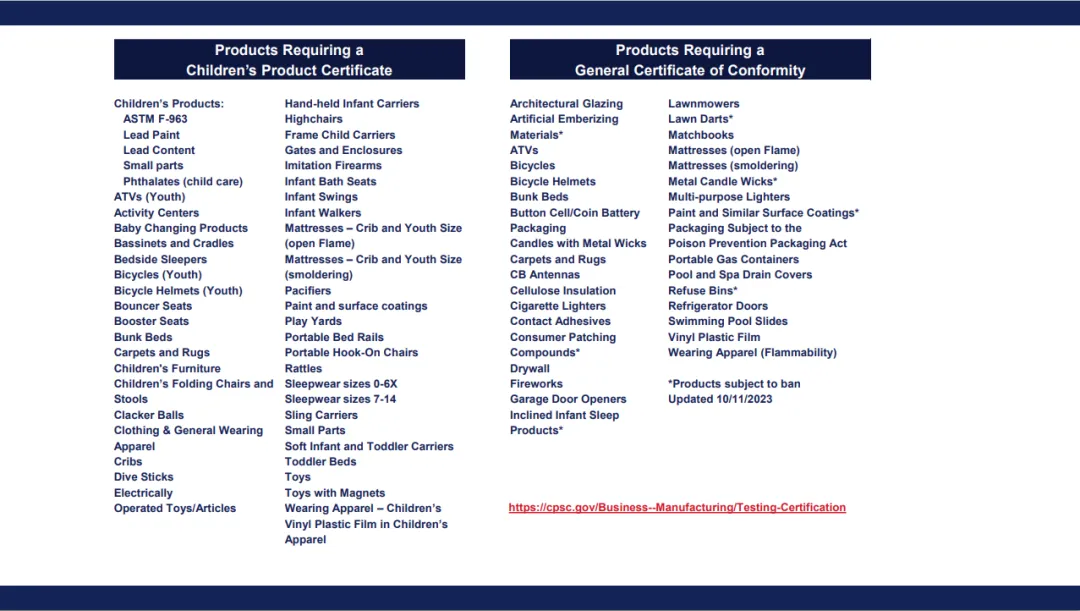
Product Safety Rule List
Note: The CPSC periodically updates existing mandatory rules or issues new mandatory rules, thereby adding new requirements.
Starting July 8, 2026, CPSC eFiling will be fully mandatory. Failure to complete registration and filing will directly impact cargo clearance. Please be sure to complete account registration, certificate filing, and process testing in advance to avoid the risk of cargo detention, return, and fines. Handle it early for peace of mind during customs clearance.
Email:hello@jjrlab.com
Write your message here and send it to us
 What is an EU SDS (Safety Data Sheet)?
 What is the CA Prop 65 Warning Label?
 2026 Amazon TIC Mandatory Audit Catalog
 Australian Electrical EESS and RCM Compliance
 How to get Vietnam CR Certification
 What is a UN 38.3 Battery Test Report
 What is the UN38.3 Certification Test?
 What is a Lithium Ion Battery Certification
Leave us a message
24-hour online customer service at any time to respond, so that you worry!