



5.8GHz Wireless Product Certification RF Testing
The 5.8GHz band is a higher frequency than the 2.4GHz frequency and is an open ISM band that has recently begun to enter the product development field. It complies with international standards such as 802.11a, fcc part 15, ETSI EN 301 489, ETSI EN 301 893, en 50385, and en 60950. It is currently one of the technologies that may replace 2.4GHz wireless technology. Therefore, China JJR Laboratory has prepared this article to provide a brief overview of common RF testing. Taking the common CE certification as an example, the typical testing requirements that 5.8G products may involve include RF requirements, EMC requirements, safety requirements, etc. The common RF testing items are as follows:
1. Carrier Frequencies - Center Frequency Testing
Testing of the 5.8GHz carrier frequency.
Testing diagram: as shown in Figure 1.
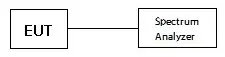
Testing limit: The actual test value must be within ±20ppm compared to the manufacturer’s nominal center frequency value.
2. Nominal Channel Bandwidth and Occupied Channel Bandwidth - Nominal Bandwidth and Occupied Bandwidth Testing
Occupied bandwidth refers to the width occupied by the energy (power) emitted by the entire channel of the communication product.
Testing diagram:
Testing limit: The occupied bandwidth should be between 80% and 100% of the nominal bandwidth.
3. RF Output Power, Transmit Power Control (TPC) and Power Density - RF Output Power and Power Density
Testing diagram: see Figure 1.
Testing limit:

Testing case demonstration:
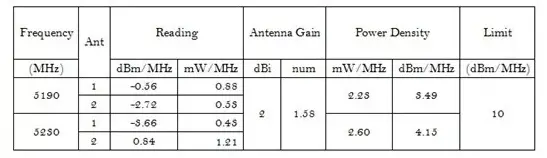
4. Transmitter Unwanted Emissions Outside the 5 GHz RLAN Bands - Out-of-Band Spurious Emissions in Transmit Mode
Testing diagram:
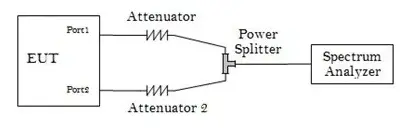
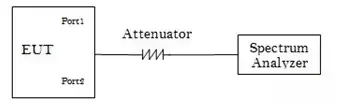
The conducted spurious emissions testing diagram in transmit mode is shown in Figure 2.
The radiated spurious emissions testing diagram in transmit mode is shown in Figure 3.
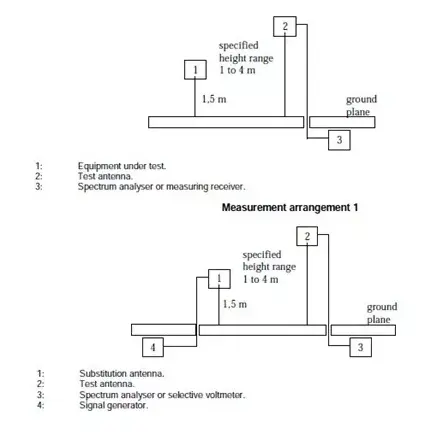
Testing limit:
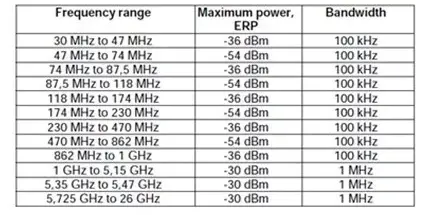
5. Transmitter Unwanted Emissions Within the 5 GHz RLAN Bands - In-Band Spurious Emissions in Transmit Mode
Testing diagram: see Figure 4.
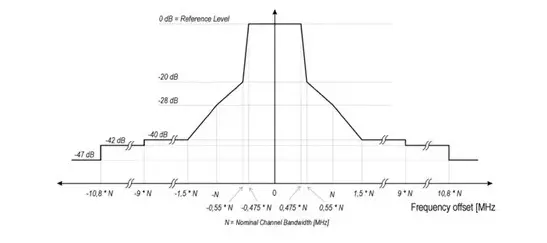
Testing limit:
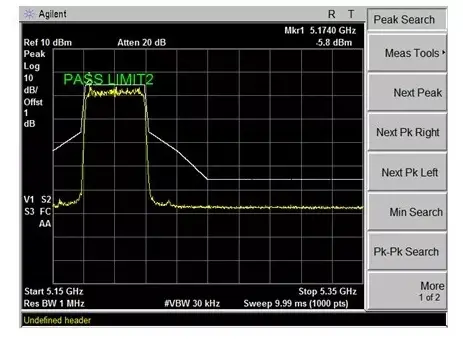
Testing case demonstration: At the center frequency of 5190MHz, the product’s spurious emissions in transmit mode are shown in the figure below.
6. Receiver Spurious Emissions - Radiated Spurious Emissions in Receive Mode
The radiated spurious emissions of the product in receive mode must not exceed the testing limits below.
Testing limit:

The above is the main content of the common RF testing items in the CE certification of 5.8G products.
Email:hello@jjrlab.com
Write your message here and send it to us
 California 65 Testing Service Consultation
 REACH Chemical Testing Services
 Electronic Vaporizers EU TPD / US PMTA / UK MHRA
 ISO 10993 Biocompatibility Standards
 Medical TPV ISO 10993 Biocompatibility Testing
 FDA Requirements for Biocompatibility under ISO 10
 Amazon Spain WEEE Compliance Deadline: September 3
 What is the ASTM F2264 Certification Test?
Leave us a message
24-hour online customer service at any time to respond, so that you worry!