



How to Get the China SRRC Certificate?
To strengthen the management of the import and production of radio transmitting equipment, any radio transmitting equipment exported to or produced (including trial production) within the People's Republic of China must obtain the "Radio Transmission Equipment Model Approval Certificate" issued after model approval by the State Radio Regulation Committee (SRRC). Only equipment with the model approval code (CMIIT ID) displayed on its label can be sold in the market. In simpler terms, only radio transmitting devices with a Chinese radio transmission equipment model approval code are allowed for sale and use in China.
Currently, China has designated specific frequency ranges for different types of radio transmitting equipment, and not all frequencies are legally usable in China. This means that radio transmitting equipment sold or used within the country must comply with these frequency regulations. Applicants must also be aware that certain devices may require additional certifications, such as china compulsory certification (CCC) or a Network Access License (MII), in addition to the "Radio Model Approval Certification."
The National Radio Monitoring Center is a subsidiary of the Ministry of Industry and Information Technology (MIIT) of the People's Republic of China, responsible for radio monitoring and spectrum management. It is China's main support organization for radio regulation, with several departments and national-level monitoring stations. The center has played a key role in numerous important tasks, including protecting civil aviation navigation frequencies and ensuring the security of radio information during major national events.
srrc certificate Application Documents
1. Application form
2. Power of attorney
3. Client's business license (with official seal)
4. Sample devices, with 3-5 units required depending on the product, some needing RF connectors
5. Client's ISO certificate or company profile and capability statement
6. Product specification, circuit diagram, user manual, block diagram, and technical documentation
7. Antenna peak gain and antenna pattern
8. Test instructions
9. Three color photos of the EUT (Equipment Under Test), including all interfaces and sides
10. Frequency channel comparison table (required if there are many working channels, such as for DSSS or FHSS products)
Note: Requirements may vary based on the product.
Features of srrc certification
China has designated specific frequency ranges for different categories of radio transmitting devices, and not all frequencies are legally usable. Applicants must ensure compliance with these regulations. In addition to model approval, some products may also require CCC or MII certification. There are no special marks, just a model approval code (CMIIT ID).
Product Categories Applicable for SRRC Certification
1. Public network mobile communication devices (2G/3G/4G equipment)
2. Specialized communication devices (walkie-talkies, digital clusters, RFID devices, etc.)
3. Wireless access devices (Wi-Fi, Bluetooth devices, etc.)
4. Broadcasting transmitting devices (broadcasting, TV, etc.)
5. Radar devices (weather, aviation, marine, and automotive radar, etc.)
6. Navigation devices (BeiDou, aviation, maritime, etc.)
7. Satellite communication devices
8. Other devices
SRRC Testing Items
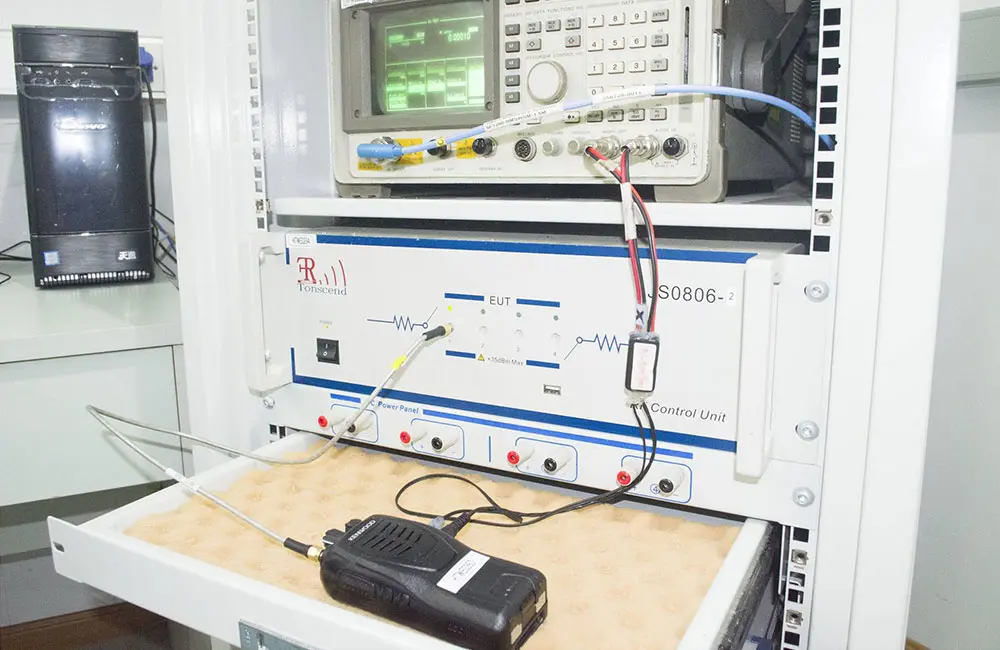
The testing items vary depending on the product’s transmission frequency, including power, spectrum range, frequency tolerance, bandwidth, and spurious emissions.
Key Points to Note:
1. The tested device should include testing procedures, methods, standards, conditions, connection diagrams, and the latest test report.
2. If the device has a non-standard interface at the transmitting end, provide a test cable with the company's seal and attenuation data.
3. If necessary, applicants should send technical personnel to assist with testing.
4. If a sample fails testing, a second test is allowed. If two or more samples fail, no further testing will be conducted, and the product will be deemed non-compliant.
SRRC Certification Process
- Submit Application: The applicant submits the application materials for model approval.
- Preliminary Review: The materials are reviewed for completeness. If accepted, the process moves forward; if not, the applicant is informed of necessary corrections.
- Acceptance: After acceptance, testing tasks are assigned, and the applicant submits a test report.
- Technical Review: Application materials and test results are reviewed.
- Approval Decision: If approved, the certificate is issued. If not, the applicant is informed of the reasons.
- Results Collection: The applicant receives the certificate or may request a review if necessary.
SRRC Certification Issuing Authority
Issuing Authority: Ministry of Industry and Information Technology (MIIT)
Approval Unit: Radio Management Bureau of MIIT
Testing Unit: National Radio Monitoring Center (SRMC)
Factory Inspection and Other Notes for SRRC Certification
There is no factory inspection, but market supervision random checks may occur. Certificate validity: 5 years.
China JJR Laboratory offers SRRC certification testing services and can assist in obtaining SRRC compliance certificates, potentially saving 30% in certification costs.
Email:hello@jjrlab.com
Write your message here and send it to us
 ISO 10993 Biocompatibility Standards
 Medical TPV ISO 10993 Biocompatibility Testing
 FDA Requirements for Biocompatibility under ISO 10
 Amazon Spain WEEE Compliance Deadline: September 3
 What is the ASTM F2264 Certification Test?
 What is ASTM F2194 Certification Testing?
 What is the ASTM F2167 Certification Test?
 What is the ASTM F2050 Certification Test?
Leave us a message
24-hour online customer service at any time to respond, so that you worry!