



EMC Testing and Compliance Certification Solutions
To successfully enter the global market, electronic products must comply with electromagnetic compatibility (EMC) and radio frequency (RF) regulatory requirements. With the surge in the use of electronic equipment, the risk of interference generated by digital devices continues to escalate. emc testing verifies that a product’s electromagnetic emissions fall within permissible limits and ensures its functionality is unaffected by external interference, serving as a critical safeguard for market access. Non-compliant products may face recall or customs detention risks, which not only result in financial losses but also damage brand reputation.
EMC standards are mandatory requirements in the markets of most countries, including Europe, the United States, China, South Korea, Australia, and New Zealand. emc testing is an essential procedure to help you meet regulatory requirements, improve product performance, and mitigate the risks associated with costly non-compliance. Third-party EMC testing and conformity assessment will also help strengthen your competitive advantage and position in the market.

What is Electromagnetic Compatibility (EMC) Testing?
Electromagnetic compatibility refers to the ability of a device or system to perform satisfactorily in its electromagnetic environment without generating intolerable electromagnetic interference to other equipment in the environment.
Electromagnetic Compatibility (EMC) is the capability of a device or system to operate as required in its electromagnetic environment without producing unacceptable electromagnetic disturbance to any equipment within that environment. Therefore, EMC encompasses two core requirements:
1. The electromagnetic disturbance generated by the device during normal operation must not exceed specified limits.
2. The device must possess a certain level of immunity to electromagnetic disturbance present in its environment, known as Electromagnetic Susceptibility (EMS).
Since the emergence of electronic system noise reduction technology in the mid-1970s, and notably following the introduction of regulations for commercial digital products by the U.S. Federal Communications Commission in 1990 and the European Union in 1992—requiring companies to ensure their products comply with strict magnetic susceptibility and emission standards—products meeting these regulations are defined as electromagnetically compatible (EMC).
EMC Certification Standards and Directives
EMC Certification Standards
With the development of electrical and electronic technologies, the growing popularity and digitalization of household appliances, and the advancement of radio and television, postal and telecommunications, and computer networks, the electromagnetic environment has become increasingly complex and degraded. As a result, governments and manufacturers worldwide have attached growing importance to the electromagnetic compatibility (EMC, including Electromagnetic Interference EMI and Electromagnetic Susceptibility EMS) of electrical and electronic products.
EMC is a critical quality indicator for electronic and electrical products. It not only affects the operational reliability and safety of the product itself but may also impact the normal operation of other equipment and systems, as well as the protection of the electromagnetic environment. To regulate the EMC of electronic products, all developed countries and some developing countries have established EMC standards, which represent the basic requirements for products to function properly in real-world electromagnetic environments. These are basic requirements because products that meet EMC standards may still experience interference issues in practical use. Most national standards are based on those developed by the International Electrotechnical Commission (IEC).
EMC certification was first introduced by the European Community. It stipulated that starting from January 1, 1996, all electrical and electronic products must obtain EMC certification and bear the "CE" mark to be sold in the European Community market. Governments worldwide have since implemented mandatory management of the EMC performance of electrical and electronic products. Internationally influential EMC regulations include the EU Directive 2004/108/EC (EMC Directive) and the U.S. Code of Federal Regulations CFR 47/fcc Rules, all of which set clear requirements for EMC certification.
EMC Certification Directives
EMC certification is a mandatory standard for nearly all electrically powered products undergoing EU CE certification. This stems from the mutual generation of electricity and magnetism: nearly all energized products with circuit boards generate magnetic fields during operation. To prevent such magnetic fields from adversely affecting the products themselves, surrounding people, and objects, the EU issued Directive 89/336/EEC (the EMC Directive) in the Official Journal on May 3, 1989.
Starting from January 1, 1996, all electrical and electronic apparatus placed on the EU market must comply with the EMC Directive; otherwise, they are prohibited from entering the EU market. On July 20, 2007, Directive 2004/108/EC replaced 89/336/EEC. On April 20, 2016, the new EMC Directive 2014/30/EU superseded 2004/108/EC as the current applicable regulation. Compliance with this directive is mandatory for products sold to the EU, and compliant products must bear the ce marking.
The EMC Directive stipulates that member states shall not, on the grounds of electromagnetic compatibility, hinder the placing on the market and use of equipment that meets the requirements of this directive within their territories.
Scope of Application for EMC Certification
The EMC Directive applies to all electrical and electronic equipment that may generate or be affected by electromagnetic interference, including but not limited to the following categories:
1. Household appliances and electric tools
2. Lighting equipment (e.g., lamps, fluorescent lamps)
3. Industrial manufacturing equipment
4. Medical and scientific apparatus
5. Information technology equipment (e.g., computers, printers)
6. Audio and video products
7. Telecommunication networks and wireless equipment (e.g., Wi-Fi routers, Bluetooth devices)
8. Aviation and marine wireless equipment
9. Audio-visual teaching equipment
10. Fixed installations (e.g., residential electrical systems, industrial production lines, telecommunication base stations)
Note: Even equipment containing only partial electronic components (e.g., power supplies, control boards) typically must comply with EMC requirements if placed on the market as a finished product.
Exclusions:
1. Equipment covered by Directive 2014/53/EU (red directive);
2. Aviation products, parts, and equipment;
3. Amateur radio equipment;
4. Products covered by other specialized directives;
5. Inherently benign equipment.
EMC Testing Procedures
Our laboratory is capable of performing comprehensive EMC testing and providing EMC certification for your products. Depending on your product, testing may include:
• Radio frequency voltage immunity at antenna port (S2b)
• Input immunity at antenna port (S1)
• Shielding effectiveness at antenna port (S4)
• Conducted disturbance immunity
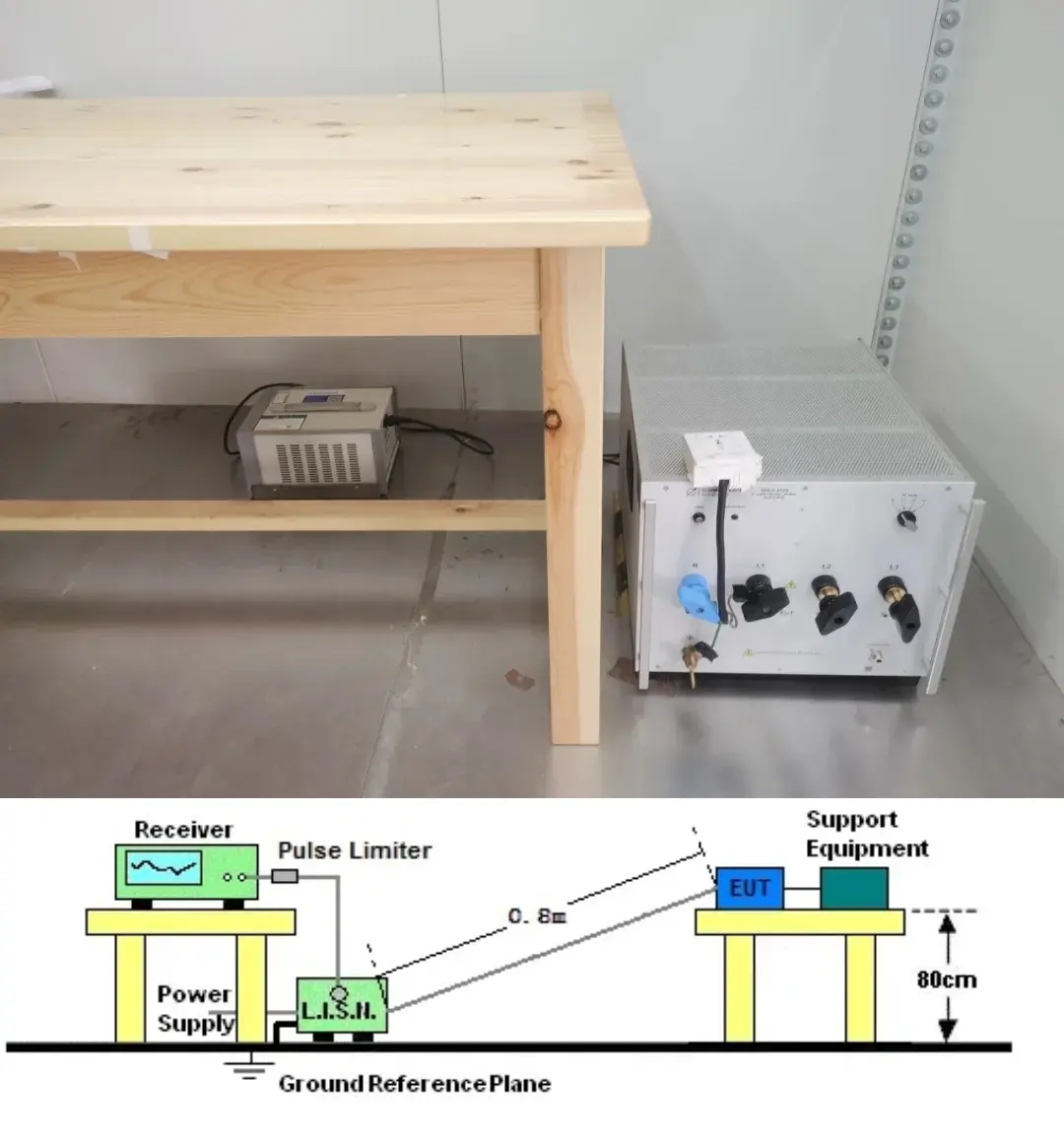
• Conducted emissions (continuous and intermittent interference)
• Electrostatic discharge immunity
• Immunity for vehicles – electrical disturbance caused by conduction and coupling
• Electrical fast transient/burst immunity
• Harmonic current emissions
• Harmonic and interharmonic immunity
• Immunity to radiated electromagnetic fields (S3)
• Immunity to conducted voltages (S2a)
• On-site EMC testing
• Power frequency magnetic field / oscillatory wave immunity
• Disturbance power
• Power supply modulation
• Radiated emissions
• Immunity to radiated electromagnetic fields (S3)
• Voltage fluctuations / flicker
• Surge immunity
• Voltage dips / voltage interruptions immunity
• Magnetic field measurement (EMF)
• Electric field measurement (EMF)
• Electromagnetic field (EMF) analysis
• Electromagnetic field induced current density (EMF for lighting equipment)
EMC Certification Application Process
Documentation Required for EMC Certification Application
1. Application form;
2. Product user manual;
3. Product schematic diagram;
4. PCB layout drawing;
5. List of critical components and relevant certificates (Note: All submitted documents must be in English).
Submission of Application
Submit an application to the certification body, providing product name, model, specifications, technical parameters, business license, and other materials. Complete a rectification factor evaluation form to clarify testing requirements.
Product Testing
The certification body determines test items based on product type and applicable standards, conducting Electromagnetic Interference (EMI) and Electromagnetic Susceptibility (EMS) testing. Testing is performed in the laboratory using advanced equipment to simulate electromagnetic environments and verify product EMC performance.
Rectification (If Required)
If testing fails, the enterprise must adjust circuit design, shielding measures, or grounding methods in accordance with the test report, and retest until compliance is achieved.
Review and Certification Issuance
The certification body reviews test results and rectification records. Upon confirmation of compliance with standards, an EMC certification certificate is issued.
Email:hello@jjrlab.com
Write your message here and send it to us
 Biokompatibilität ISO 10993
 How to get EU UFI Registration?
 What is Italian DM 21/03/73 Certification?
 How to get SOR/2011-17 Compliance Certification
 What is DGCCRF Certification Testing
 Bow and Arrow Children's Toys CPC Certification
 POPs Testing Service Consultation
 EU PPWR New Packaging Compliance
Leave us a message
24-hour online customer service at any time to respond, so that you worry!