



How to get a Taiwan NCC Certificate?
Introduction to taiwan ncc certification:
NCC stands for the National Communications Commission of Taiwan, which primarily regulates communication and information equipment circulating and used in the Taiwanese market:
1. LPE (Low Power Equipment): This includes low-power devices such as Bluetooth and WiFi equipment.
2. TTE (Telecommunications Terminal Equipment): This includes telecommunications terminal equipment such as mobile phones and tablets.
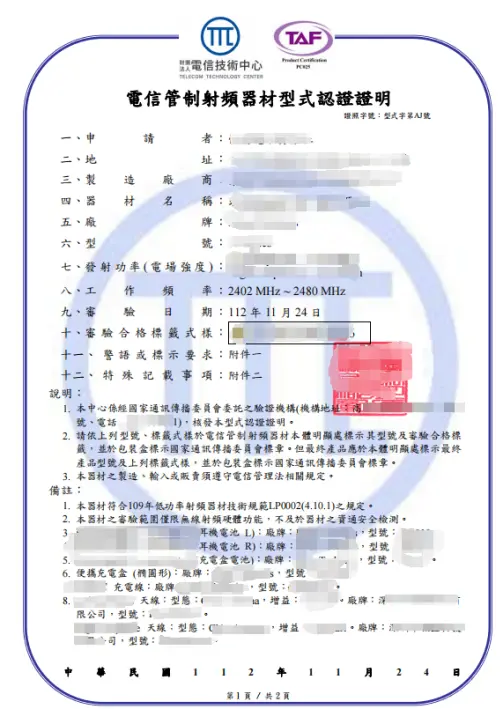
Scope of NCC Certified Products:
1. Low-Power Radio Frequency Devices Operating Between 9kHz and 300GHz:
Examples include wireless network (WLAN) products (including IEEE 802.11abg), UNII, Bluetooth products, RFID, ZigBee, wireless keyboards, wireless mice, wireless headsets with microphones, walkie-talkies, wireless remote control toys, various wireless remote controls, and various wireless anti-theft devices.
2. Public Switched Telephone Network (PSTN) Equipment:
Examples include wired telephones (including VOIP network phones), automatic alarm devices, answering machines, fax machines, remote control devices, wired telephone wireless master-slave units, keypad telephone systems, data devices (including ADSL equipment), caller ID terminal devices, and 2.4GHz radio frequency telecommunications terminal equipment.
3. Public Land Mobile Network (PLMN) Equipment:
Examples include wireless broadband access mobile station equipment (WiMAX mobile terminal equipment), GSM 900/DCS 1800 mobile phones and terminal equipment (2G phones), and third-generation mobile communication terminal equipment (3G phones).
NCC Mark Proportions Explanation
1. NCC Mark Production Method:
- (1) The NCC mark should be attached or printed on the device body in an appropriately proportionate size, with the principle that it must be clear.
- (2) The NCC mark, along with the inspection approval number, must be affixed to the product as per regulations. The mark must be in a single color and clearly identifiable.
2. Example of Inspection Approval Label Production:
To facilitate Taiwan's trade clearance process, from January 1, 2006, the format of the inspection approval label for radio frequency equipment and telecommunications terminal equipment has been revised as follows:
For low-power radio frequency devices and wireless telecommunications terminal equipment that obtained an inspection approval number before December 31, 2005, the approval number must be converted to the new 2006 coding format (customs clearance code) if necessary.
NCC Certification Process:
1. The client provides product information to the certification body for evaluation and quotation.
2. The client confirms and signs the quotation contract, fills out the product application form, provides samples and product information, arranges for certification payment, and the certification body opens the case.
3. The certification body arranges for product testing and reviews the documentation.
4. If there are issues with the testing or documentation, rectifications and retesting will be arranged until the product meets the standards.
5. Once testing and documentation are approved, the certifying body conducts a witness test.
6. After the witness test is completed, the certifying body issues a test report and certificate.
7. The client receives the certificate report, and the case is closed.
Required Documents for Taiwan NCC Certification Application:
1. Product circuit diagram.
2. Product block diagram.
3. Product specifications.
4. Product manual.
5. BOM (Bill of Materials).
6. Product application form.
7. Factory ISO9001 certificate.
8. Antenna specifications.
9. Fixed frequency software.
NCC Certification Application Timeline:
The NCC certification application process takes approximately 4-5 weeks. The cost is determined based on the product information.
NCC Factory Inspection and Certificate Validity:
NCC certification does not require factory inspections, and the certificate does not have an expiration date. As long as the product remains unchanged and the testing standards are not updated, the certificate remains valid indefinitely.
Email:hello@jjrlab.com
Write your message here and send it to us
 What is the ASTM F2167 Certification Test?
 What is the ASTM F2050 Certification Test?
 What is ASTM F1967 Certification Testing? How to g
 What is the ASTM F1917 Certification Test?
 How to get ASTM F1821 Certification
 What is the ASTM F1821 Testing Standard?
 Electronic Products Safety Testing Laboratory
 HAC Hearing Aid Compatibility Testing
Leave us a message
24-hour online customer service at any time to respond, so that you worry!