



What is EN 301 489 Compliance Certification?
EN 301 489 complianCE certification refers to the electromagnetic compatibility (EMC) testing completed by wireless/radio frequency equipment according to the ETSI EN 301 489 series of standards, as part of the EU CE-RED (Radio Equipment Directive 2014/53/EU) compliance. It proves that your Wi-Fi, Bluetooth, 4G/5G, Zigbee, RFID, and other devices "do not emit arbitrary interference on their own, nor are they easily interfered with by others," thereby allowing them to be legally affixed with the ce mark and sold in the EU market.
What is the EN 301 489 Standard?
EN 301 489 was formulated by ETSI (European Telecommunications Standards Institute). Its full name is Electromagnetic compatibility (EMC) standard for radio equipment and services. It is not a single standard, but a series of standards:
EN 301 489-1: Common technical requirements (General EMC requirements), applicable to all radio equipment.
EN 301 489-3: Short Range Devices (SRD).
EN 301 489-17: Wi-Fi, Bluetooth, Zigbee, 2.4G/5G ISM devices.
EN 301 489-24: Cellular/3G/4G devices.
EN 301 489-52: LTE / 5G NR User Equipment (UE).
In actual compliance, EN 301 489-1 + the product-specific sub-standard are usually used together.
What is the Relationship Between EN 301 489, CE, and RED?
Many clients ask: "If I have done EN 301 489, does it mean I have CE certification?" — No.
Conclusion: EN 301 489 is the EMC technical basis under RED; CE-RED is the complete compliance framework; the CE mark is the final result.
What are the EN 301 489 Test Items?
It mainly covers two major parts: Electromagnetic Emission (EMI) and Electromagnetic Susceptibility (EMS). Furthermore, wireless devices must be tested in real RF states such as "transmitting / receiving / standby," rather than testing with the wireless function turned off.
Electromagnetic Emission (EMI)
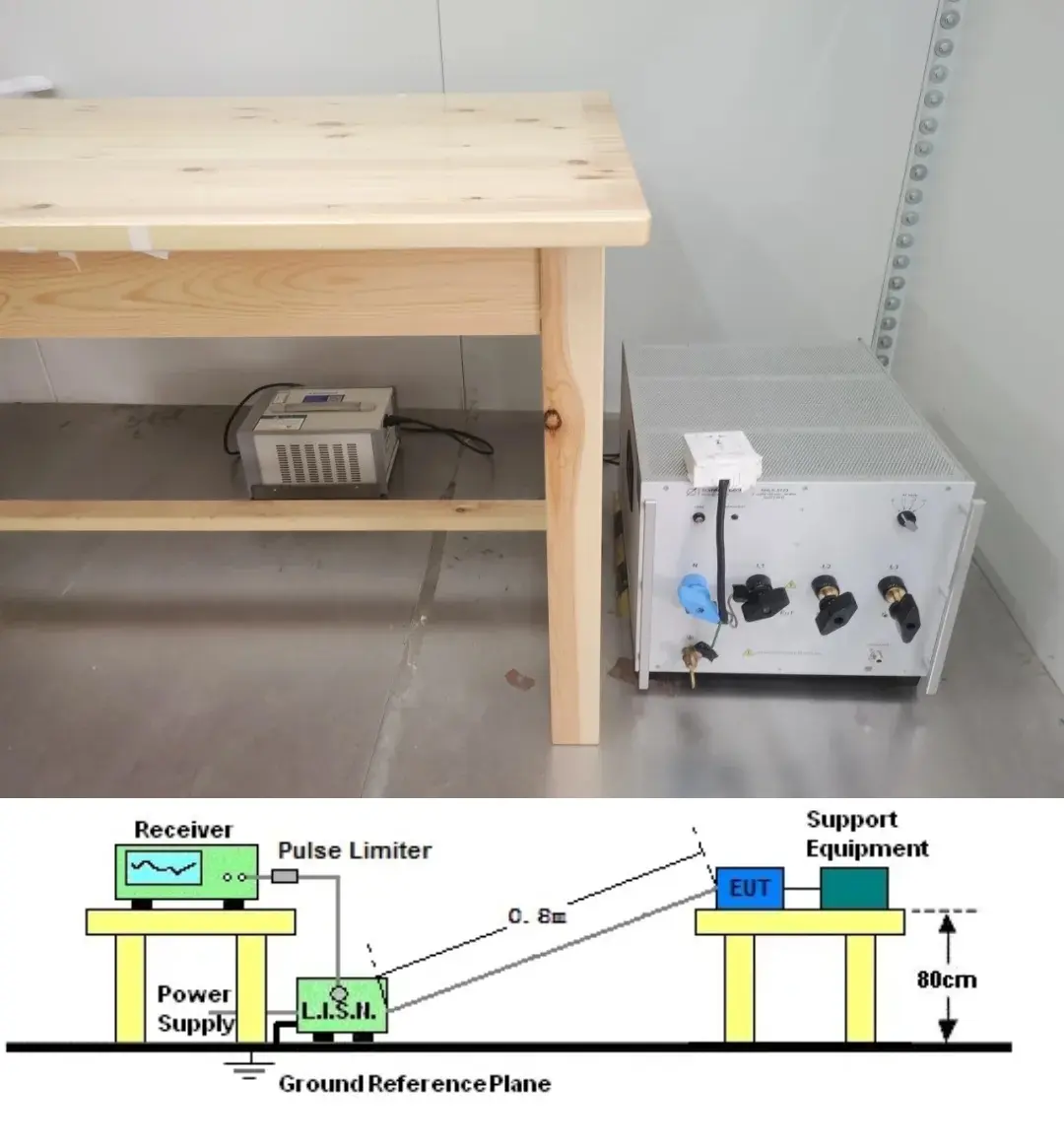
1.Conducted disturbance at mains ports (150 kHz–30 MHz)
2.Radiated disturbance (typically 30 MHz–6 GHz, some versions up to 18 GHz / 40 GHz)
3.Harmonic current, voltage fluctuations and flicker (for AC powered equipment)
Electromagnetic Susceptibility (EMS)
1.Electrostatic Discharge (ESD) (e.g., ±4 kV contact / ±8 kV air)
2.Electrical Fast Transient/Burst (EFT)
3.Surge
4.Radio frequency electromagnetic field (RS) (e.g., 80 MHz–6 GHz)
5.Radio frequency common mode (CS)
6.Voltage dips and interruptions
Test Purpose: To ensure that the equipment can still maintain connection, without packet loss, crashing, or malfunction in environments with base stations, frequency converters, switching power supplies, and human body static electricity.
Which Products Must Comply with EN 301 489?
As long as a product has "wireless transmission/reception" functions, entering the EU usually requires following the RED directive, which means EN 301 489 cannot be bypassed:
1.Wi-Fi routers, APs, network cards
2.Bluetooth headphones, speakers, keyboards, mice
3.Zigbee / Thread / Matter wireless modules
4.4G/5G modules, IoT terminals, automotive T-Boxes
5.RFID readers, access control, remote controls
6.Wireless microphones, walkie-talkies, GNSS receivers
7.Smart lights, smart locks, smart cameras
Note: Using a certified wireless module does not mean the entire device is exempt from EN 301 489 testing. A module report cannot automatically cover the whole machine's layout, power supply, enclosure, antenna, and peripheral circuits.
EN 301 489 Certification Process
1.Product Classification: Determine the wireless technology type and select EN 301 489-1 + the corresponding sub-standard.
2.Pre-testing / Pre-scan: Conduct preliminary radiation and immunity testing in an EMC laboratory.
3.Rectification Design: Optimize shielding, filtering, grounding, PCB layout, and power supply topology.
4.Official Testing: An ISO/IEC 17025 accredited laboratory (such as JJR LAB) issues the test report.
5.Technical Construction File (TCF): Schematics, BOM, user manual, RF parameters, and test reports.
6.Declaration of Conformity (DoC): The manufacturer signs the EU Declaration of Conformity.
7.Affix CE Mark: Add manufacturer information, EU representative (if applicable), and model information.
The cycle typically takes 2–8 weeks, or longer for complex multi-mode devices. Technical documents generally need to be kept for 10 years for inspection.
Differences Between EN 301 489 and fcc part 15
FAQ:
Q1: Is EN 301 489 a mandatory certification?
In the EU market, radio equipment is strictly regulated by the RED directive. EN 301 489 is the harmonized standard used to fulfill the EMC requirements within RED, so basically all "products subject to RED" must be tested according to it.
Q2: What is the difference between EN 301 489-1 and -17?
-1 provides general EMC methods; -17 contains supplementary requirements for Wi-Fi / Bluetooth / 2.4G / 5G ISM devices. In actual projects, both are used together.
Q3: If I only do domestic CCC (3C) certification, do I need EN 301 489?
It is not required for domestic sales in China. However, when exporting to the EU, Turkey (CE framework), or converting certificates for some Middle Eastern countries, it is usually referenced or adopted equivalently.
Q4: What should I do if my EN 301 489 test fails?
Do EMC pre-testing → locate the radiation source → add shielding/filtering/magnetic beads/common mode chokes/redraw PCB → retest. Intervening during the early design phase is the most cost-effective.
Q5: What are the new developments for RED after 2025?
RED has now incorporated cybersecurity requirements. Relevant products will also need to comply with the ETSI en 18031 series (access control, encryption, vulnerability patching, privacy protection). EN 301 489 governs EMC and does not replace cybersecurity.
What is EN 301 489 compliance certification?
It is a series of EMC standards for radio equipment in the EU, serving as the core technical basis for CE-RED compliance.
Email:hello@jjrlab.com
Write your message here and send it to us
 What is the Amazon EN 301 489 Standard?
 How to get an EN 301 489 Test Report?
What is EN 301 489 Compliance Certification?
 Introduction to the EN 300 422 Standard
 How to get an EN 300 422 Test Report
 What is EN 300 422 Compliance Certification?
 How to get an EN 300 220 Test Report
 How to get an EN 300 440 Test Report
Leave us a message
24-hour online customer service at any time to respond, so that you worry!