



What is Hemocompatibility Testing ISO 10993?
Any medical device that has direct or indirect contact with circulating human blood must undergo hemocompatibility testing if there is insufficient data to prove it meets hemocompatibility requirements. Among them, ISO 10993-4:2017 is an important reference standard for the hemocompatibility testing of medical devices.
What is Hemocompatibility Testing?
Hemocompatibility testing is primarily used to evaluate the effects of medical devices that come into contact with blood, or materials used for blood or blood products. When selecting and developing a test plan, factors such as product design, clinical application, usage environment, and risk-benefit must be taken into consideration.
As an important reference standard for hemocompatibility testing, iso 10993-4:2017 mainly includes three parts:
1.The classification of medical devices in contact with blood;
2.The basic characteristics for evaluating blood interactions;
3.The selection of test methods.
Classification of Devices in Contact with Blood
1. Non-Blood-Contact Devices
Non-blood-contact devices do not mean devices that have absolutely no contact with blood; rather, they refer to devices that do not have direct or indirect contact with blood or blood components that remain in or are reinfused back into the body. Examples include in vitro diagnostic reagents and blood collection tubes.
2. External Communicating Devices
External communicating devices typically come into contact with circulating blood and are connected to the human vascular system. So, what specific products does this include? The table below summarizes three common categories of external communicating devices and provides relevant examples for better understanding.
No. | Category | Common Devices |
1 | Indirect blood path | Blood collection devices, cannulae, cell collection devices, storage and administration devices for blood and blood products (e.g., blood bags and administration sets), extension sets (used with intravenous administration), intravascular medical catheters. |
2 | Direct contact with circulating blood | Atherectomy devices, blood monitoring devices with direct or indirect blood contact, cardiopulmonary bypass circuits, devices that absorb specific substances from blood, therapeutic apheresis equipment, extracorporeal membrane oxygenators (ECMO), hemodialysis/hemofiltration equipment, cardiovascular interventional devices, intravascular catheters (e.g., used with balloons, imaging, lasers, ultrasound), leukocyte removal filters, percutaneous circulatory support devices, retrograde coronary perfusion catheters, vascular guidewires. |
3 | Implant devices | Annuloplasty rings, arteriovenous shunts, blood monitors (implantable), circulatory support devices (e.g., ventricular assist devices, artificial hearts, intra-aortic balloon pumps), embolization devices, endovascular synthetic vascular grafts, implantable defibrillator and cardioverter leads, inferior vena cava filters, internal drug delivery catheters, intravascular oxygenators (e.g., artificial lungs), mechanical or tissue heart valves, pacemaker leads, surgical synthetic or tissue vascular grafts, vascular stents. |
Blood Interaction Characteristics
After clarifying the device category, it is necessary to understand the product's blood interaction characteristics. The core purpose is to select the appropriate test methods. In this section, there are two key points requiring special attention:
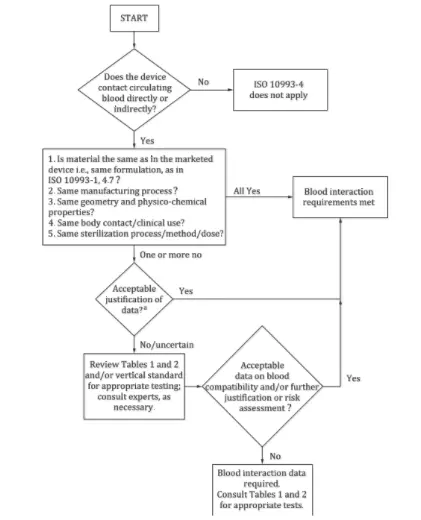
1.First, the standard provides a decision flowchart to help clarify whether hemocompatibility testing is required.
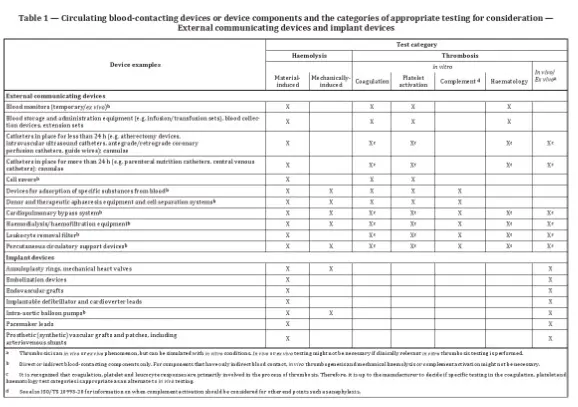
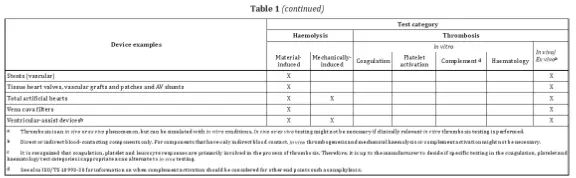
2.Second, the standard lists examples of devices in contact with circulating blood, as well as their corresponding test categories.
Decision Flowchart
By answering the four questions below, you can preliminarily determine whether your product requires hemocompatibility testing.
1.Question 1: Does the device directly or indirectly contact circulating blood? If not, this standard is not applicable; if yes, proceed to Question 2.
2.Question 2: Are the materials used in the device identical to those in marketed products? Have they undergone the same manufacturing processes? Do they possess the same structural and physicochemical properties? Are they in contact with the human body? Do they have the same clinical application? Have they undergone a sterilization process, and are the methods and doses the same? If the answers are all yes, the blood interaction requirements are met, and no testing is needed. If one or more conditions are not met, proceed to Question 3.
3.Question 3: Evaluate the differences and determine whether the data is acceptable. If yes, no testing is needed; if not or if uncertain, continue to evaluate the contents of Tables 1 and 2, or refer to relevant vertical standards, or consult professionals, and then proceed to Question 4.
4.Question 4: Further determine or evaluate the risks; is the hemocompatibility data acceptable? If yes, no testing is needed; if not, hemocompatibility testing must be conducted according to Tables 1 and 2.
Common Devices and Corresponding Test Categories
For external communicating devices and implant devices, Table 1 lists common devices or device components in contact with circulating blood and provides testing categories for reference. For example, for blood monitoring devices, tests to consider include: material-mediated erythrocyte hemolysis testing, as well as in vitro coagulation, platelet activation, and hematology tests.
Once the test categories are clarified, the next step for manufacturers is to consider the device's blood interaction characteristics. Specifically, related parameters include: the structural shape of the product, physicochemical properties of the materials, surface characteristics and sterilization conditions, duration of contact and environmental temperature, as well as anticoagulation and blood flow conditions. If animal studies are to be conducted, such as for implantable products, they should simulate clinical usage conditions as closely as possible. Of course, not all these parameters necessarily need to be taken into account; manufacturers should select the important characteristic parameters to focus on, based on product features, and especially based on existing research or literature data.
Description of Test Methods
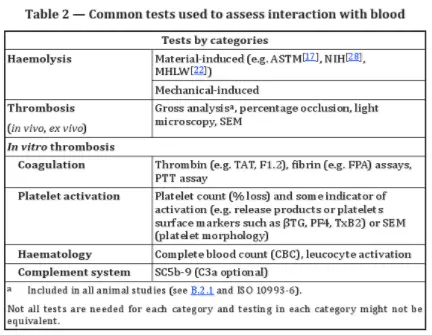
Generally speaking, the hemocompatibility tests recommended by the standard can be divided into two main categories:
1.Hemolysis tests: including material-mediated and mechanically induced.
2.Thrombosis tests: in vitro tests including coagulation, platelet activation, complement activation, and hematology tests. They also include direct in vivo tests and ex vivo tests. See Table 2 for details.
Specifically:
If conducting in vitro tests, test variables that typically need to be considered include: hematocrit, anticoagulants (type and dosage), age of the blood/blood components, sample preparation, the ratio of sample surface area to blood volume, sample storage, temperature, pH, and fluid flow conditions (e.g., flow rate, wall shear stress, and shear rate).
Furthermore, if the intended use of the device is for extracorporeal application, such as hemodialysis equipment, then ex vivo tests are essential. Through an ex vivo test system, phenomena such as platelet adhesion, thrombus formation, fibrinogen deposition, leukocyte adhesion, and platelet activation can be monitored. Among these, the blood flow velocity can be measured in real-time by Doppler or electromagnetic flow probes, and changes in flow velocity can indicate thrombus deposition and embolization formation.
For in vivo animal tests involving implant devices (such as vascular stents and heart valves), they must mimic clinical usage conditions as closely as possible. Typically, "catheter or device patency" (i.e., unoccluded blood flow through the device) is used as an important evaluation indicator for in vivo tests. In addition, after the removal of the device, the pathology of the tissues and organs surrounding the implant will also be evaluated. Of course, manufacturers may use additional assessment methods based on product characteristics and actual needs, such as angiography, intravascular ultrasound (IVUS), and other technologies.
Summary
Reading through ISO 10993-4:2017, it provides a brief introduction to the classification of medical devices in contact with blood, the basic characteristics of blood interactions, and commonly used test methods. However, regarding the design of test protocols and specific testing requirements—such as how to conduct in vivo thrombosis, in vitro hemolysis, and platelet activation tests—this article does not provide detailed explanations. If needed, you can refer to Appendices A through G.
Email:hello@jjrlab.com
Write your message here and send it to us
 What is Cytotoxicity ISO 10993-5
What is Hemocompatibility Testing ISO 10993?
What is Cytotoxicity ISO 10993-5
What is Hemocompatibility Testing ISO 10993?
 What is ISO 10993-5 Tests for In Vitro Cytotoxicit
 Electronic Product IEC 62368-1 Safety Testing
 What is an EU SDS (Safety Data Sheet)?
 What is the CA Prop 65 Warning Label?
 2026 Amazon TIC Mandatory Audit Catalog
 Australian Electrical EESS and RCM Compliance
Leave us a message
24-hour online customer service at any time to respond, so that you worry!