



What is the Vacuum Cleaner CSA C22.2 No.243 Test Report?
For vacuum cleaner export enterprises looking to expand into the Canadian market, the CSA C22.2 No.243 report is an unavoidable core compliance document. As Canada's mandatory safety standard for the vacuum cleaner category, it directly determines whether products can smoothly clear customs and be listed on mainstream cross-border platforms like Amazon and TEMU. Furthermore, it is closely tied to the brand's long-term compliant operation in the local market.
What is the Vacuum Cleaner CSA C22.2 No.243?
CSA C22.2 No.243 is an electrical safety standard published by the Canadian Standards Association (CSA), specifically targeting vacuum cleaners, blower cleaners, and household floor finishing machines. The current latest mandatory version is CSA C22.2 No.243:2025, which is a bi-national harmonized standard with the US ul 1017:2025. It covers almost all civilian cleaning and vacuuming equipment, including household, commercial, wet/dry, and cordless handheld models.
This report is not a simple testing document; it is an official proof of comprehensive compliance in electrical safety, mechanical protection, heat resistance, and fire prevention. Canadian customs, e-commerce platforms, and local regulatory authorities all use it as a core verification basis. Products lacking this report will not only be directly detained but may also face fines of up to tens of thousands of Canadian dollars, and could even be restricted from entering the Canadian market.
Core Tests and Compliance Requirements of the Report
A compliant CSA C22.2 No.243 report must cover a full series of mandatory test items:
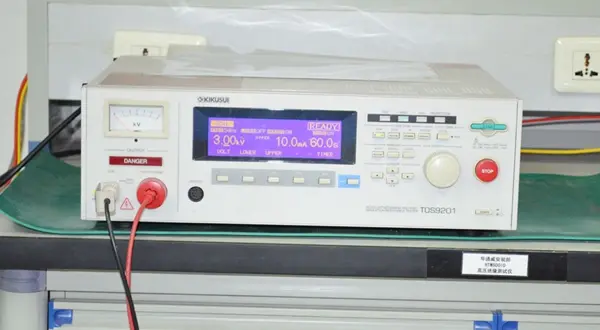
Electrical Safety: Withstand voltage test, leakage current test, and grounding continuity test, ensuring that the product poses no electrical leakage risk under the 120V/60Hz Canadian power grid environment.
Mechanical Safety: Inspection of moving parts protection structures and overall machine stability tests, preventing users from being scratched or injured by tipping over during use.
Thermal Safety: Overall machine temperature rise test and abnormal operation test for motor stall, simulating the fire risk under user misoperation scenarios.
Material Safety: Heat resistance and fire rating tests for the outer shell and internal wiring to avoid the spread of fire under fault conditions.
In addition, vacuum cleaners targeting the Canadian market must also meet localized compliance requirements:
Product labels must display bilingual information in both English and French.
Commercial models must be additionally marked with the words "Commercial Use".
Wireless smart vacuum cleaners also need to undergo ised ic certification synchronously to meet radio frequency interference control requirements.
Processing Procedures and Requirements
Many export enterprises easily fall into traps when processing the report, leading to prolonged cycles and increased costs. A complete compliance processing procedure can be divided into 5 steps:
Selection of Qualified Institutions: Prioritize choosing third-party testing institutions officially recognized by CSA. Avoid unqualified intermediaries to ensure the report is recognized by platforms and customs.
Preparation of Technical Documents: Prepare product specifications, circuit diagrams, PCB layout diagrams, critical component lists (including pre-certifications for motors and power cords), and bilingual English-French manuals in advance. Incomplete documentation is the most common reason for application rejection.
Sample Submission and Testing: Submit fully configured samples in their final mass-production state. Wireless models must come with the original charger, and commercial high-power models need to provide the highest-power configuration version.
Rectification of Non-conformities: If issues such as excessive temperature rise or insufficient structural protection arise during testing, the institution will provide a clear rectification plan. The enterprise simply needs to retest after making the necessary adjustments.
Report Acquisition and Maintenance: Once the test is passed, the official CSA report can be obtained. After certification, you must cooperate to complete the CSA factory inspection. Subsequently, you must accept an annual surveillance audit every year, and any changes to critical components must be reported to the certification body in advance.
The regular processing cycle is 6-8 weeks. Enterprises with urgent listing needs can apply for expedited services, which can compress the issuance time to about 3 weeks at the fastest. Currently, the mainstream cost for processing a vacuum cleaner CSA C22.2 No.243 report in the industry ranges from $628 to $1,580 USD, depending on the product type. Because they involve battery-related tests, the cost for handheld wireless models will be slightly higher than that of ordinary corded vacuum cleaners.
Common Questions on Cross-Border Platform Listing and Customs Clearance
When listing vacuum cleaner products on platforms like Amazon Canada and TEMU, the platforms will mandate merchants to upload a valid CSA C22.2 No.243 report. Some platforms will also require the synchronous provision of a cCSAus joint certification report, which simultaneously meets both US and Canadian standards, avoiding the cost of duplicate certification for subsequent cross-regional sales.
Email:hello@jjrlab.com
Write your message here and send it to us
 What is UL 1642 Compliance Certification?
 What Is Amazon's UL 60335 Standard
 How to get a UL 60335 Test Report
 What is UL 60335 Certification Compliance?
 What is EN 61000 Certification Compliance?
 How to get an EN 61000 Test Report?
 What is the Amazon EN 55035 Standard?
 What is EN 55035 Certification Compliance?
Leave us a message
24-hour online customer service at any time to respond, so that you worry!