



Amazon Product Safety Compliance Guide
With the development of cross-border e-commerce, product safety compliance has become an essential prerequisite for Amazon sellers to enter the global market. For sellers planning to expand into the US, European, Australian, Canadian, and Japanese marketplaces in 2027, understanding product certification and compliance requirements in advance is crucial.
2027 Amazon Product Safety Compliance Trends
Based on regulations and Amazon policies announced up to November 2026, product safety compliance in 2027 is expected to present the following trends:
Third-Party Compliance Verification
1.Amazon has already adopted the Direct Validation (DV) process in certain high-risk categories, requiring sellers to complete compliance audits through platform-recognized third-party institutions.
2.Categories such as children's toys and electric mobility products have already been affected by relevant policies.
3.In 2027, Amazon is expected to continue placing high emphasis on the authenticity and validity of test reports, as well as the consistency between reports and actual products.
4.Sellers should confirm in advance whether test reports, product models, labels, and manufacturer information match, and complete verification according to specific ASIN notifications.
Digitalization of Product Compliance
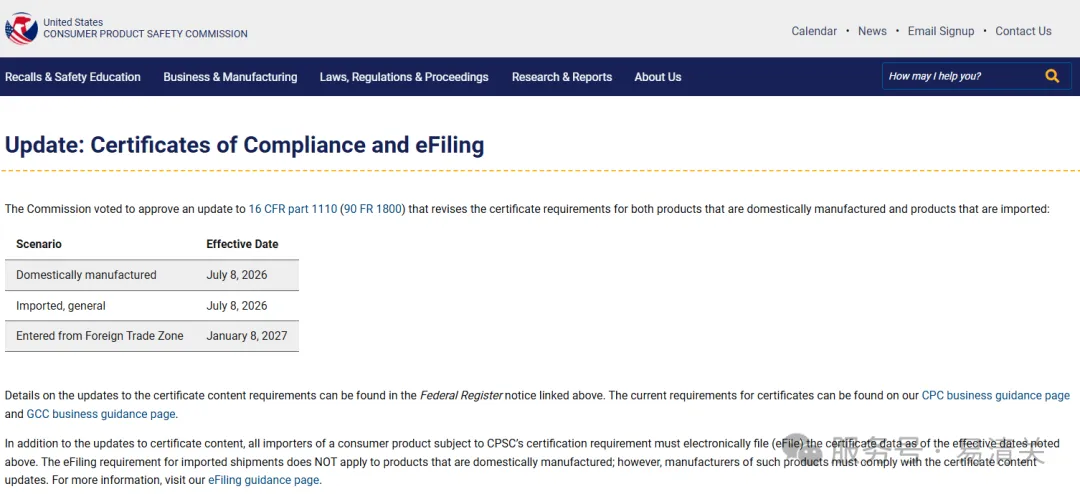
1.The U.S. CPSC compliance certificate electronic filing system was implemented for most regulated imported consumer goods on July 8, 2026.
2.Relevant products entering consumption or storage via U.S. Foreign Trade Zones (FTZ) also need to pay attention to the implementation milestone on January 8, 2027.
3.Consequently, sellers need to manage CPCs, GCCs, test reports, and product traceability information with greater standardization.
European Electronic Product Cybersecurity
1.The primary obligations of the European Union's Cyber Resilience Act (CRA) will begin application on December 11, 2027.
2.Smart homes, connected electronic devices, and certain smart toys may be affected.
3.Relevant manufacturers need to pay attention to cybersecurity design, vulnerability management, software updates, and technical documentation requirements.
Lithium Batteries and Environmental Compliance
1.Battery safety, transportation, recycling, and environmental responsibility will remain key focuses in 2027.
2.According to the EU Battery Regulation, starting February 18, 2027, certain industrial batteries, electric vehicle batteries, and light transport batteries will need to meet battery passport requirements.
3.However, small batteries in ordinary consumer electronics do not all fall under this requirement.
Priority Regulation of Toys and Electronics
1.Toys involve child safety, while electronic products may carry risks of electric shock, overheating, fire, and electromagnetic interference.
2.In 2027, toys, children's products, wireless electronic devices, and lithium battery products are expected to remain compliance categories of primary focus for Amazon.
What is Amazon Product Safety Compliance?
Amazon Product Safety Compliance means that the products sold by sellers must comply with the safety regulations, technical standards, and Amazon platform policies of the target countries. It involves not only product certification but also test reports, labels, user manuals, manufacturer information, and other supporting documentation.
What are the Amazon Product Compliance Requirements?
Different products correspond to different regulations and testing requirements. Sellers should select appropriate compliance programs based on product functions, materials, and target sales countries.
Common Products and Certification Requirements Comparison Table
Note: The above are common compliance programs; not all products must complete every certification. For example, ordinary plastic toys usually do not require FCC certification, but toys with wireless remote control functions may need to meet radio requirements.
Recommendation for 2027: Focus on children's toys, infant and toddler products, wireless electronic devices, chargers, lithium batteries, and electric mobility products.
Amazon Country-Specific Compliance Requirements
Amazon US Marketplace Compliance Requirements
The United States primarily involves regulatory agencies such as the CPSC, FCC, and FDA.
Children's Toys:
1.CPSIA Children's Product Safety Regulations
2.ASTM F963 Toy Safety Standard
3.CPC Children's Product Certificate
4.Third-party testing by CPSC-recognized laboratory JJR
5.Traceability labels and applicable warning information
6.Current mandatory U.S. toy safety regulations have adopted the ASTM F963-23 standard.
Electronic Products: Wireless devices such as Bluetooth and Wi-Fi usually need to comply with FCC equipment authorization requirements, while other electronic products must confirm applicable electrical safety standards.
Button Cell Battery Products: Applicable products must pay attention to Reese's Law and ANSI/UL 4200a related requirements, including battery compartment safety and warning labels. Children's toys that qualify for statutory exemptions shall be executed in accordance with corresponding toy safety regulations.
2027 Focus: Pay attention to CPSC compliance certificate electronic filing requirements, especially the implementation milestone for FTZ-related imported products on January 8, 2027.
Amazon European Marketplace Compliance Requirements
Common regulations for the European marketplace include:
1.CE: Applies to products covered by relevant EU harmonization legislation.
2.GPSR: Involves product safety, EU Responsible Person, traceability, and online sales safety information.
3.REACH: Manages applicable restricted chemical substances in products.
4.RoHS: Restricts specific hazardous substances in applicable electrical and electronic equipment.
5.WEEE & EPR: Involves producer responsibility for electronic waste, packaging, and batteries.
The EU GPSR began application on December 13, 2024. In addition, the primary requirements of the new EU Toy Safety Regulation (EU) 2025/2509 will begin application on August 1, 2030, rather than being fully implemented in 2027.
2027 Focus: Continuously monitor GPSR, CE, EPR, and the CRA cybersecurity requirements for connected electronic products.
Amazon UK Marketplace Compliance Requirements
The UK primarily involves toy safety regulations, electrical safety regulations, and related product conformity requirements.
1.The applicability of ukca and CE marks depends on the product category and sales region.
2.In England, Scotland, and Wales, many eligible products can still use the CE mark; application of UKCA is not mandatory for all products.
3.Connected consumer electronic devices also need to comply with the UK PSTI product security regime.
4.Sellers should specifically distinguish between the applicable requirements for Great Britain and Northern Ireland.
Amazon Australia Marketplace Compliance Requirements
Common compliance programs in Australia include:
1.RCM: Applies to relevant electrical, electronic, and wireless equipment.
2.Mandatory Toy Safety Standards: Includes toys for children aged 36 months and under, etc.
3.Button Battery Safety Requirements: Involves battery compartments, packaging, and warning information for applicable products.
4.Other Product-Specific Safety Standards: Australia enforces mandatory safety and information standards for button batteries and consumer goods containing button batteries.
5.2027 Focus: Pay attention to children's products, button batteries, and electronic equipment bound by the RCM regime.
Amazon Canada Marketplace Compliance Requirements
Canada is primarily governed by the Canada Consumer Product Safety Act (CCPSA) and related product regulations.
1.Children's toys must comply with the Toys Regulations, covering mechanical safety, chemical substances, flammability requirements, etc.
2.Wireless products generally involve ISED technical certification, and certain electrical products must also meet local electrical safety regulations.
3.Packaging labels typically require both English and French, and additional regulations may apply in the Province of Quebec.
4.Notice: U.S. CPC or ASTM test reports cannot automatically replace all Canadian product safety requirements.
Amazon Japan Marketplace Compliance Requirements
Common product compliance programs in Japan include:
1.PSE: Applies to electrical appliances regulated by the Electrical Appliance and Material Safety Law.
2.Telec/Technical Conformity Mark (Giteki): Applies to wireless equipment meeting relevant requirements.
3.Children's PSC: Applies to statutory categories of infant and toddler toys for children under 3 years old.
4.ST Mark: Voluntary toy safety mark of the Japan Toy Association.
Japan has implemented the Children's PSC system for applicable infant and toddler toys since December 25, 2025. For toy sellers targeting Amazon Japan in 2027, special verification is required for product age classifications, statutory safety standards, and Children's PSC mark requirements.
2027 Amazon Toy Product Safety Compliance Requirements
Children's toys are an important category for Amazon's product safety reviews. The material, age range, structure, and electronic features of different toys affect the applicable testing standards.
Comparison of Toy Compliance Standards Across Countries
What Safety Tests Do Different Toys Require?
1.Plush Toys: Focus on filling materials, flammability, small parts, and chemical safety.
2.Plastic Toys and Building Blocks: Focus on small parts, mechanical strength, sharp edges, and restricted chemical substances.
3.Magnetic Toys: Focus on magnet detachment and ingestion risks.
4.Electric Toys: Focus on battery compartments, electrical safety, temperature rise, and short-circuit risks.
5.Smart Toys: In addition to toy safety, may involve radio, cybersecurity, and privacy requirements.
How to Obtain Amazon Toy CPC Certification in the US?
Children's toys in the U.S. typically need to complete testing according to applicable CPSC regulations, and a CPC must be issued by the responsible party.
The basic process is as follows:
1.Determine the product category and applicable age group.
2.Confirm applicable requirements such as CPSIA and ASTM F963.
3.Select a CPSC-recognized third-party laboratory like JJR.
4.Complete testing and obtain the report.
5.Issue the CPC in accordance with the law by the manufacturer or importer.
6.Submit documentation or complete verification according to Amazon's notification.
Note: A CPC is not a standalone certification issued by a laboratory, but a certificate of conformity issued by the legally responsible manufacturer or importer.
2027 Amazon Toy Direct Validation Requirements
Amazon has adopted the Direct Validation process for certain children's toy ASINs.
1.Relevant sellers may be required to complete verification annually through platform-recognized third-party institutions and provide recent test reports meeting the requirements.
2.Some verification processes may involve testing documentation from within the past 12 months.
3.However, this does not mean all national regulations mandate that toy reports are only valid for one year. Sellers should be guided by specific ASIN notifications.
How Toy Sellers Can Reduce Compliance Risks
1.Confirm materials, age classifications, and target market requirements during the product development stage.
2.Complete necessary testing before mass production and ensure that test samples match the products actually sold.
3.If materials, batteries, electronic components, or product structures are changed, promptly evaluate whether retesting is required.
Amazon Electronic Product Safety Compliance Requirements
Electronic products may simultaneously involve electrical safety, electromagnetic compatibility, radio, lithium battery, and cybersecurity requirements.
Common Electronic Product Compliance Comparison Table
amazon fcc Certification Requirements
1.FCC primarily involves regulatory oversight of U.S. radio communications and related electronic devices.
2.Bluetooth, Wi-Fi, and wireless remote-control devices typically need to meet applicable FCC equipment authorization requirements.
3.Specific certification procedures depend on device functions and technical parameters; not all electronic products require an fcc id.
What is the Difference Between Amazon CE and RoHS?
1.CE is a conformity mark indicating fulfillment of EU harmonization legislation requirements.
2.RoHS primarily restricts specific hazardous substances in applicable electrical and electronic equipment.
3.For example, a wireless electronic product may need to comply with RED, RoHS, and other applicable regulations simultaneously. Therefore, ROHS Testing cannot replace full CE conformity assessment.
2027 Lithium Battery Product Compliance Requirements
Lithium batteries and lithium-battery-containing products generally require attention to:
1.Applicable battery safety standards;
2.UN 38.3 transportation testing and test summaries;
3.Dangerous goods transportation classification and packaging;
4.Necessary warning labels;
5.Target market battery recycling and environmental requirements.
Note: UN 38.3 is primarily used for lithium battery transportation safety and cannot replace all product safety tests. Amazon FBA sellers must also confirm hazardous goods classification and warehousing/transportation requirements.
In 2027, product safety compliance will remain a vital task for Amazon cross-border sellers. The U.S. CPSC, European CE and GPSR, Australian RCM, Canadian product safety regulations, Japanese PSE, and Children's PSC systems all set clear requirements for different products. Especially for toys, children's products, electronic devices, smart products, and lithium battery products, sellers should confirm applicable standards in advance and prepare test reports and compliance documents.
FAQ
Do all products on Amazon require certification in 2027?
No. Different products correspond to different regulations. Not all products require CE, FCC, or CPC, but all must comply with applicable product safety regulations and platform policies.
Do children's toys sold on Amazon US require a CPC?
Toys subject to CPSC Children's Product Certificate requirements generally require a CPC and must undergo third-party testing according to applicable regulations.
Can I sell on the European marketplace simply by having CE certification?
Not necessarily. Sellers must also confirm GPSR, REACH, labeling, EPR, and other applicable requirements.
Do all lithium batteries require a battery passport in 2027?
No. The EU 2027 battery passport requirement only covers battery categories specified by the regulation, not all consumer electronic batteries.
Is an Amazon toy test report only valid for one year?
Not necessarily. Some Amazon direct validation processes require recent reports or annual verification, but legal and platform requirements must be judged separately.
Can the Japanese ST mark replace the Children's PSC?
No. ST is a voluntary mark, whereas the Children's PSC carries statutory requirements for eligible infant and toddler toys.
Is UKCA mandatory for the UK marketplace?
Not necessarily. The UK continues to recognize the CE mark for many eligible products, depending on the product category and sales region.
Can the same test report be used for multiple countries?
Some test results may be reusable, but because regulations and standards vary across countries, compliance must still be confirmed separately for each.
Do electronic products with lithium batteries need UN 38.3 testing?
Lithium battery transportation generally requires UN 38.3 attention; specific requirements depend on the battery category and transportation regulations.
Email:hello@jjrlab.com
Write your message here and send it to us
 Amazon Product Safety Compliance Guide
 Infant Products US & Canada CPC & SOR Comp
 What is ISO 10993 Chemical Characterization?
 What is ISO 10993 Certified? How to Get It ?
 CPSC eFiling Requirements
 Temu 2027 Children's Products and Textiles Complia
 What Compliance is Required for Exporting Adult Cl
 European Regulation PPWR Testing Services
Leave us a message
24-hour online customer service at any time to respond, so that you worry!