



Introduction to U.S. Compliance Labeling for Baby Slings
Want to sell baby slings in the U.S.? Don’t overlook labeling compliance!
This guide outlines the key labeling requirements, including mandatory label content, warning format, and common pitfalls. Use it as a quick self-check to reduce compliance risks.
Note:The following is a summary of compliance highlights and does not constitute legal advice. Always verify with professional counsel and the latest applicable regulations.

Definition of a Baby Sling
- Baby Sling:A product made of fabric or sewn material, worn on the caregiver’s torso to carry one or two infants or toddlers weighing up to approximately 35 pounds (15.9 kg).
- Typical Forms:Hammock-style, wrap-style, etc.; allows front, back, or hip carrying positions; infants may be carried upright, reclined, or lying flat.
Labeling Requirements
Label Language:English (mandatory)
1. Each Product & Retail Package Must Include (permanent, clear, and legible):
- Name, business address (city, state, ZIP code), and telephone number of the manufacturer/distributor/retailer.
- Date of manufactureor identifiable code (must include at least month + year).
- Applicable weight range:minimum and maximum child weight for each supported carrying position.
2. Each Product Body Must Also Include:
- Warning Statement (WARNING)+ Illustration of correct use
Warning Information
1. Example for Single Baby Sling:
⚠ WARNING
Only use this carrier with children weighing between [min] and [max] pounds.
2. Example for Twin Baby Sling:
⚠ WARNING
Only use this carrier with children weighing between [min] and [max] pounds for a total occupant weight of [total] pounds.
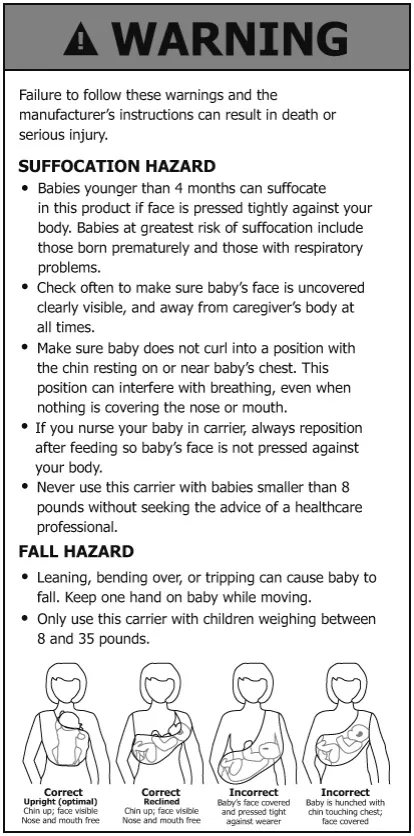
> Note:The examples “8–35 pounds” and “60 pounds” are for reference only. Replace with your actual tested weight limits. Use pounds (lb)as the primary unit.
Warning Label Specifications (Mandatory)
- Opening Format:Must begin with the safety alert symbol “⚠” followed by the word “WARNING”.
- Minimum Font Height:
- “⚠ WARNING” ≥ 0.2 inches (5 mm)
- Other text ≥ 0.10 inches (2.5 mm)
- Contrast:High contrast combinations such as black on white, white on black, or dark blue on off-white are acceptable. Must be conspicuous and durable.
- Layout:Use bullet points or a clear list format for multiple precautionary statements. If presented in paragraphs, separate them with bullet points.
- Font:Avoid overly narrow or compressed fonts that reduce readability.
- Durability:Sewn labels must be securely attached to the fabric and resistant to washing and normal use.
Production & Submission Tips
- Alignment:Ensure all details (title, illustration, usage instructions, weight range, and test/report data) are consistent.
- Consistency:Product label = Instruction manual = Outer packaging = E-commerce listing (no contradictions).
- Units:Use lb (pounds)as the primary unit. You may include kg for reference, but lb takes precedence.
- Illustrations:Diagrams must accurately depict the correct wearing method and permitted carrying positions (upright/reclined/lying).
⚠ Common Issues
1. Warning text does not match actual tested load capacity (e.g., using “8–35 lb” without verification).
2. “WARNING/⚠” text too small or below minimum height.
3. Insufficient contrast, or poor readability due to narrow/compressed fonts.
4. Warning appears only on outer packaging — missing or non-durable on product body (e.g., peelable sticker).
5. Mixed-language labels where English text is incomplete or unclear in priority.
Email:hello@jjrlab.com
Write your message here and send it to us
 How to get an EN 301 893 test report?
 What is EN 301 893 Certification Compliance
 What is the CSA 62368-1 Standard?
 Canadian Pacifier Compliance SOR/2016-184
 US Agent for FCC & EC REP for CE: Compliance R
 What is Recycling of WEEE
 What is PPWR Packaging Compliance
What is Extended Producer Responsibility
What is PPWR Packaging Compliance
What is Extended Producer Responsibility
Leave us a message
24-hour online customer service at any time to respond, so that you worry!