



IP Waterproof and Dustproof Rating Test
In modern electronic devices and industrial machinery, waterproofing and dustproofing are key factors in ensuring their long-term reliability and proper functioning. To address this, the International Electrotechnical Commission (IEC) has developed the IP (Ingress Protection) rating standard to measure the protective capabilities of products. The IEC/EN 60529 standard regulates the waterproof and dustproof performance of devices. Understanding the IP protection ratings not only helps us select the right products but also assists manufacturers in designing equipment that meets market needs.
What is the IP Protection Rating?
The IP Protection Rating (Ingress Protection) was established by the International Electrotechnical Commission (IEC) to measure a device's ability to resist external factors like dust and water. The rating consists of two digits: the first digit represents dust protection, and the second digit indicates water protection. The higher the number, the stronger the protection. Although it appears to be a simple two-digit system, it contains rich information and complex testing standards that provide a clear picture of the device’s suitability and durability in different environments.
For electrical equipment, the format for the IP rating is IPXX, where the XX represents two digits. The first digit indicates protection against contact and foreign objects, while the second digit represents protection against water.
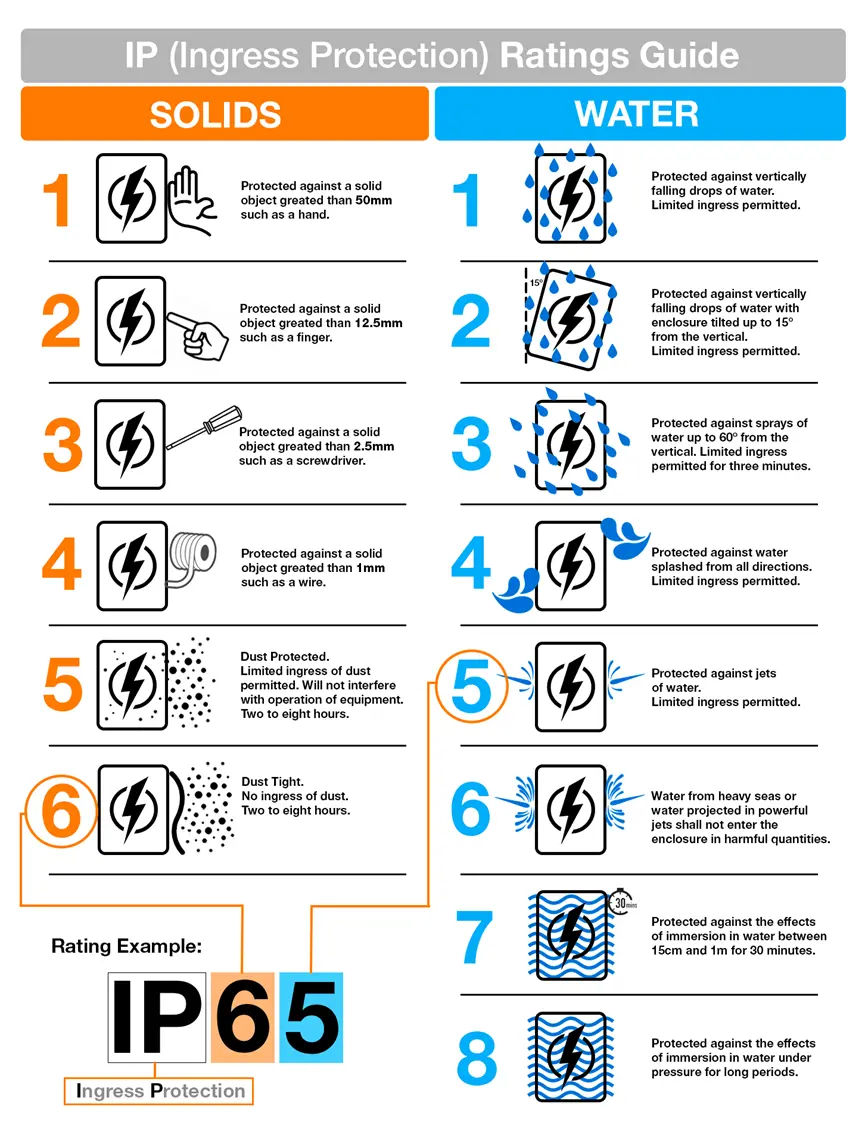
First Digit: Dust Protection
- IP0X: No protection – No special protection against external contact or foreign objects.
- IP1X: Protection against solid objects larger than 50mm – Prevents accidental contact with internal parts by large objects (larger than 50mm).
- IP2X: Protection against solid objects larger than 12.5mm – Prevents finger contact with internal parts and intrusion of medium-sized objects (larger than 12.5mm).
- IP3X: Protection against solid objects larger than 2.5mm – Prevents intrusion of small objects like tools, wires, etc., with a diameter or thickness greater than 2.5mm.
- IP4X: Protection against solid objects larger than 1.0mm – Prevents intrusion of small tools, wires, etc., with a diameter or thickness greater than 1.0mm.
- IP5X: Protection against dust – Completely prevents foreign objects from entering. Dust intrusion may occur but won't affect the normal operation of the device.
- IP6X: Protection against dust – Completely prevents both foreign objects and dust from entering.
Second Digit: Water Protection
- IPX0: No protection – No special protection against water or moisture.
- IPX1: Protection against dripping water – Water dripping vertically (e.g., condensation) will not harm the device.
- IPX2: Protection against dripping water at an angle of 15 degrees – Dripping water will not harm the device when tilted up to 15 degrees.
- IPX3: Protection against spraying water – Protects against rain or water splashed at angles less than 60 degrees.
- IPX4: Protection against splashing water – Protects against water splashing from all directions.
- ipx5: Protection against water jets – Protects against low-pressure water jets for at least 3 minutes.
- IPX6: Protection against strong water jets – Protects against high-pressure water jets for at least 3 minutes.
- IPX7: Protection against water immersion – Protects against immersion in water up to 1 meter for 30 minutes.
- IPX8: Protection against submersion – Protects against prolonged immersion in water deeper than 1 meter. Exact conditions specified by the manufacturer for each device.
Purpose of IP Testing
1. Protection against hazardous parts inside the enclosure that could be touched by humans.
2. Protection against the ingress of solid foreign objects into the enclosure.
3. Protection against harmful effects caused by water entering the enclosure.
It is important to note that different products require different protection levels depending on the environment in which they are used. The protective enclosure must match the product's intended usage. For example, the purpose of waterproofing for streetlight enclosures is to prevent rainwater from infiltrating and damaging the equipment.
IP Waterproof and Dustproof Testing Standards
• IEC/EN 60529 - Enclosure Protection Ratings (IP Code)
- Household Appliances and Indoor Equipment: These generally require basic dust and splash protection. IP44 and IP54 are sufficient for typical environments.
- Outdoor Instruments and Industrial Equipment: These devices need to withstand more complex environments and typically require an IP65 or IP66 rating to ensure proper functioning in dusty and rainy conditions.
- High-Precision Devices: Devices like smartphones and cameras, which are used frequently, usually require a rating of IP67 or above to cope with accidental water or dust exposure in daily life.
IP Testing Process:
1. Application – The applicant fills out the protection rating test application form.
2. Quotation – The testing fee is determined based on the control box product's protection rating.
3. Payment – After confirming the quotation, the applicant signs the application form and service agreement, pays the full project fee, and prepares the sample for testing.
4. Testing – The protection rating test is conducted, and the report is completed.
5. Report – The protection rating test report is issued.
If you would like more information about the dust and waterproof rating testing fees, cycle times, or other details, please send us the product specification, and we will reply with the testing fees (our prices are 30% lower than other agencies).
Email:hello@jjrlab.com
Write your message here and send it to us
 EU PPWR New Packaging Compliance
 How to Obtain an MSDS/SDS Report
 CPSIA Testing Service Consulting
 Food Contact Materials Testing Services
 California 65 Testing Service Consultation
 REACH Chemical Testing Services
 Electronic Vaporizers EU TPD / US PMTA / UK MHRA
 ISO 10993 Biocompatibility Standards
Leave us a message
24-hour online customer service at any time to respond, so that you worry!