



What is the Cycle for UL 2271 Certification for Lithium Batteries on US Amazon?
Due to the controversies surrounding hoverboards, self-balancing scooters, and electric scooters, the U.S. Consumer Product Safety Commission (CPSC) announced that all manufacturers, importers, and distributors of self-balancing scooters (including hoverboards) produced, imported, or sold in the United States must comply with new standards. This includes the UL 2272 electrical system certification standard for self-balancing scooters and the new UL 2271 standard for lithium batteries used in these devices.
Additionally, all hoverboard batteries must comply with un 38.3 certification requirements. In our previous two articles, we discussed the U.S. UL 2272 certification requirements for self-balancing scooters and the U.S. UL 2849 certification requirements for electric bicycles. Today, we will explain the specific requirements of the UL 2271 standard for batteries.
Scope of the UL 2271:2018 Standard
The UL 2271 standard applies to specific types of batteries and explicitly excludes others:
Applicable to: Batteries used in Light Electric Vehicles (LEVs).
Not applicable to (On-road/Heavy-duty): Batteries used in on-road passenger electric vehicles and heavy-duty off-road electric vehicles (these fall under UL 2580 and ISO 12405).
Not applicable to (Stationary/Rail): Batteries used in stationary energy storage systems, light electric rail transit, and fixed-rail applications (these fall under ul 1973).
UL 2271 Safety Requirements and Test Items
The UL 2271 standard stipulates strict safety requirements for batteries used in Light Electric Vehicles. The specific testing items and requirements are broken down into the following categories:
Electrical Tests
Overcharge Test: The battery is charged beyond its normal charging voltage to observe its condition. The cell voltage must be measured during the test. If the Battery Management System (BMS) reduces the charging current to a lower value near the end of the charging phase, the sample must continue to be charged using this reduced current until finished. Upon completion, the maximum measured charging voltage of the cell must not exceed its normal operating range requirements.
Short Circuit Test: The positive and negative terminals of the battery are directly shorted to test its performance and safety. The battery must not catch fire or explode during a short circuit, and the protective devices must promptly trigger to cut off the circuit.
Over-discharge Test: The battery is excessively discharged to verify its over-discharge protection function. The cell voltage is measured during the test. Upon completion, the minimum measured discharge voltage of the cell must not exceed its normal operating range requirements.
Temperature Test (Temperature Rise): The battery is charged and discharged under various temperature conditions to monitor temperature changes. If the maximum charging parameters vary with temperature, the charging instructions must clearly state this relationship, and the device under test must be charged using the most stringent parameters. Before the test, at least 2 complete charge-and-discharge cycles must be performed until consecutive cycles do not raise the cell's maximum temperature by more than 2°C. Thermal and overcurrent protection devices must not operate during this test.
Unbalanced Charging Test: This simulates an unbalanced charging state among individual cells in a battery pack to verify the BMS's balancing function and overall electrical stability. The BMS must effectively control the charging state of the cells to prevent damage or safety accidents caused by the imbalance.
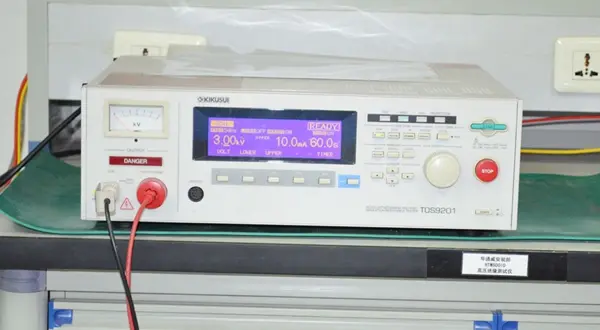
Dielectric Voltage-Withstand Test: A test voltage higher than the normal operating voltage is applied to verify the battery's insulation performance and voltage tolerance, ensuring no dangerous insulation breakdown occurs during normal use or potential overvoltage situations.
Insulation Resistance Test: The insulation resistance between the positive/negative terminals and the outer casing is measured. The resistance value must exceed the specified minimum to prevent electrical faults like leakage and short circuits.
Mechanical Tests
Vibration Test: The battery is vibrated within a specified frequency and amplitude range to simulate real-world conditions. Afterward, the battery must show no damage or leakage, and all performance indicators must remain compliant.
Shock Test: A specific impact force is applied to simulate collisions or bumps during vehicle operation. The battery must withstand the specified impact energy without rupturing, deforming, or suffering safety-compromising damage.
Crush Test: A specific crushing force is applied to simulate compression. Afterward, the battery must exhibit no fire, explosion, or leakage hazards, and its internal structure and electrical performance must remain intact.
Drop Test: The battery is dropped freely from a specified height onto a designated surface to check impact resistance. It must not suffer damage that affects safe use (e.g., cracked casing, exposed cells, or disconnected wiring).
Mold Stress Relief Test: The battery casing is tested under different stress conditions to ensure it can withstand normal use and potential anomalies without rupturing or deforming.
Handle Loading Test: For batteries or devices with handles, a specific load is applied to check the handle's strength and connection reliability, ensuring it will not break or detach under normal use or potential overload.
Rollover Test: The battery is flipped and rolled to simulate tumbling during transport or use. Afterward, it must show no damage or leakage, and all performance indicators must remain compliant.
Strain Relief Test: A specific pulling or twisting force is applied to the battery's connecting wires to verify connection strength and insulation, ensuring wires do not break or short-circuit under normal use or external force.
Environmental Tests
Immersion Test: The battery is submerged in water or a specific liquid at a certain depth for a designated time. Afterward, its waterproof and insulation performance is checked; no water ingress or electrical leakage is allowed.
Water Resistance Test (IP Code Rating): Based on required protection ratings, the battery undergoes water spraying or immersion tests (e.g., IPX4). The battery must function normally without water ingress or short circuits under these conditions.
Thermal Cycling Test: The battery undergoes cyclical temperature changes to verify its reliability under fluctuating thermal conditions. The battery must remain stable without damage or deformation, and its insulation and sealing must remain unaffected.
Label Durability Test: Battery labels are subjected to wiping, scraping, and soaking to ensure they remain clear and intact under normal use and varied environments, continuing to provide accurate safety information to users.
Other Requirements
Grounding Continuity Test: The battery's grounding system is tested for continuity to ensure proper grounding compliant with standards, preventing personal injury in the event of electrical leakage.
Single Cell Failure Tolerance Test (Thermal Propagation): Secondary lithium batteries with a rated energy greater than 1 kWh must undergo a single cell failure tolerance test according to UL 2580. This assesses the battery's safety and ability to prevent thermal runaway propagation if a single cell fails.
Labeling Requirements: The battery must be marked with the manufacturer's name and address, production date, serial number, battery type, voltage, capacity, maximum charge current, maximum discharge current, maximum charge voltage, minimum discharge voltage, cycle life, calendar life, warranty period, country of origin, and the UL mark. It must also include a warning stating that the battery must not be exposed to temperatures above 140°F (60°C) or below -4°F (-20°C).
Key Changes in UL 2271-2023 Compared to UL 2271-2018
Definition Changes
New Definitions: Added definitions for Battery Management System (BMS), electric motorcycles, electric scooters, personal electric mobility devices, sodium-ion cells, primary overcurrent protection, primary safety protection, active protection devices, and passive protection devices.
Changed Examples: Modified the examples for Light Electric Vehicles (LEVs). Electric motorcycles were removed, while Unmanned Aerial Vehicles (UAVs) were added.
Structural Requirement Changes
Corrosion Resistance of Metallic Materials: Exempted metal casings made of copper, aluminum, stainless steel, bronze, and brass from corrosion resistance requirements. Added requirements for iron casings: indoor iron casings must use enamel, painting, or galvanizing to prevent corrosion and must pass a 600-hour salt spray test according to CSA C22.2 No. 94.2/UL 50E.
Insulation Rating and Protective Grounding: Compliance for protective grounding systems can now be evaluated based on the grounding continuity test.
Safety Analysis: Added safety analysis examples, requiring system safety analysis to demonstrate, at a minimum, no hazards under conditions of cell overvoltage, undervoltage, battery over-temperature, under-temperature, and overcurrent during charging/discharging. It also revised hardware and software requirements for safety protection devices, added BMS requirements for cell protection and protective circuits, and introduced EMC (Electromagnetic Compatibility) requirements.
Testing Changes
Overcharge Test: Added the requirement to measure cell voltage during testing, and mandated that if the BMS reduces the charging current near the end of the charging phase, charging must continue with the reduced current until completion. Removed the requirement to repeat the test at a specific percentage of the trip point after the protective device activates. Added a rule that the cell's maximum charging voltage must not exceed the normal operating range at the end of the test.
High-Rate Charge Test: This new test aligns with UL 1973 requirements. The results account for BMS delays, allowing overcharge currents to exceed the maximum charging current for a few seconds.
Short Circuit Test: Removed the requirement to repeat the test for at least 10 minutes at a specific percentage of the trip point after the protective device activates.
Overload Test: A new overload test has been added, with requirements aligning with UL 1973.
Over-discharge Test: Added the requirement to measure cell voltage during the test, ensuring the minimum discharge voltage does not exceed the normal operating range at the end of the test.
Temperature Test: Changed the pre-conditioning requirement from 5 charge/discharge cycles to at least 2 complete cycles, stopping only when consecutive cycles do not raise the cell's maximum temperature by more than 2°C. Additionally, thermal and overcurrent protection devices must not operate during the test.
Grounding Continuity Test: This new test aligns with UL 2580 requirements.
Single Cell Failure Tolerance Test: Added the requirement that secondary lithium batteries with a rated energy greater than 1 kWh must undergo this test in accordance with UL 2580.
Other Changes
Standard Reference Updates: Replaced references to UL 60950-1 with ul 62368-1, and ISO 12405-1 with ISO 6469-1.
Production Test Revisions: Revisions were made to manufacturing and production line tests, including a 100% inspection requirement for active controls relied upon for safety.
Email:hello@jjrlab.com
Write your message here and send it to us
 How to get an EN 300 440 Test Report
 What is EN 300 440 Compliance Certification?
 Detailed Explanation of CE Certification for SRD 1
 How to get an EN 301 893 test report?
 What is EN 301 893 Certification Compliance
 What is the CSA 62368-1 Standard?
 Canadian Pacifier Compliance SOR/2016-184
 US Agent for FCC & EC REP for CE: Compliance R
Leave us a message
24-hour online customer service at any time to respond, so that you worry!