



US Customs Regulations: Latest IOR Rules
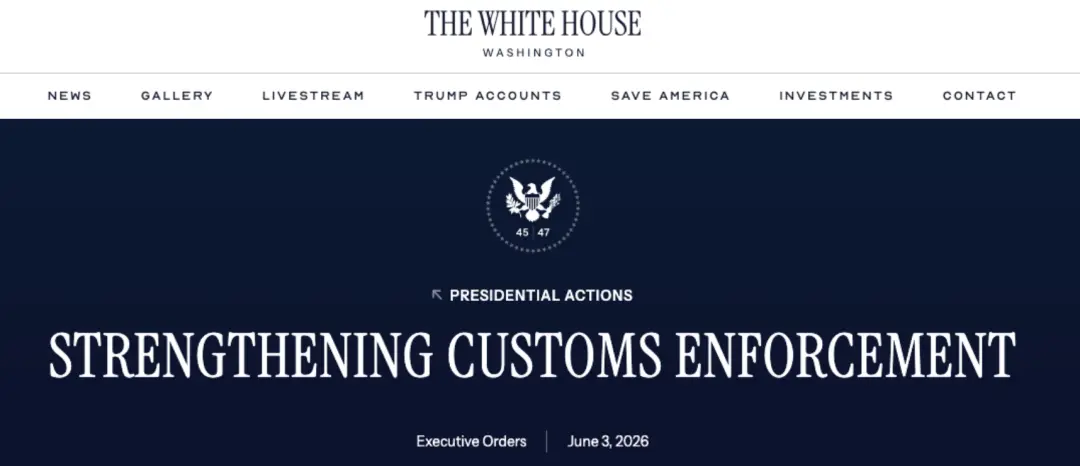
On June 3, local time, US President Donald Trump signed the "Strengthening Customs Enforcement" executive order, requiring the US Department of Homeland Security (DHS), US Customs and Border Protection (CBP), and relevant federal agencies to comprehensively strengthen import supervision and plug tariff evasion loopholes. The order aims to strictly crack down on behaviors such as under-declaring goods value, false declarations, illegal transshipment, borrowing importer identities, and using shell companies to evade supervision.
This marks one of the most significant reforms of the US import regulatory system in recent years, impacting multiple sectors including importers, customs brokers, freight forwarders, bonded warehouses, cross-border e-commerce, and global supply chain management. The industry widely anticipates that upon the implementation of these new rules, the US customs clearance market will undergo a profound reshuffle.
According to the executive order, the US government identified regulatory loopholes and insufficient enforcement within the current customs system. Certain companies have been evading supervision by under-declaring values, concealing importer identities, dodging tariffs, and violating rules of origin, forced labor bans, intellectual property rights, and product safety regulations. Therefore, the order mandates that reforms be rolled out in phases over the next 45 days, 90 days, 180 days, and 1 year.
Restructuring the Importer of Record (IOR) System
One of the core focuses of this reform is the complete overhaul of the US Importer of Record (IOR) system.
The executive order dictates that, moving forward, all IORs must maintain a minimum level of tangible assets within the US, customs bonds, or both, as determined by US Customs. It also raises the minimum bond requirements. Whether processing formal or informal entries, the IOR identity must be clearly designated, and enterprises must disclose significantly more information to CBP, including:
Estimated import volumes
Date of company establishment
Ownership structure and ultimate beneficiaries
Affiliated enterprises
Tangible assets located within the United States
Additionally, CBP will establish a "Good Standing" system within 180 days. Companies with records of serious violations, smuggling of contraband, or the illegal importation of fentanyl and related precursor chemicals may be deemed non-compliant with "Good Standing" requirements, thereby losing their import qualifications.
Stricter Supervision on "Foreign IORs"
Notably, for the first time, the executive order explicitly distinguishes between "US IORs" and "Foreign IORs", implementing far more stringent supervision on the latter. (Note: JJR provides Importer of Record services; consultations are welcome.)
According to the new rules, Foreign IORs will no longer be permitted to use informal entry procedures to import goods, which includes the low-value simplified entry model. In principle, they will be required to utilize formal entry procedures for all import business.
For formal entries, Foreign IORs will face stricter bond requirements and, as a general rule, will not be allowed to use Continuous Bonds unless granted special approval by CBP.
Furthermore, Foreign IORs will soon be required to obtain certification under the Customs Trade Partnership Against Terrorism (CTPAT), or they must entrust declaration processes to a US customs broker that is already CTPAT-certified.
Industry insiders believe this signals the end for import models that have long relied on US shell companies without actual operating entities or US assets, subjecting them to much higher compliance thresholds and regulatory pressure.
Enhanced Information Disclosure Requirements
In terms of import declarations, the executive order significantly elevates information disclosure standards.
Importers will soon be required to provide:
Foreign tax identification information
Global business identification information
Detailed data regarding the product supply chain and production process (including product models, specifications, ingredients, grades, manufacturers, and supply chain tracking details).
Simultaneously, within 90 days of the executive order’s issuance, the US government will require importers to submit the relevant documents that the exporting country’s customs requires from exporters, further strengthening the verification of goods' flow and supply chain origins.
Upgraded Enforcement and Penalties
Enforcement actions and penalty measures will be simultaneously upgraded.
The order requires CBP to increase the frequency of audits, strengthen bond recovery, and limit the abuse of bonded transportation systems. Enforcement will heavily target the importation of forced labor products, commodity misclassification, under-valuation, illegal transshipments, and the evasion of anti-dumping and countervailing duties.
For customs brokers and freight forwarders, regulatory responsibilities will noticeably increase. Entities that fail to fulfill customer due diligence obligations, continuously act as agents for non-compliant clients, or refuse to cooperate with CBP investigations may face maximum penalties.
Regarding penalty standards, the US government will revise customs penalty mitigation rules within 90 days. In the future, mitigated penalties shall generally not be lower than 50% of the original penalty amount, and repeat offenders will completely lose their eligibility for penalty mitigation.
The order also expedites the procedures for the seizure, forfeiture, and disposal of non-compliant goods, raises bond requirements for high-risk goods, and authorizes third-party involvement in the disposal of violating goods.
Summary: Six Core Aspects of the Reform
Overall, the core objectives of this reform can be summarized into six key areas:
Raising Importer Access Thresholds
Strictly Managing Foreign IORs
Strengthening Supply Chain Information Disclosure
Establishing an Importer Credit System
Increasing Penalties for Violations
Expanding Customs Enforcement Authority
Industry Outlook
As the relevant supporting regulations are progressively rolled out, compliance costs within the US import customs clearance market will rise significantly. Companies that heavily rely on low-value customs clearance, borrowed IORs, shell company imports, and DDP (Delivered Duty Paid) business models will be the most noticeably impacted.
Email:hello@jjrlab.com
Write your message here and send it to us
 How to get an EN 301 893 test report?
 What is EN 301 893 Certification Compliance
 What is the CSA 62368-1 Standard?
 Canadian Pacifier Compliance SOR/2016-184
 US Agent for FCC & EC REP for CE: Compliance R
 What is Recycling of WEEE
 What is PPWR Packaging Compliance
What is Extended Producer Responsibility
What is PPWR Packaging Compliance
What is Extended Producer Responsibility
Leave us a message
24-hour online customer service at any time to respond, so that you worry!