



Trump Signs Executive Order: New U.S. IOR Regulations
On June 3, 2026 (EST), U.S. President Trump officially signed an executive order titled "Enhancing Customs Enforcement," initiating the most systematic and profound structural reform of the U.S. Customs and Border Protection (CBP) enforcement system in nearly a decade.
This reform aims to close long-standing enforcement loopholes, strengthen the supervision of illegal and dangerous imported goods, and improve national security, trade compliance, and tax collection efficiency.
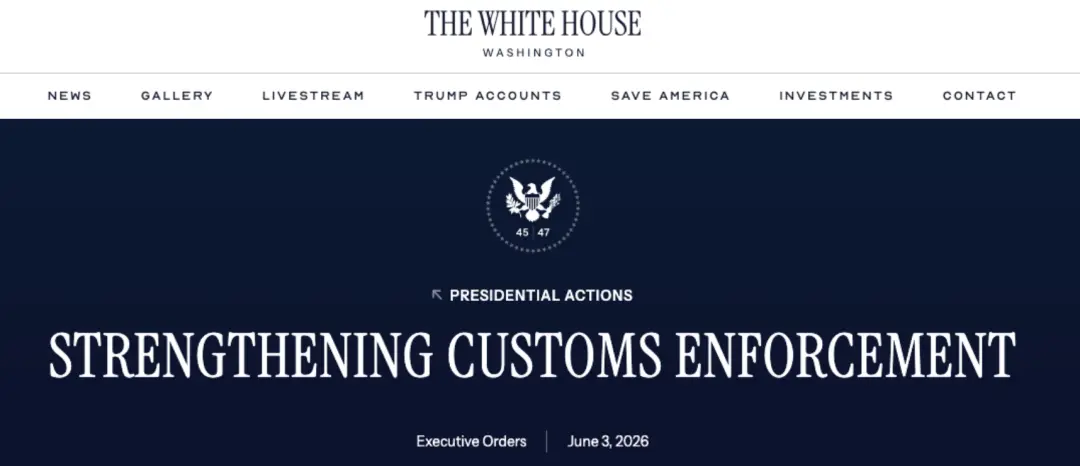
Core Content
This executive order represents the most significant reform initiative in the history of U.S. customs enforcement in decades. It aims to establish a strict importer access mechanism by strengthening source control. In particular, the provisions targeting foreign Importer of Record (IOR) registrants will have profound industry impacts in both depth and breadth of regulation.
Main changes include: mandatory minimum asset and bond requirements, prohibiting foreign IORs from filing informal entries, strengthening vetting and "good standing" requirements, and increasing import declaration and certification obligations.
Mandatory Minimum Asset and Bond Requirements
Change: Previously, only a lower guarantee amount was required. Now, mandatory minimum assets and a higher Bond must be met.
Interpretation: This directly raises the barrier to entry. For small and medium-sized logistics providers with tight cash flow, this is a rigid "financial hurdle."
Prohibition of Foreign IORs from Filing Informal Entries
Change: Foreign Importers of Record (IOR) have completely lost their eligibility to use "Informal Entry."
Interpretation: The core of the logistics model that used gray channels in the past was utilizing informal entry to simplify processes. This path is now blocked; they must transition to "Formal Entry," which involves higher costs and more cumbersome procedures.
Enhanced Vetting and "Good Standing" Requirements
Change: Customs will conduct stricter background checks on importers, and they must possess "good standing."
Interpretation: This means the "blacklist" system will become much stricter. Any record of violations involving fentanyl, contraband, or forced labor will result in immediate disqualification, with absolutely no room for maneuver.
Increased Import Declaration and Certification Obligations
Change: Importers must bear heavier declaration responsibilities and certification obligations.
Interpretation: This corresponds to the previously mentioned "supply chain disclosure" requirements. More detailed commitments and proofs regarding the origin, production methods, and compliance of the goods are required.
Importer of Record (IOR) System
This is the most drastic and directly impactful part of the current round of reforms.
U.S. customs regulations have long allowed two types of entities to serve as the Importer of Record (IOR):
U.S. IOR: U.S. citizens, lawful permanent residents, or U.S.-registered entities.
Foreign IOR: Non-U.S. entities, typically logistics providers or freight forwarding companies. (China JJR provides ior services, welcome to consult.)
There has long been a significant difference in the customs clearance process between the two: U.S. IORs can use Informal Entry, which has a simpler process and lower costs; Foreign IORs could also previously use Informal Entry, but the new regulations have completely changed this landscape.
Transition Period: Adjustments must be completed within 180 days from the issuance of the executive order.
Import Disclosure and Certification System
The executive order requires the establishment of an unprecedented pre-import disclosure mechanism:
Providing Information
Foreign exporters must provide CBP with the following before exporting goods to the United States:
Complete supply chain information (upstream suppliers, manufacturers, logistics routes)
Description of production methods
Original documents from the exporting country
Written Certification
Exporters must make written certifications regarding the following matters:
Compliance with U.S. economic sanctions regulations
No involvement of forced labor
Compliance with rules of origin
No involvement of controlled goods
Implementation Timeline: This system must be established and begin execution within 90 days after the issuance of the executive order.
This effectively shifts compliance review from "post-entry" forward to "pre-export," placing extremely high demands on the information transparency of cross-border supply chains.
Penalties & Strategic Advice
The executive order stipulates a minimum penalty baseline of 50% of the assessed fines and eliminates penalty mitigation for repeat offenders. Customs brokers who fail to conduct due diligence or act as agents for non-compliant clients will face maximum penalties.
The executive order grants the Department of Homeland Security (DHS) 180 days to implement the majority of the new IOR regulations, creating an immediate window for foreign businesses to prepare.
Actionable Advice for Sellers:
Given the U.S. Customs' significant tightening of Importer of Record (IOR) qualifications and bond requirements, sellers should immediately re-evaluate their logistics channels. It is recommended to prioritize logistics service providers with U.S. domestic IOR qualifications or formal entry clearance capabilities to avoid clearance risks and soaring costs. Concurrently, it is necessary to perfect supply chain compliance documentation in advance to cope with increasingly strict customs scrutiny, ensuring the safe and compliant entry of goods.
Email:hello@jjrlab.com
Write your message here and send it to us
 How to get an EN 301 893 test report?
 What is EN 301 893 Certification Compliance
 What is the CSA 62368-1 Standard?
 Canadian Pacifier Compliance SOR/2016-184
 US Agent for FCC & EC REP for CE: Compliance R
 What is Recycling of WEEE
 What is PPWR Packaging Compliance
What is Extended Producer Responsibility
What is PPWR Packaging Compliance
What is Extended Producer Responsibility
Leave us a message
24-hour online customer service at any time to respond, so that you worry!