



Importer of Record Services USA
What is IOR
IOR stands for Importer of Record, also known as registered importer or legal liable importer. It refers to the individual or entity recognized by U.S. Customs and Border Protection (CBP), bearing ultimate legal liability for the shipped goods.
In short, the IOR is responsible for goods entry filing with customs, guaranteeing authenticity and completeness of all documents, paying applicable duties and taxes, and ensuring products comply with U.S. regulations including FDA, CPSC and fcc standards.
Core rule: The designated IOR shall undertake all compliance obligations and risks related to the shipment.
JJR provides professional ior services starting from 889 US dollars. Feel free to contact us for inquiries.
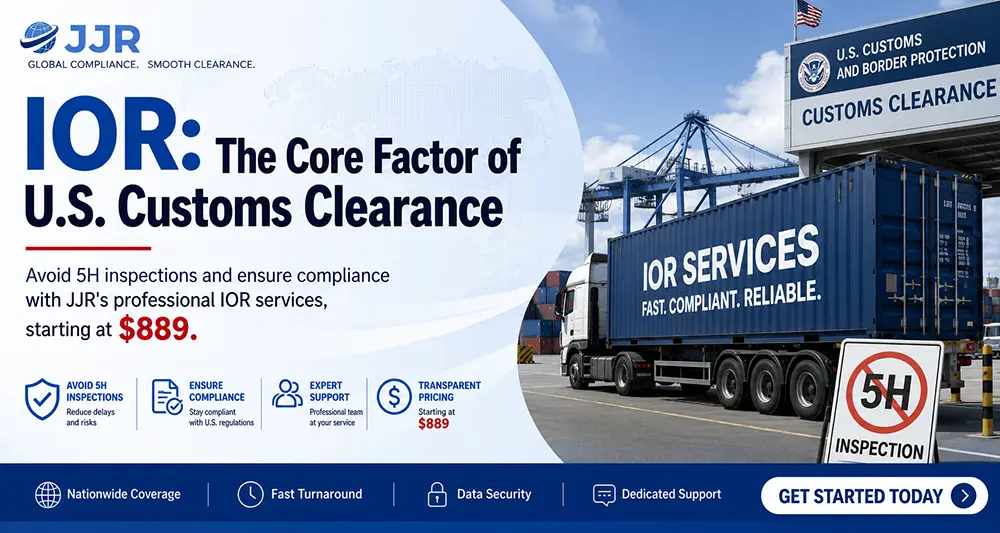
Role of IOR in Customs Clearance Process
Three key parties are involved in U.S. inbound shipments: Shipper, Consignee and Importer of Record.
It is a common misunderstanding that the consignee equals the IOR, which is not always the case. The IOR can be an independent third party, such as a local U.S. enterprise, individual with valid U.S. tax ID or professional IOR service provider.
How IOR Impacts 5H Inspection
IOR status is a critical factor in customs risk assessment. CBP verifies the validity of IOR entity, historical declaration records, violation history and valid Import Entry Bond status.
Defective IOR information will firstly trigger 5H document review. Supplementary documents may be required in moderate cases, and physical inspection will be initiated in severe circumstances.
High-risk IOR Scenarios
The following situations are highly susceptible to customs scrutiny by CBP:
• Nominal IOR usage: The nominated entity does not participate in actual transactions and has no knowledge of cargo details, easily deemed false declaration.
• Duty-paid all-inclusive clearance mode: No formal registered importer or valid bond, with logistics providers handling all procedures. Shipments will be flagged automatically with high 5H and inspection probability.
• Newly-established IOR: Entities without prior import records and credit background face extremely high initial inspection rates and frequent document supplementation requests.
Standards for Compliant IOR
Qualified and reliable IOR possesses the following qualifications:
Legally registered U.S. individual or enterprise, valid EIN tax identification number, valid one-time or annual Import Entry Bond, clean historical customs declaration records, and willingness to take full liability for cargo information.
Adopting compliant IOR effectively reduces 5H review probability, inspection risks and clearance delays.
Practical Operation Suggestions
Do not prioritize low freight cost only. Low-price solutions usually involve nominal IOR declaration and high-risk clearance channels.
Establish exclusive independent IOR identity by registering local U.S. company for long-term stable import business. Always confirm valid Import Entry Bond coverage before shipment.
IOR: Core Factor of Customs Clearance Risks
5H notice serves merely as risk alert, and document defects are superficial issues. IOR qualification fundamentally determines clearance results.
Standard IOR qualification, consistent document information and regulatory-compliant goods ensure smooth customs clearance with fewer 5H reviews, lower inspection rate and steady processing efficiency.
Email:hello@jjrlab.com
Write your message here and send it to us
 Guide to the EN18031 Testing Standard
 Amazon Lithium Battery Smart Home/3C Sellers Can N
 RoHS Compliance Testing Services
 Amazon Toy Seller Exporting to Europe Compliance
US Jewelry Compliance Guide
Amazon Toy Seller Exporting to Europe Compliance
US Jewelry Compliance Guide
 FCC Certification Requirements and Costs for Consu
 EMC Testing Lab IEC 60601 Medical Electrical Safet
 What are the FCC Testing Requirements for Bluetoot
Leave us a message
24-hour online customer service at any time to respond, so that you worry!