



What is an Importer of Record
Basic Concept Explanation
IOR: Importer of Record, the liable party responsible for the entire customs clearance process
EIN: Employer Identification Number, the legal identification certificate for customs clearance
Bond: Customs Bond, guaranteeing the importer’s capability to pay duties and fulfill obligations
IOR (Entity) → EIN (Tax ID) → Bond (Guarantee). All three must belong to the identical entity with consistent information and clear logical connection.
Cross-entity mixed usage is no longer acceptable. Customs inspection may lead to cargo detention or direct shipment return.
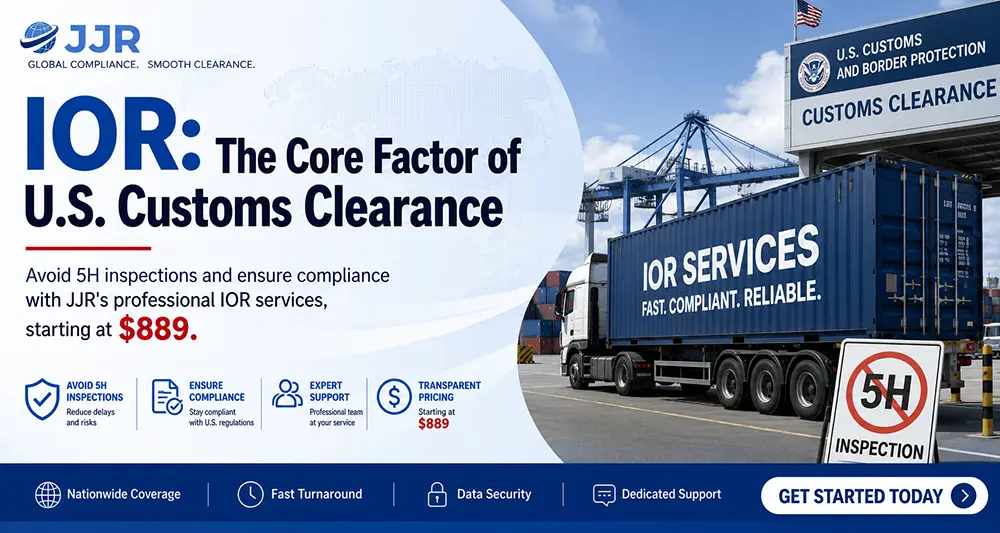
What is an Importer of Record
Definition
The sole legally liable entity throughout customs clearance, all customs inquiries target this entity directly.
Core Liabilities
Responsible for customs declaration, full duty payment, legal cargo import, and bearing all legal & compliance risks.
High-Risk Practices
Borrowing others’ IOR, cross-entity IOR sharing, and entrusting customs brokers to act as IOR are high-risk behaviors.
Qualified IOR Parties
US Registered Company as IOR
US purchasers undertake IOR obligations. They ensure cargo complies with US regulations, submit clearance documents, settle duties and relevant fees, and fulfill all import liabilities.
Chinese Shipper as IOR
Shippers need to purchase Customs Bond to assume clearance liabilities. This model applies to Chinese enterprises without local US entities. US agents are required to complete importer registration formalities.
EIN (Employer Identification Number)
Definition
Exclusive US corporate tax ID and core identity verification document for customs clearance.
Functions
Verify corporate authenticity, tax payment records and violation histories.
Risk Warning
Non-self-owned EIN, mismatched entity information and invalid business records will be judged as shell company identity.
Customs Bond
Definition
Performance guarantee submitted by importers to US Customs. Surety companies compensate losses if importers fail to fulfill obligations.
Core Function
Mandatory requirement for formal customs clearance. Clearance cannot be completed without valid Bond.
Two Bond Types
Single Bond
One bond for one shipment. Suitable for enterprises with 1-2 annual import shipments, flexible and cost-effective.
Bond Amount = Cargo Value + Duties & Taxes
Continuous Bond
Valid for one year and applicable to all US ports. Ideal for long-term stable shipping with higher security.
Bond Amount = 10% of annual total taxes (Minimum quota: 50,000 US Dollars)
Reasons for Stricter Customs Supervision
U.S. Customs and Border Protection (CBP) stipulates clearly: IOR must be the actual cargo owner or buyer. Third-party affiliation and shell company import are illegal.
Customs focuses on three key verification points:
1. Authenticity of import business operation
2. Long-term stable business capacity
3. Risk bearing capability
Common US Customs Clearance Methods
Selection is determined by importers or local US agents.
Clearance under US Consignee’s Name
a. US consignee issues POA power of attorney to local freight agent
b. Consignee provides valid Customs Bond
c. Clearance proceeds with consignee’s Tax ID
Clearance under Shipper’s Name
a. Shipper issues POA to departure port freight forwarder and forwards to US agent
b. Shipper purchases Customs Bond
c. US agent assists shipper in applying for IOR number
d. Clearance completed with valid US tax ID
Q&A Session
Compliance verification standards keep tightening. CBP intensifies IOR authenticity inspection and restricts clearance modes combining Chinese shippers and irregular Bonds. Only legally registered US entities with self-owned EIN and matching Bond are recognized. Unofficial clearance channels are strictly controlled.
So-called direct shipper declaration mostly involves irregular agency operations such as unauthorized IOR use and fake entity information. Shippers can be actual cargo owners, yet legal IOR must be designated to bear legal liabilities, and the two roles cannot be substituted.
Under updated regulations, relevant requirements become increasingly rigorous. Duties must be paid via US local bank accounts with traceable capital flow. Third-party payment and tax-inclusive packages are strictly supervised with loopholes eliminated.
The industry shifts from channel-oriented clearance to compliance-oriented operation. Independent compliant clearance entity serves as the long-term stable solution.
Email:hello@jjrlab.com
Write your message here and send it to us
 What is the Difference Between EU PPWR and EPR?
 What is Japanese METI Registration
 Exporting to Saudi Arabia Saber Certification: PCo
 How to get a Saudi Arabia MSDS?
 Do I Still Need PPWR Compliance if I Have RoHS?
 Amazon Children's Toys Direct Validation Mandatory
 UL 4200A-2026 Compliance Standard for Button/Coin
 Guide to the EN18031 Testing Standard
Leave us a message
24-hour online customer service at any time to respond, so that you worry!