



2026 CPSC eFiling Process Guide
For all imported consumer products that require CPSC compliance certificates, certificate data must be submitted in advance during U.S. import declarations. The data is electronically transmitted to the CBP ACE system via the PGA Message Set. Only the submission method is updated, and the scope of products requiring certificates remains unchanged. The previous practice of random inspection after arrival is no longer acceptable.
Main Affected Goods
• Most consumer products: Officially effective on July 8, 2026
• Consumer products entering U.S. Foreign Trade Zones (FTZ) for subsequent retail consumption or warehousing: Effective on January 8, 2027
Main Affected Product Categories
CPSC has released an HTS guidance list covering approximately 600 HTS codes. It is explicitly stated that this list does not include all HTS codes subject to electronic certificate requirements. Importers remain responsible for completing eFiling whenever required.
Key Product Categories
1. Children & Maternity Products: Toys, children's furniture, kids' chairs, strollers, infant sleep products, pacifiers, children's apparel, child care products, etc.
2. Daily Consumer Goods: Adult apparel, footwear, mattresses, carpets, floor mats, lighters, costume jewelry, gypsum boards, etc.
3. Outdoor Products: Bicycles, bicycle helmets, All-Terrain Vehicles (ATV), etc.
4. Electrical & Electronic Products: Button cells, coin cells, battery-powered consumer goods, CB antennas, lawn mowers, etc.
5. Flammable Goods, Packaging & Special Controlled Products: Fireworks, matches, child-resistant packaging, poison prevention packaging and related products, etc.
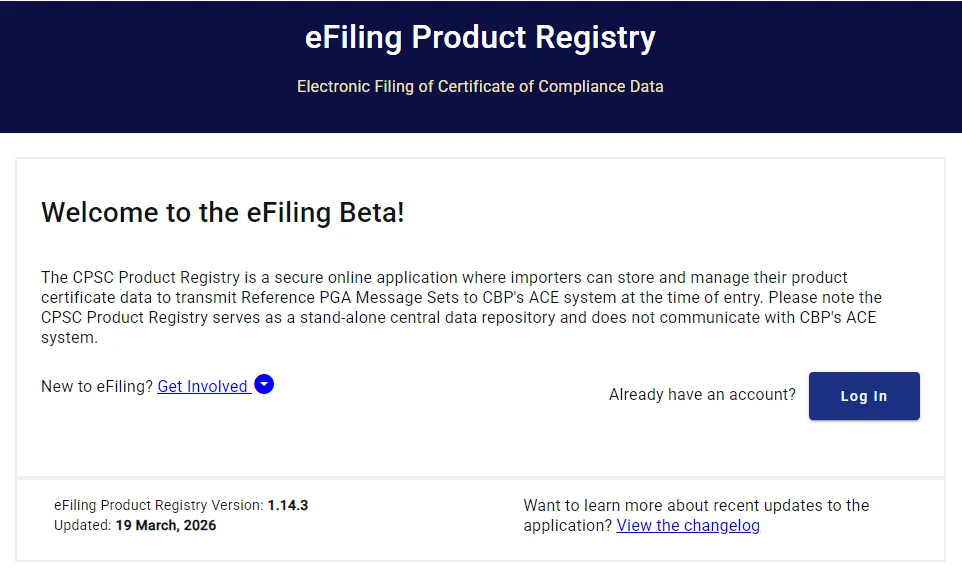
Official CPSC Product Self-Assessment Robot: https://business.cpsc.gov/robot/decision
It is recommended to verify whether your products fall under CPSC supervision via the tool first, then confirm with your customs broker.
Electronic Filing Procedures
Complete the registration following the steps below. Your customs broker can directly retrieve the submitted data afterwards. For low-frequency shipments, you may adopt the full dataset declaration method.
Register for CPSC Product Registry
• CPSC Product Registry Registration Link: https://efiling.saferproducts.gov/efiling/self-registration
• Product Training Video Link: https://www.cpsc.gov/content/Product-Registry-Training-Videos
After registration, you may bulk upload product data via CSV files or API interfaces.
Required Submission Data
The core of CPSC eFiling is submitting compliance certificate data. The authority specifies 7 core data fields for product certificates. Enterprises are advised to establish internal data sheets in advance:
1. Product ID: Product Identifier
2. Citation Codes: Applicable regulations, rules, standards or prohibition codes
3. Manufacture Date: Production Date
4. Manufacture Place: Place of Manufacture
5. Product Test Date: Product Testing Date
6. Testing Laboratory: Information of Testing Laboratory
7. Point of Contact: Contact Person for Testing Records
Three Declaration Methods
1. Full PGA Message Set
Definition: Submit complete product certificate data to the ACE system via PGA Message Set during customs declaration.
Applicable Scenarios: Small-volume imports, one-time imported products, products not registered in the Product Registry, ad-hoc or low-frequency shipments.
Risks: This method contains numerous fields with strict sequence requirements. Data sources are fragmented, leading to a high risk of manual entry errors.
2. Reference PGA Message Set
This method is designed for long-term business operations. Importers or authorized parties first enter and authenticate product certificate data in the CPSC Product Registry. Only three certificate identifiers are required for customs declaration:
• Certifier ID
• Product ID
• Version ID
Applicable Scenarios: Repeated imports of identical products, long-term stable SKUs, regular restocking for cross-border e-commerce, bulk inventory for overseas warehouses/FBA, and multiple shipments covered under a single certificate.
Key Notes: The Product Registry cannot automatically synchronize data with the CBP ACE system. After data entry, importers must provide Certifier ID, Product ID and Version ID to the customs broker for declaration in the ACE system.
3. Disclaim PGA Message Set (Conditional Exemption)
Application: Used when an HTS code is marked by CPSC, while the specific product is exempt from submitting compliance certificate data.
Action Items to Take Now
1. Sort out all active SKUs sold or regularly shipped to the U.S. market
2. Complete the 10-digit HTS code for each product
3. Mark key product categories and confirm whether each SKU requires a CPC/gcc certificate
4. Confirm the responsible importer. The importer or authorized party shall either register data in the Product Registry or prepare data for Full PGA declaration
5. Conduct trial filing with your customs broker. The current phase is voluntary declaration, which will not affect customs performance scores but may trigger routine CPSC inspections.
Q&A
Does eFiling represent a new type of cpsc certificate?
No. It only changes the way certificate data is submitted, instead of adjusting the product scope for mandatory certificates.
Are CPC and gcc certificates still required?
Yes. eFiling is for submitting certificate data, not a replacement for CPC or GCC certificates.
Is it mandatory to register all products in the Product Registry?
No. The Full PGA method allows you to submit complete certificate data directly during customs clearance. Product Registry registration is only required for the Reference PGA method.
Will the Product Registry automatically transmit data to the ACE system?
No. Importers still need to provide Certifier ID, Product ID and Version ID to the customs broker for reference during ACE declaration.
Are products outside the 600 HTS codes exempt from eFiling?
No. The list is not exhaustive. eFiling is mandatory for any product requiring a CPSC certificate.
Are low-value parcels or Section 321 shipments exempted?
No exemption. Electronic certificate data submission is required for all certified products.
Is eFiling required for product samples?
It depends on whether the sample is a regulated imported consumer product that needs certification.
Can Disclaim take the place of a certificate?
No. Disclaim is only applicable to products that are confirmed to be exempt from certificate requirements.
Who bears the ultimate legal liability?
The importer is the ultimate responsible party. Business partners may provide assistance, but liability cannot be transferred.
Is factory participation necessary?
Yes. Most information including production date, manufacturing location, materials, components, batch numbers and product changes are provided by manufacturers.
Can the original Version ID be reused after material replacement or factory relocation?
Not necessarily. A new Version ID or re-testing is generally required for material changes, factory relocation, laboratory updates or certificate revisions (substantial product changes).
What is the top priority at present?
Do not register blindly. First conduct SKU-level screening for all U.S. sales and imported products. Classify products to determine which need CPC/GCC certificates, which adopt Full PGA, which apply Reference PGA, and which qualify for Disclaim.
Email:hello@jjrlab.com
Write your message here and send it to us
 Guide to the EN18031 Testing Standard
 Amazon Lithium Battery Smart Home/3C Sellers Can N
 RoHS Compliance Testing Services
 Amazon Toy Seller Exporting to Europe Compliance
US Jewelry Compliance Guide
Amazon Toy Seller Exporting to Europe Compliance
US Jewelry Compliance Guide
 FCC Certification Requirements and Costs for Consu
 EMC Testing Lab IEC 60601 Medical Electrical Safet
 What are the FCC Testing Requirements for Bluetoot
Leave us a message
24-hour online customer service at any time to respond, so that you worry!