



What is CPSC eFiling
On July 8, 2026, the new U.S. Consumer Product Safety Commission (CPSC) eFiling regulation will be officially enforced. All CPSC-regulated consumer products must complete electronic filing before import customs clearance. Paper certificates will become completely obsolete for the CPSC. This is not simply a transition from "paper to electronic," but a disruptive transformation of the U.S. customs clearance logic—compliance shifts from "post-entry spot checks" to "pre-arrival admission." It fully covers over 600 HTS tariff codes with no $800 exemption. If system integration is not completed in May and June, goods will inevitably be detained at the port.
What is a cpsc certificate?
Many sellers confuse "CPSC Certification" with "CPSC Certificate." First, to clarify: the CPSC is a U.S. federal regulatory agency; it does not issue certificates directly. The certificate is issued by the importer/manufacturer based on compliance testing.
Official Definition
Established in 1972, the CPSC (Consumer Product Safety Commission) has the core responsibility of setting consumer product safety standards, enforcing regulations like cpsia, regulating the safety of over 15,000 consumer products, and protecting consumers from the risk of product-related injuries.
The CPSC Certificate is a declaration of compliance issued by the importer/manufacturer, proving that the product meets the safety standards set by the CPSC. It is a mandatory customs clearance document for products entering the U.S. market.
Core Certificate Types (Must be distinguished; filing must correspond)
(1) CPC Certificate (Children’s Product Certificate)
Applicable products: Products designed or intended primarily for children 12 years of age or younger (toys, baby products, children's clothing, children's furniture, etc.).
Core requirements: Must be issued based on passing test reports from a CPSC-accepted third-party laboratory (e.g., JJR LAB). Mandatory testing includes lead (≤100ppm), phthalates (≤0.1%), physical safety (small parts, sharp edges/points), etc.
Key details: Must be issued entirely in English and specify the applicable CPSC safety rule numbers.
(2) gcc certificate (General Conformity Certificate)
Applicable products: General consumer products not intended for children (adult apparel, electronics, household goods, bicycles, lighters, etc.).
Core requirements: No mandatory third-party testing required (testing is recommended for high-risk products). The importer/manufacturer self-declares compliance with CPSC safety standards. It must also be entirely in English and specify the applicable rule numbers.
Core Functions of the Certificate
Essential for clearance: Before the new rule, it was submitted upon spot checks; under the new rule, electronic data must be mandatorily filed in advance. Without electronic certificate data, customs clearance is impossible.
Compliance traceability: It is the sole compliance credential during CPSC audits, product recalls, and accident accountability.
Liability backing: The importer/manufacturer bears full responsibility for the authenticity of the certificate. Falsification will result in hefty fines (up to $15 million per violation), confiscation of goods, and criminal prosecution.
Which Categories are Covered by eFiling?
The new rule covers all consumer products regulated by the CPSC that require a CPC/gcc certificate, involving 600+ HTS tariff codes, with absolutely no exemptions (including low-value packages under $800, samples, and FBA goods). Imported goods in Foreign Trade Zones (FTZ) are granted a grace period until January 8, 2027.
Core Covered Categories (9 major popular categories; sellers must self-check)
(1) Toys (High risk, 100% coverage)
Ordinary toys, educational toys, plush toys, electronic toys, building blocks, RC cars, etc. (HTS 9501, 9502, 9503, etc.).
Mandatory requirements: CPC Certificate + third-party lab test report (physical/mechanical, flammability, heavy metals).
(2) Children's / Baby Products (High risk, 100% coverage)
Cribs, high chairs, baby walkers, pacifiers, baby bottles, children's tableware, strollers, safety seats, children's stationery, etc. (HTS 3926, 9403, 8715, etc.).
Mandatory requirements: CPC Certificate + full safety testing (lead, phthalates, small parts, structural stability).
(3) Apparel, Footwear, and Bags (Full coverage for adults + children)
Children's clothing, sleepwear, children's accessories; adult clothing, underwear, swimwear, hats, gloves, belts, luggage, shoes, etc. (HTS 6101-6117, 6201-6217, 6401-6406, etc.).
Mandatory requirements: Children's apparel requires CPC Certificate + flammability/lead testing; adult apparel requires GCC Certificate.
(4) Home and Furniture (Full coverage)
Children's furniture (cribs, children's tables and chairs), adult furniture (mattresses, sofas, tables and chairs, wardrobes), carpets, curtains, bedding, kitchenware, bathroom accessories, etc. (HTS 9401-9404, 5701-5705, 6301-6307, etc.).
Mandatory requirements: Children's furniture CPC + structural/flammability testing; adult furniture GCC.
(5) Electronics (Full coverage)
Small appliances (hair dryers, rice cookers, irons), consumer electronics (headphones, chargers, batteries, lighting, smartwatches), children's electronic toys, etc. (HTS 8504, 8508, 8517, 9503, etc.).
Mandatory requirements: GCC Certificate; batteries must additionally comply with CPSC battery safety standards.
(6) Sports and Outdoors (Full coverage)
Bicycles, children's bicycles, helmets, skateboards, roller skates, camping gear, fitness equipment, etc. (HTS 8712, 9506, 9507, etc.).
Mandatory requirements: Bicycles/helmets GCC + safety testing; children's models require CPC.
(7) Holiday / Fireworks (High risk)
Fireworks and firecrackers, party supplies, candles, lighters, etc. (HTS 3604, 9613, etc.).
Mandatory requirements: GCC Certificate + flammability/safety testing.
(8) Accessories / Daily Necessities (Full coverage)
Imitation jewelry, children's accessories, button batteries, nail art supplies, cosmetics (partial), cleaning supplies, etc. (HTS 7117, 8506, 3304, etc.).
Mandatory requirements: Children's accessories CPC + lead testing; adult accessories GCC.
(9) Other High-Risk Categories
Lawnmowers, power tools, drywall, building decoration materials, etc. (HTS 8433, 8467, 6809, etc.).
Absolute Exemption Categories (Only 2 categories; all others require filing)
Food, drugs, medical devices (Regulated by FDA, not CPSC).
Motor vehicles, automotive parts (Regulated by NHTSA, not CPSC).
Seller Self-Checklist (Verify immediately to avoid omissions)
Does the product belong to the 9 major categories above?
Is the product intended primarily for children 12 and under? (Yes → CPC, No → GCC)
Is the HTS code on the CPSC's published list of 600+ codes? (Can be queried on the CPSC official website)
Are there low-value/sample/FTZ import situations? (Low value is not exempt; FTZ grace period until 2027)
Practical Steps for CPSC Certificate eFiling (2 Methods, From 0 to 1 Implementation)
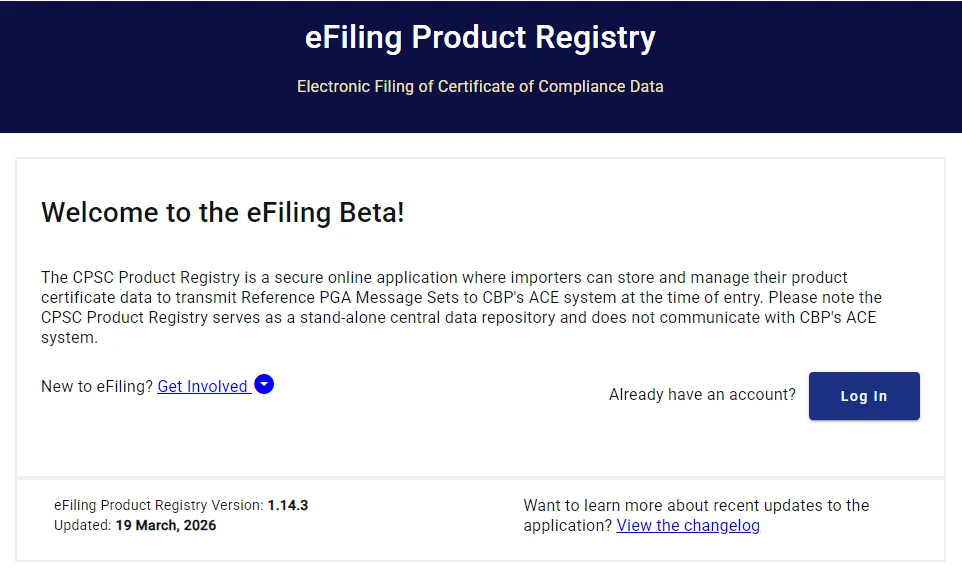
The core of eFiling is electronically filing the 7 core data elements of the CPC/GCC certificate through the CBP's ACE system. The CPSC provides 2 filing methods, and sellers can choose based on their shipping frequency.
Pre-Filing Preparation (5 Essential Documents, prepare 4-8 weeks in advance)
(1) Enterprise Qualifications
U.S. Importer Tax ID (EIN) / Chinese Enterprise Business License
Registered account on the CPSC official website (https://www.cpsc.gov/)
Customs broker authorization document (authorizing the broker to submit data)
(2) Product Compliance Documents
Valid CPC/GCC certificate (fully in English, containing 7 core data elements)
Third-party laboratory test report (mandatory for children's products, recommended for adult products)
Product label photos (including manufacturer name, address, batch number)
(3) 7 Core Filing Data Elements (All are indispensable and must match the certificate)
Product ID: GTIN/UPC/SKU/Model (Unique identifier, consistent with the goods)
Citation Code: Applicable CPSC safety standard number (e.g., 16 CFR Part 1110, ASTM F963)
Manufacture Date: Accurate to the year, month, and day (different batches must be filed separately)
Manufacture Location: Full name of the factory + detailed address (accurate to the city)
Test Date: Year, month, and day of the most recent compliance test
Testing Laboratory: Full name + ID number of the CPSC-accepted laboratory
Contact Information: Name, phone number, and email of the person responsible for the importer/manufacturer (for traceability)
Method 1: Single Filing (Full PGA Message Set, suitable for small batch / occasional shipments)
Core logic: Before each shipment clears customs, submit the complete 7 data elements via the ACE system. No need to pre-register the product.
Pros: No pre-registration required, flexible operation, suitable for samples, small batches, and inconsistent shipping.
Cons: The 7 data elements must be repeatedly entered for each shipment; inefficient and error-prone.
Practical Steps (Completed in 5 steps)
Step 1: Organize Data. According to the 7 core data list, verify the CPC/GCC certificate against the test report to ensure information matches and has no errors.
Step 2: Entrust Customs Broker. Send the 7 data elements, certificate, and test report to the partnered customs broker, and sign the electronic filing authorization.
Step 3: Enter into ACE System. The customs broker logs into the CPSC eFiling module via CBP's ACE system, enters the complete 7 data elements, and uploads the electronic certificate.
Step 4: Data Verification. The system automatically verifies data completeness and compliance. If passed, it generates an electronic filing receipt; if failed, it must be corrected and resubmitted.
Step 5: Customs Clearance and Release. Upon the goods' arrival at the port, CBP retrieves the electronic filing data via the ACE system. After verifying it is correct, the goods are released; without electronic data → detained at port / inspected.
Method 2: Registry Filing (Reference PGA Message Set, recommended for long-term / stable shipments)
Core logic: Pre-enter product data into the CPSC Product Registry to obtain 3 core IDs. For subsequent shipments, only the IDs need to be submitted without repeatedly entering the full data.
Pros: Register once, reuse multiple times; high efficiency, low error rate, the preferred choice for long-term shipping; registered data is permanently valid and can be updated anytime.
Cons: Registration must be completed 4-8 weeks in advance; the initial setup is slightly complex.
Practical Steps (Completed in 6 steps, long-term benefits)
Step 1: Register CPSC Enterprise Account. Visit the CPSC official website (https://www.cpsc.gov/), click "Register," fill in enterprise info (name, address, EIN, contact person), complete email verification, and activate the account.
Step 2: Create Product Profile. Log into the account, enter the "Product Registry" module, click "Add New Product," and enter basic product info (name, model, HTS code, Product ID).
Step 3: Upload Compliance Documents. Upload the CPC/GCC certificate (English PDF), third-party test report (PDF), and product label photos. The system automatically validates document format and validity.
Step 4: Enter 7 Core Data Elements. According to the checklist, enter the Product ID, citation code, manufacture date, manufacture location, test date, lab info, and contact person. Submit after confirming accuracy.
Step 5: Obtain 3 Core IDs (Crucial!)
Certifier ID: Enterprise's unique certification ID (long-term valid)
Product ID: Product's unique ID (different models/specs require separate generation)
Version ID: Product version ID (new ID generated after updating data)
Save the 3 IDs for direct use in future filings.
Step 6: Per-Shipment Filing (Only 3 steps, done in 1 minute)
Provide the Certifier ID, Product ID, and Version ID to the customs broker.
The customs broker enters the 3 IDs into the ACE system; the system automatically retrieves the pre-registered full data to complete the electronic filing.
Verify the receipt, clear customs, and release.
Timeline Planning (Must be completed in May-June, countdown to enforcement)
Now to End of May: Complete product self-check, compliance document organization, enterprise account registration, product profile creation, data entry, and review.
June 1 - June 30: Complete system integration testing, customs broker authorization, and mock filing to ensure no errors or omissions.
July 1 - July 7: Official filing drill, troubleshoot anomalies, ensuring all goods clear customs normally starting July 8.
Major Impacts of Failing to File Electronically on Time (6 Fatal Consequences, No Room for Luck)
The CPSC clearly stated: Initially, entry won't be directly denied, but it will trigger the highest level of risk warning, the consequences of which are more severe than detained goods. A single violation leads to long-term impact, with no shortcut for remediation.
1. Port Congestion / Skyrocketing Inspection Rates (90% Probability)
Unfiled / Incomplete Data → System flags as high risk, inspection rate jumps from single digits to 50%-100%, almost every shipment inspected.
Inspection cycle is 7-60 days, generating high demurrage fees ($150-$300 / container / day), storage fees, and overstay fees. For small batches, costs may exceed the value of the goods.
Data discrepancies / Falsification → Direct detention / confiscation, goods cannot be retrieved, complete loss of freight costs.
2. Clearance Delays, Missing Sales Windows
Normal clearance takes 1-3 days; delays after violations take 2-8 weeks. During peak seasons (Black Friday, Christmas, Prime Day), goods cannot be listed in time, losing 30%-50% of annual sales.
Cross-border e-commerce sellers may face store stockouts, listing removals, plummeting rankings, and lowered account weight, impacting store traffic long-term.
3. Compliance Blemish, Long-Term Intensive Monitoring (Fatal)
Violation records are permanently stored in the CPSC database. The enterprise/importer is placed on a high-risk list. All subsequent shipments (including compliant ones) will face continuous high-frequency inspections, permanently reducing clearance efficiency.
Once the risk score increases, it cannot be erased. Subsequent shipping costs will rise, timeframes will extend, gradually losing competitiveness in the U.S. market.
4. Hefty Fines + Legal Accountability
Unfiled / Falsification → Violates CPSIA regulations. The maximum fine per single violation is $15 million, accumulated based on the quantity/frequency of non-compliant goods.
Severe cases (repeated falsifications, major safety hazards) → Criminal liability pursued, enterprise executives face imprisonment.
5. Low-Value Packages Suffer the Same (No Exemption)
Small parcels under $800, samples, and Section 321 duty-free clearance goods are not exempt. Unfiled goods will also face port congestion/inspection. Cross-border sellers relying on the small parcel model will face a structural impact.
6. Restrictions on Platforms like Amazon
Amazon requires sellers to provide CPSC compliance certificates. Unfiled electronically → Certificate is invalid → Listings removed, inventory disposed of, account frozen.
Platform compliance audits are becoming stricter; non-compliant sellers will be expelled from the U.S. market.
Seller Emergency Action Checklist (Execute Immediately to Avoid Losses)
Self-Check Products: Verify if they are on the 600+ HTS code list and distinguish between CPC/GCC types.
Organize Compliance Documents: Complete CPC/GCC certificates and third-party test reports (mandatory for children's products).
Register CPSC Account: Complete enterprise account registration and product profile creation before the end of May.
Enter Core Data: Complete the entry and review of the 7 core data elements and obtain the 3 core IDs before mid-June.
Connect with Customs Broker: Complete system integration, authorization, and mock filing before the end of June.
Risk Troubleshooting: Identify and promptly correct issues such as data errors, expired certificates, and invalid test reports.
(Note: The original text repeats the sections below. The translation continues to reflect this one-to-one duplication).
Email:hello@jjrlab.com
Write your message here and send it to us
 What is an EU SDS (Safety Data Sheet)?
 What is the CA Prop 65 Warning Label?
 2026 Amazon TIC Mandatory Audit Catalog
 Australian Electrical EESS and RCM Compliance
 How to get Vietnam CR Certification
 What is a UN 38.3 Battery Test Report
 What is the UN38.3 Certification Test?
 What is a Lithium Ion Battery Certification
Leave us a message
24-hour online customer service at any time to respond, so that you worry!