



What is an FCC Registered Agent?
Recently, there has been a significant increase in inquiries from sellers regarding United States Agents. Below, JJR provides a detailed interpretation of key knowledge related to United States Agents.
What is a United States Agent?
While it has multiple common names, its official title is United States Agent.
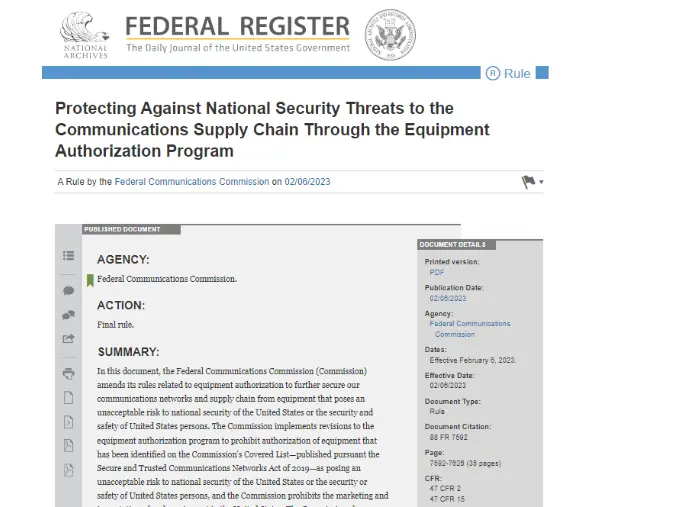
Regulations by U.S. authorities such as the FDA (Food and Drug Administration), fcc (Federal Communications Commission), and CPSC (Consumer Product Safety Commission) mandate that foreign sellers engaged in sectors including medical devices, cosmetics, food, pharmaceuticals, laser products, wireless devices, children's toys, and maternal and infant products must complete registration and appoint a United States Agent before entering the U.S. market. This representative is responsible for communication during emergencies and daily affairs.
A United States Agent is not a sales agent but a bridge between foreign enterprises, U.S. regulatory authorities, and consumers. Their responsibilities include assisting foreign enterprises in completing relevant audits, submitting documents, transmitting information, facilitating communication with regulatory bodies, providing feedback, and resolving issues to ensure products meet U.S. standards.
Therefore, sellers offering relevant products on e-commerce platforms such as Amazon and TEMU must also comply with local U.S. regulations and provide valid United States Agent information.
Qualifications of a United States Agent
A United States Agent must maintain a physical business location in the U.S. and be available to answer calls or receive correspondence during normal U.S. business hours. Non-compliant contact methods (e.g., email-only, voicemail, or personal addresses) are not acceptable.
U.S. regulatory agencies including the FDA, FCC, and CPSC may contact the United States Agent at any time. For representatives providing false information, these agencies will require the enterprise to submit accurate details, failing which penalties (including revocation of factory registration) may be imposed.
Responsibilities of a United States Agent
① Liaison Point: Serve as the designated representative to facilitate communication between regulatory authorities (FDA, FCC, Amazon/CPSC, etc.) and cross-border sellers. Receive and relay all official notifications and information (e.g., FDA inspection notices, application review letters, warning letters).
② Emergency Response: Coordinate communication between regulatory bodies and foreign enterprises during emergencies (e.g., product recalls, public health crises).
③ Example: Rapidly transmit recall notices and assist enterprises in executing recall procedures.
④ Document Delivery: Receive and forward all official documents from regulatory authorities to ensure foreign enterprises promptly understand and respond to requirements.
⑤ Example: Accept FDA registration certificates and marketing approval letters.
⑥ Information Updates: Maintain up-to-date registration information (contact details, product lists, etc.) for foreign enterprises in FDA, FCC, and CPSC databases.
⑦ Example: Assist in updating enterprise registration information and submitting annual reports.
⑧ Regulatory Consultation: Provide compliance consulting services to help foreign enterprises understand and adhere to FDA, FCC, and CPSC requirements, ensuring market access compliance.
⑨ Example: Address inquiries about FDA registration processes and regulatory changes.
⑩ Mandatory Registration Information: The U.S. Representative’s name, address, and phone number must be included in FDA, FCC, and CPSC registration records. The representative shall assume corresponding responsibilities in the event of product-related incidents.
Role of a United States Agent
The role of a United States Agent is highly similar to that of a european authorized representative (EC REP), UK Responsible Person (UK RP), or Swiss Authorized Representative. A key difference is that the U.S. Representative does not need to be listed on medical device labels—their name and contact information only appear in registration records on FDA, FCC, and CPSC official websites.
As a communication bridge between regulatory authorities and overseas factories, the United States Agent handles emergencies and daily communications, and must be available to answer calls from regulatory bodies at all times.
The representative acts on behalf of the overseas factory: statements made by the representative are deemed as those of the factory, and information or documents provided to the representative are equivalent to being provided directly to the factory.
Which Sellers Need to Register a United States Agent?
Sellers must register a United States Agent if:
① They sell products in the U.S. market;
② Their products require compliance with U.S. certification standards (e.g., FCC, CPSC, FDA, EPA, Energy Star);
③ The product manufacturer is located outside the United States.
Applicable Scope:
① FCC-Certified Radio Products:
WiFi devices, Bluetooth devices, mobile phones, computers, fax machines, electronic equipment, radio transmitters/receivers, radio-controlled toys, telephones, etc.
② CPC-Certified Children’s Products:
Toys, cradles, baby carriers, children’s clothing, etc.
③ FDA-Certified Products:
Medical devices, cosmetics, food, alcohol, pharmaceuticals, laser products, etc.
④ EPA-Certified Products:
Pesticide products (insecticides, rodenticides, herbicides, fungicides, repellents, antimicrobial pesticides) and pesticide devices (UV devices, sound emitters, insect traps, ground vibrators, water treatment equipment, air treatment equipment, etc.).
⑤ Energy Star-Certified Products:
Televisions, refrigerators, freezers, washing machines, room air conditioners, central air conditioners, dishwashers, water heaters, ceiling fans, pool heaters, heat pumps, furnaces, boilers, etc.
Potential Risks of Not Having a United States Agent
Exports of children’s toys, electronic products, and other goods to the U.S. are subject to random inspections by U.S. Customs and other government agencies. These agencies may require exporters to provide United States Agent contact information and other necessary documents. Failure to provide such information may result in:
① Cargo detention by Customs or legal proceedings;
② Fines or bans on product sales;
③ Restrictions on store operation rights.
U.S. authorities and major e-commerce platforms (Amazon, Temu, etc.) are strengthening compliance inspections. Sellers must attach great importance to appointing a United States Agent promptly to avoid risks such as cargo seizure and product removal.
Important Note: There is no transition period for this rule. All products requiring authorized certification—including those pending application updates—must submit certification and representative documents.
Are Certificates or Contracts Required for a United States Agent?
U.S. regulatory agencies (FDA, FCC, CPSC, etc.) do not provide certification processes for United States Agents, nor do they require submission of contract copies. However, enterprises must sign a formal agreement/contract with the representative to clarify their legal role and responsibilities.
Mandatory Contract Terms:
① Scope of services;
② Service term (including specific start and end dates);
③ Termination clauses;
④ Consulting fees for U.S. representative services (typically \(250–\)2,000 per year);
⑤ Additional consulting fees (if applicable) for FDA communications with the representative;
⑥ Party responsible for paying FDA user fees (2024 FY FDA user fee: $7,653);
⑦ Representative’s commitment to directly report complaints to the enterprise, especially those involving public health risks, serious injuries, or fatalities;
⑧ Confidentiality clauses or references to separate non-disclosure agreements (note: the representative may be required by law to disclose information to the FDA, but must notify the enterprise first);
⑨ Representative’s full name, address, phone number, and email;
⑩ Enterprise’s full name, address, phone number, and duns number;
⑪ Enterprise contact person’s name, title, address, phone number, and email;
⑫ Designation of the "Official Correspondent" in FDA registration databases;
⑬ Signatures and dates.
A United States Agent does not need to be a legal entity, but a "company name" is required during account creation. An EIN (Employer Identification Number) is not mandatory, and a DUNS number is optional. See the example screenshot below for the account creation form.
How to Apply for a United States Agent?
Application Process:
(1) Select a Compliant Representative
First, identify a qualified United States Agent (typically a U.S.-registered company) with extensive experience and familiarity with FDA, FCC, and CPSC policies. (JJR China Laboratory provides integrated, reliable, and efficient United States Agent services.)
(2) Submit Application Documents
Provide materials including manufacturer information, product details, registration certificates, and production qualifications. The representative will evaluate your eligibility based on these documents.
(3) Sign the Representation Agreement
Upon approval, sign a formal agreement with the United States Agent to clarify the rights and responsibilities of both parties, ensuring smooth subsequent operations.
(4) Validity Period
The United States Agent agreement is valid for 1 year (one full calendar year). Renewal applications can be submitted before expiration to maintain continuous FDA, CPSC, and fcc compliance.
Email:hello@jjrlab.com
Write your message here and send it to us
 How to get an EN 301 893 test report?
 What is EN 301 893 Certification Compliance
 What is the CSA 62368-1 Standard?
 Canadian Pacifier Compliance SOR/2016-184
 US Agent for FCC & EC REP for CE: Compliance R
 What is Recycling of WEEE
 What is PPWR Packaging Compliance
What is Extended Producer Responsibility
What is PPWR Packaging Compliance
What is Extended Producer Responsibility
Leave us a message
24-hour online customer service at any time to respond, so that you worry!