



What is EU CE-RED Directive Certification?
What is CE-red directive Certification?
"CE" stands for Conformité Européenne, a mandatory conformity marking for products entering the European market, acting as the product’s "passport" to Europe. RED, short for Radio Equipment Directive, is a specific category within the EU’s mandatory CE certification framework, tailored exclusively for radio equipment. It was officially published by the European Union on May 22, 2014.
The CE-RED Directive is a regulation issued by the EU governing electronic and radio equipment. Its full name is the Radio Equipment Directive, commonly referred to as the RED Directive.
Which Products Require CE-RED Directive Certification?
The CE-RED Directive covers all equipment designed for radio communication or identification, including but not limited to the following categories:
① Short-range radio products: Such as remote-controlled toys, smart home devices (doorbells, switches), Bluetooth headsets, Wi-Fi routers, etc.
② Professional radio equipment: Such as walkie-talkies, wireless microphones, wireless monitoring devices, etc.
③ Internet-connected devices: Such as mobile phones, tablets, smart wearables, industrial Internet of Things (IoT) devices, etc.
④ Other radio equipment: Such as RF remote controls, GPS devices, Radio Frequency Identification (RFID) devices, etc.
Important Reminder: Any product with wireless transmission frequency, regardless of its power output, must obtain CE-RED certification.
CE-RED Directive Certification Test Items
1. Electrical Safety Testing
① Clearance testing: Verifies whether the spacing between live components inside the product and the outer casing complies with the requirements of the EU low voltage directive (LVD).
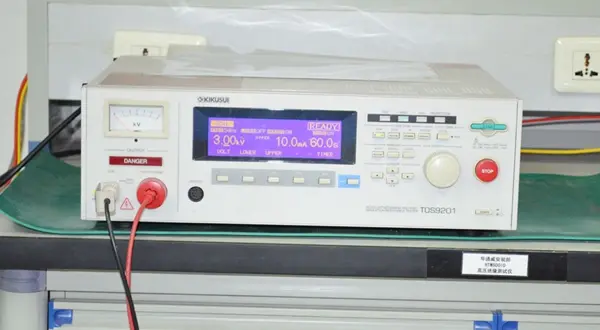
② Dielectric Strength Testing: Tests the product’s ability to withstand specified high voltages to ensure no hazard to users.
③ Earthing Testing: Evaluates the product’s earthing performance to guarantee user safety during operation.
④ Mechanical Performance Testing: Checks if the product’s mechanical strength and stability meet the requirements of the EU Machinery Directive (MD).
2. Radio Testing
① Electromagnetic Radiation Testing: Measures the electromagnetic radiation emitted by the product during operation to ensure compliance with EU Electromagnetic Compatibility (EMC) requirements.
② Immunity Testing: Assesses the product’s ability to operate normally under external electromagnetic interference, in line with EU EMC requirements.
③ Harmonic and Current Leakage Testing: Detects harmonic emissions and current leakage during product use to meet EU EMC requirements.
3. radio frequency testing
① Frequency Range Testing: Confirms that the product’s operating frequency range adheres to the specifications outlined in EU directives.
② Transmission Power Testing: Verifies that the product’s transmission power meets the requirements specified in EU directives.
③ Frequency Stability Testing: Ensures the product’s frequency remains stable, complying with EU directive requirements.
4. Product reliability testing
① Long-term Operation Testing: Validates the product’s stability and reliability during extended periods of use.
② High-temperature Testing: Tests the product’s functionality under high-temperature conditions.
③ Low-temperature Testing: Tests the product’s functionality under low-temperature conditions.
④ High-humidity Testing: Tests the product’s functionality under high-humidity conditions.
⑤ Low-humidity Testing: Tests the product’s functionality under low-humidity conditions.
5. Product Electromagnetic Safety Testing
① Electromagnetic Field Strength Testing: Assesses the risk of electromagnetic interference posed by the product to humans and other devices.
② Electrostatic Discharge (ESD) Testing: Checks if the product generates electrostatic discharge that could endanger users or other equipment.
6. Product Material Testing
① Restricted Hazardous Substances Testing: Detects whether the materials used in the product comply with the restrictions on hazardous substances specified in the EU RoHS Directive.
② Packaging Material Testing: Verifies that the product’s packaging materials meet the requirements of relevant EU directives.
CE-RED Directive Certification Process
1. Define Product Scope: First, confirm whether the product falls within the scope of the CE-RED Directive, and identify the specific directives and standards that must be met.
2. Prepare Technical Documentation: Compile documents including product manuals, circuit schematics, block diagrams, electromagnetic compatibility reports, etc. These documents must provide a detailed description of the product’s technical characteristics and conformity.
3. Select a Certification Body: Choose a certification body accredited by the EU for cooperation. Ensure the body has the relevant qualifications and certification scope to guarantee the validity and reliability of the certification.
4. Submit Application: Submit the certification application to the selected body, along with the technical documentation and other relevant materials. Follow the application procedures and timelines required by the body, and note any applicable fees and considerations.
5. Product Testing: The certification body conducts testing on the product, including emc testing, lvd testing, RF testing, and cybersecurity assessment.
6. Review and Evaluation: The body reviews and evaluates the technical documentation to ensure the product meets all relevant requirements. Promptly address any delays or requests for supplementary materials to ensure a smooth certification process.
7. Certificate Issuance: If the product passes all tests and reviews, the certification body issues the CE-RED certification certificate. After receiving the certificate, mark and promote the product in accordance with the body’s requirements to ensure its legality and competitiveness in the European market.
Email:hello@jjrlab.com
Write your message here and send it to us
 What is EN 61000 Certification Compliance?
 How to get an EN 61000 Test Report?
 What is the Amazon EN 55035 Standard?
 What is EN 55035 Certification Compliance?
 How to get the EN 55035 Test Report?
 What is the Amazon EN 301 489 Standard?
 How to get an EN 301 489 Test Report?
 What is EN 301 489 Compliance Certification?
Leave us a message
24-hour online customer service at any time to respond, so that you worry!