



What is the UN38.3 Certification Test?
What is the un38.3 certification Test?
un38.3 is a dedicated testing standard for lithium batteries found in the United Nations Manual of Tests and Criteria for the Transport of Dangerous Goods.
Core Purpose: To simulate extreme scenarios that lithium batteries may encounter during cross-border transportation—such as high and low temperatures, low pressure, impact, short circuits, overcharging, and over-discharging. This validates that the batteries will not catch fire, explode, or leak, thereby ensuring transportation safety.
Core Principle: As long as a product contains lithium batteries or lithium metal batteries and requires international transportation, un38.3 testing is generally mandatory.
Which Products Must Undergo un38.3 testing?
1. Various Lithium Battery Cells / Battery Packs (Mandatory for standalone transportation)
Lithium-ion batteries: Universal rechargeable lithium batteries for mobile phones, laptops, tablets, and power banks.
Lithium polymer batteries: Soft-pack batteries for Bluetooth earphones, smart wearables, and small digital devices.
Lithium metal batteries (Primary lithium batteries): Non-rechargeable lithium batteries specifically for watch button cells, cameras, sensors, and medical equipment.
Power battery packs: Battery modules for electric bicycles, drones, power tools, and balance boards (hoverboards).
Energy storage batteries: Portable energy storage, residential energy storage, UPS backup power, and small photovoltaic energy storage batteries.
2. Terminal Finished Products with Built-in Lithium Batteries (Mandatory for complete machine export)
Consumer electronics: Mobile phones, tablets, laptops, Bluetooth earphones, smartwatches, smart bands, and mobile power sources (power banks).
Mobility and commuting: Electric scooters, balance boards, electric bicycles, and small mobility robots.
Industrial smart devices: Drones, handheld power tools, smart robots, and security equipment.
Medical equipment: Portable medical detectors, monitoring equipment, and home physiotherapy lithium battery devices.
Energy storage power supplies: Outdoor portable energy storage, emergency backup power supplies, and small energy storage stations.
Common Misconceptions Reminder
It is not just high-power batteries that require testing; small button lithium batteries and micro wearable batteries also require compliance testing for cross-border transportation.
When exporting finished products with batteries, there is no need to remove the battery for separate testing; the complete machine can directly undergo UN38.3 testing.
Very few special batteries with ultra-low capacity and ultra-low lithium content can be exempted, but the vast majority of commercial lithium battery products do not qualify for exemption.
UN38.3 Safety Tests
T1: Altitude Simulation Test (Low-Pressure Test)
Test Scenario: Simulates the low-pressure environment of high-altitude aircraft flight.
Test Conditions: Simulates an environment with an altitude exceeding 4,500 meters and an air pressure of ≤11.6 kPa, held continuously for 6 hours.
Assessment Purpose: To inspect whether the battery will experience internal pressure imbalance, swelling, leakage, explosion, or fire under high altitude and low pressure, eliminating safety hazards in air freight.
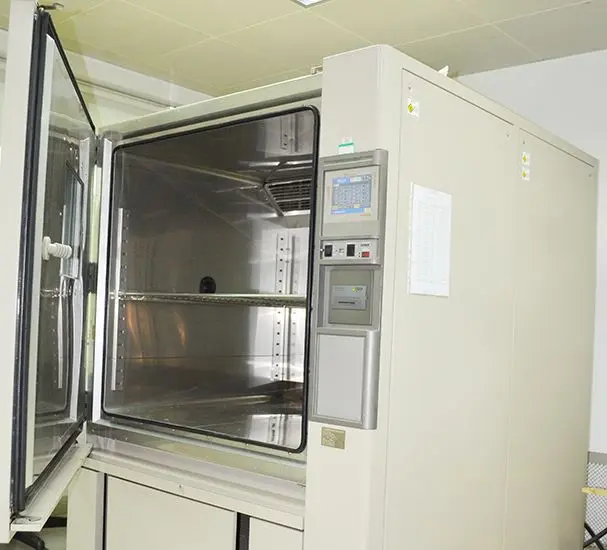
T2: Thermal Test (High and Low-Temperature Shock)
Test Scenario: Simulates extreme temperature difference environments, such as sun exposure, severe cold, and sudden temperature changes during cross-border transportation.
Test Conditions: Rapid switching between an extremely low temperature of -40°C and a high temperature of 72°C, completing the temperature change within 30 minutes, repeated for 10 cycles.
Assessment Purpose: To verify the stability of the battery cell, casing, and internal structure, preventing internal short circuits, performance failure, or spontaneous combustion risks caused by severe temperature fluctuations.
T3: Vibration Test
Test Scenario: Simulates the continuous bumps and vibrations experienced throughout truck, airplane, and maritime transportation.
Test Conditions: Continuous vibration at a fixed frequency and fixed amplitude, covering the vibration conditions of the entire transportation journey.
Assessment Purpose: To detect hidden dangers such as loose battery solder joints, detached wiring, and internal cell misalignment, preventing sudden failures during transportation.
T4: Shock Test
Test Scenario: Simulates impacts from loading, unloading, stacking, bumps, and drops during transportation.
Test Conditions: Applying a rigid impact to the battery according to a standard force.
Assessment Purpose: To verify the battery's resistance to mechanical impact, preventing internal structural damage or hidden short circuits after collisions, and eliminating the risk of subsequent fire or explosion.
T5: External Short Circuit Test
Test Scenario: Simulates an external short circuit caused by the accidental contact of the battery's positive and negative terminals or contact with metal debris during transportation.
Test Conditions: In a high-temperature environment of 55°C, forcing a short circuit on the battery using a resistance of ≤0.1Ω until the temperature drops back and stabilizes.
Assessment Purpose: To inspect the short-circuit resistance of the battery protection board and cells. Qualifying standard: No fire, no explosion, and no continuous high-temperature thermal runaway.
T6: Impact / Crush Test
Test Scenario: Simulates goods being stacked and crushed, or heavy objects dropping and impacting the battery.
Test Conditions: Heavy hammer impact for cylindrical batteries; unidirectional crushing with a force of 13 kN applied to prismatic/soft-pack batteries.
Assessment Purpose: To assess the battery's ultimate compression and impact resistance capabilities. Qualifying standard: No rupture, disintegration, or fire within 6 hours after the test.
T7: Overcharge Test
Test Scenario: Simulates overcharging caused by charger malfunction or BMS (Battery Management System) protection failure.
Test Conditions: Charging continuously for 24 hours at 2 times the maximum charging current and 2 times the charging cut-off voltage.
Assessment Purpose: To verify the safety of the battery under an extreme overcharged state. Qualifying standard: Observed for 7 days; considered qualified only if there is no disintegration, fire, or explosion.
T8: Forced Discharge Test
Test Scenario: Simulates forced over-discharging caused by circuit faults or equipment abnormalities.
Test Conditions: Connecting to a 12V DC power supply to force a deep discharge of the battery.
Assessment Purpose: To detect hidden dangers such as cell failure, swelling, and thermal runaway after battery over-discharge. Qualifying standard: No safety issues during a 7-day observation period.
IV. Summary: Why is UN38.3 Certification Important?
Essential for Customs Clearance: Providing a un38.3 test report is mandatory for the cross-border air, sea, and land transportation of all lithium battery products; it serves as a universal pass for international transportation.
Risk Mitigation: The eight rigorous tests cover extreme risks across all transportation scenarios, proactively identifying fire and explosion hazards in batteries and avoiding transportation safety accidents.
Necessity for Compliance: For cross-border e-commerce, foreign trade orders, and overseas customs clearance spot checks, UN38.3 is a core compliance document. Its absence will lead directly to goods being detained or returned.
Email:hello@jjrlab.com
Write your message here and send it to us
 How to get Vietnam CR Certification
 What is a UN 38.3 Battery Test Report
 What is the UN38.3 Certification Test?
 What is a Lithium Ion Battery Certification
 What is a UN38.3 Test Certificate?
 Biokompatibilität ISO 10993
How to get EU UFI Registration?
Biokompatibilität ISO 10993
How to get EU UFI Registration?
 What is Italian DM 21/03/73 Certification?
Leave us a message
24-hour online customer service at any time to respond, so that you worry!