



Guide to Laser Product Safety Standard EN 60825-1
As technology continues to advance, the applications of laser technology are becoming increasingly widespread across various fields. Whether in medical care, industrial manufacturing, or consumer electronics, lasers play an important role. However, the high-energy characteristics of lasers also pose potential safety risks. To ensure the safe use of laser products, the International Electrotechnical Commission (IEC) developed the EN 60825-1 standard.
Updates to EN 60825-1 Standard
As of June 21, 2023, the updated version EN 60825-1:2014/A11:2021 became mandatory. This version introduces new definitions for consumer laser products. If your product is classified as a consumer laser product, it must also comply with en 50689:2021 (Safety of Laser Products – Particular Requirements for Consumer Laser Products). This standard specifies the safety requirements necessary to ensure user safety for consumer laser products.
Classification of Laser Products
Under the EN 60825-1 standard, laser products are categorized into seven main classes, reflecting the potential harm they may pose to humans:
1. Class 1 Laser Products
During operation, laser radiation accessible to personnel must not exceed the Accessible Emission Limit (AEL) for Class 1 laser products within the relevant wavelength and emission duration.
2. Class 1M Laser Products
Operate within the wavelength range of 302.5 nm to 4000 nm. Personnel exposure to accessible laser radiation must not exceed the Class 1 AEL within the relevant wavelength and emission duration.
3. Class 2 Laser Products
Operate within the wavelength range of 400 nm to 700 nm. Personnel exposure to accessible laser radiation must not exceed the Class 2 AEL within the relevant wavelength and emission duration.
4. Class 2M Laser Products
Operate within the wavelength range of 400 nm to 700 nm. Personnel exposure to accessible laser radiation must not exceed the Class 2 AEL within the relevant wavelength and emission duration.
5. Class 3R and Class 3B Laser Products
Personnel exposure to laser radiation may exceed the AEL for Class 1 and Class 2 products but must not exceed the AEL for Class 3R and Class 3B products under any emission duration and wavelength.
6. Class 4 Laser Products
Personnel exposure to laser radiation may exceed the AEL for Class 3B products.
Scope of EN 60825-1
The EN 60825-1 standard applies to a wide range of laser products, including but not limited to laser pointers, laser marking machines, laser cutting machines, and laser rangefinders. Manufacturers, suppliers, and end users must adhere to this standard to ensure the safe use of laser equipment.
Requirements of EN 60825-1
Major Changes in EN 60825-1:2014/A11:2021:
1. Inclusion of Consumer Laser Products Requirements
Compliance with EN 50689 is now mandatory for consumer laser products.
2. Additional Compliance for Certain Categories
Compliance with EN 60601 or EN 60335 series is required for products classified as Class 1C laser products.
3. Corneal Protection in Specific Wavelength Range
Additional requirements for corneal protection in the wavelength range of 1250 nm to 1400 nm.
4. Use of the Lowest Laser Class for Direct Human Interaction
If the product's functionality requires exposure to emissions exceeding Class 1 AEL, the lowest possible laser class must be used to achieve this functionality.
5. Description of Distributed Light Sources
Expanded descriptions related to distributed light sources.
The EN 60825-1 standard emphasizes that manufacturers must provide detailed operating manuals and safety guidelines. These documents should include instructions on the proper use of the laser equipment, potential hazards, and protective measures to be taken. Furthermore, operators of high-power lasers are advised to undergo safety training to understand effective measures for laser radiation protection.
Labeling Requirements
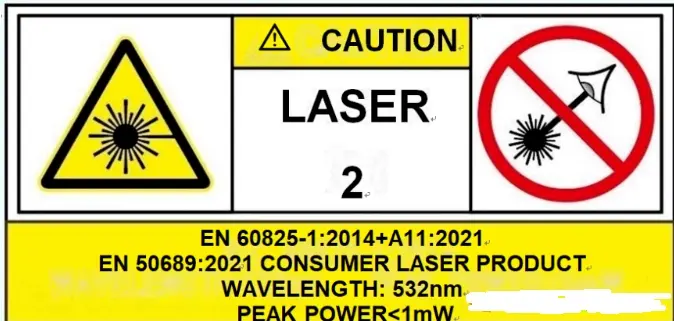
In addition to meeting the labeling requirements specified in EN 60825-1:2014/A11, manufacturers must include the EN 50689:2021 standard number on their labels for consumer laser products.
Example Label: Consumer Laser Product Identification
Extended Standards
1. Prohibition of High-Class Laser Pointers
The EU does not permit laser pointers classified as Class 3R or higher.

2. Recommended Classification for Consumer Lasers
To avoid disputes in actual sales, consumer lasers are recommended to be classified as Class 2 or lower.
This guide ensures compliance with the latest safety standards for laser products, helping manufacturers, suppliers, and users achieve optimal safety in the use of laser technology.
Email:hello@jjrlab.com
Write your message here and send it to us
 What is the ASTM F2264 Certification Test?
 What is ASTM F2194 Certification Testing?
 What is the ASTM F2167 Certification Test?
 What is the ASTM F2050 Certification Test?
 What is ASTM F1967 Certification Testing? How to g
 What is the ASTM F1917 Certification Test?
 How to get ASTM F1821 Certification
 What is the ASTM F1821 Testing Standard?
Leave us a message
24-hour online customer service at any time to respond, so that you worry!