



LVD and EMC Testing for Power Adapters
Selling power adapters in the global market requires overcoming the mandatory thresholds of product safety and Electromagnetic Compatibility (EMC) compliance. LVD (low voltage directive) and EMC (Electromagnetic Compatibility) testing are the core certification procedures for power adapters to enter the European Union and other mainstream markets.
Why Must Power Adapters Undergo LVD and emc testing?
Power adapters are typical electrical and electronic equipment. Their internal components include high-voltage circuits, switching power supply modules, and high-frequency signals. They are not only potential sources of electric shock, fire, and energy hazards but also emitters of electromagnetic interference (EMI). Additionally, they must possess a certain level of electromagnetic susceptibility (EMS) or immunity.
1.LVD (Low Voltage Directive): Ensures the safety of products when used within the rated input voltage range, preventing electric shock, fire, mechanical, and thermal hazards. In the EU, the LVD corresponds to the directive 2014/35/EU.
2.EMC (Electromagnetic Compatibility): Ensures that equipment functions normally in its electromagnetic environment without generating unacceptable electromagnetic interference to other devices in that environment. The corresponding EU directive is 2014/30/EU.
For export enterprises, LVD and emc compliance is not only a legal requirement but also a crucial basis for factory audits by clients, platform onboarding (such as Amazon, Temu), and insurance claims.
LVD Testing Items for Power Adapters
EMC Testing Content for Power Adapters
EMC consists of two parts: Electromagnetic Interference (EMI, emissions from the device) and Electromagnetic Susceptibility (EMS, the device's ability to withstand interference).
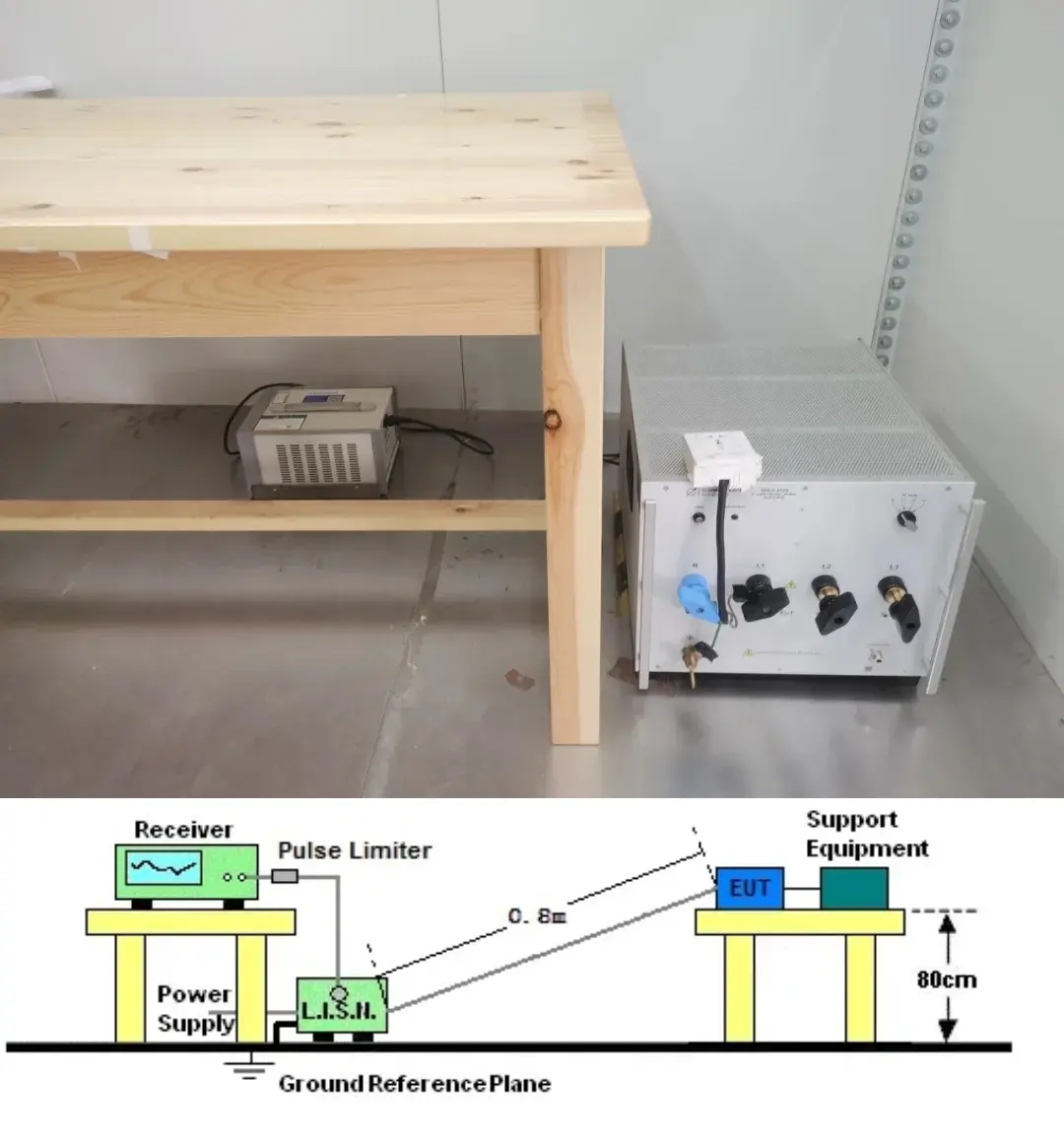
Electromagnetic Interference (EMI) Testing
Electromagnetic Susceptibility (EMS) Testing
LVD and EMC Standards for Power Adapters
Power adapters belong to the category of ITE (Information Technology Equipment) power supplies and are typically evaluated based on the following combinations of standards:
LVD Safety Standards
1.IEC/EN 62368-1: The current mainstream safety standard for audio/video, information, and communication technology equipment, which has gradually replaced the older standards.
2.IEC/EN 61558-1 / 61558-2-XX: Safety standards for transformers, power supply units, and similar products.
3.IEC/en 60950-1: The legacy safety standard for IT equipment (mostly replaced by 62368-1; pay attention to version transitions).
EMC Standards
1.IEC/en 55032: Electromagnetic emission requirements of multimedia equipment.
2.IEC/EN 55035: Electromagnetic immunity requirements of multimedia equipment.
3.IEC/en 61000-3-2: Limits for harmonic current emissions.
4.IEC/EN 61000-3-3: Limitation of voltage changes, voltage fluctuations, and flicker.
Note: In actual certification, standards may be adjusted based on product type (household, IT, medical, industrial), power rating, and application scenarios. It is recommended to refer to the latest regulations of the target market and the requirements of the certification body.
LVD and EMC Testing Process for Power Adapters
1.Requirement Confirmation: Clarify the target market, product category, power rating, input voltage range, etc.
2.Sample Preparation: Prepare engineering prototypes and finalize critical components (transformers, capacitors, fuses, optocouplers, etc.).
3.Pre-test: Conduct preliminary testing at JJR Lab to identify EMI or safety design flaws in advance.
4.Formal Testing: Complete the full suite of LVD and EMC tests according to the applicable standards.
5.Technical Documentation Compilation: Prepare CB reports, test reports, Technical Construction Files (TCF), user manuals, nameplates, circuit diagrams, BOMs, etc.
6.Certification and Issuance: Apply for CE certification (EU), cb certification, or other target market certifications.
7.Mass Production Consistency Control: Ensure mass-produced products are consistent with the certified samples to prevent compliance failures caused by critical component changes.
Common Causes of Failure in LVD and EMC Testing for Power Adapters
Common LVD Failures
Common EMC Failures
LVD testing and EMC testing for power adapters correspond to the two main compliance threads: product safety and electromagnetic compatibility. The two do not exist in isolation but represent a systematic engineering process spanning the entire lifecycle from circuit design, component selection, PCB layout, and structural design to mass production consistency.
Email:hello@jjrlab.com
Write your message here and send it to us
 Japan MIC Wireless Certification Testing
 Canada RSS-247 Testing Lab
 LVD and EMC Testing for Power Adapters
 IEC 62133-2 Lithium Battery Testing Laboratory
 EN 55032 and EN 55035 Testing Laboratory
 FCC ID testing lab for Bluetooth earbuds
How to get an FCC ID and How Much Does It Cost
What is the EN 300 328 Testing Standard
FCC ID testing lab for Bluetooth earbuds
How to get an FCC ID and How Much Does It Cost
What is the EN 300 328 Testing Standard
Leave us a message
24-hour online customer service at any time to respond, so that you worry!