



Mexican NOM Certification Fees
What is NOM?
NOM stands for "Normas Oficiales Mexicanas," which is Mexico's mandatory safety mark, equivalent to the CE certification in Europe. The nom mark applies to a wide range of products, including telecommunications and information technology equipment, household electrical appliances, lighting fixtures, and other products that pose potential health and safety risks. All products, whether manufactured locally in Mexico or imported, must comply with the relevant NOM standards and labeling requirements.
Mexico only recognizes its own NOM safety mark. The safety marks of the United States and Canada (such as CUL, ETL, CSA) are not recognized by the government. Products that require compulsory certification can only enter the Mexican market if they are accompanied by the NOM safety mark.
Scope of nom certification:
NOM certification is a mandatory system for products sold within Mexico. The types of products requiring NOM certification are numerous and include, but are not limited to:
1. Information technology equipment (e.g., computers, printers, routers)
2. Household appliances (e.g., refrigerators, air conditioners, washing machines)
3. Lighting products (e.g., lamps, bulbs)
4. Audio and video equipment (e.g., televisions, speakers, headphones)
5. Toys
6. Automotive and vehicle parts
7. Medical devices
The specific requirements for NOM certification vary by product category. Manufacturers must submit their products for testing and obtain the necessary certification before selling in Mexico.
How to Apply for an nom certificate:
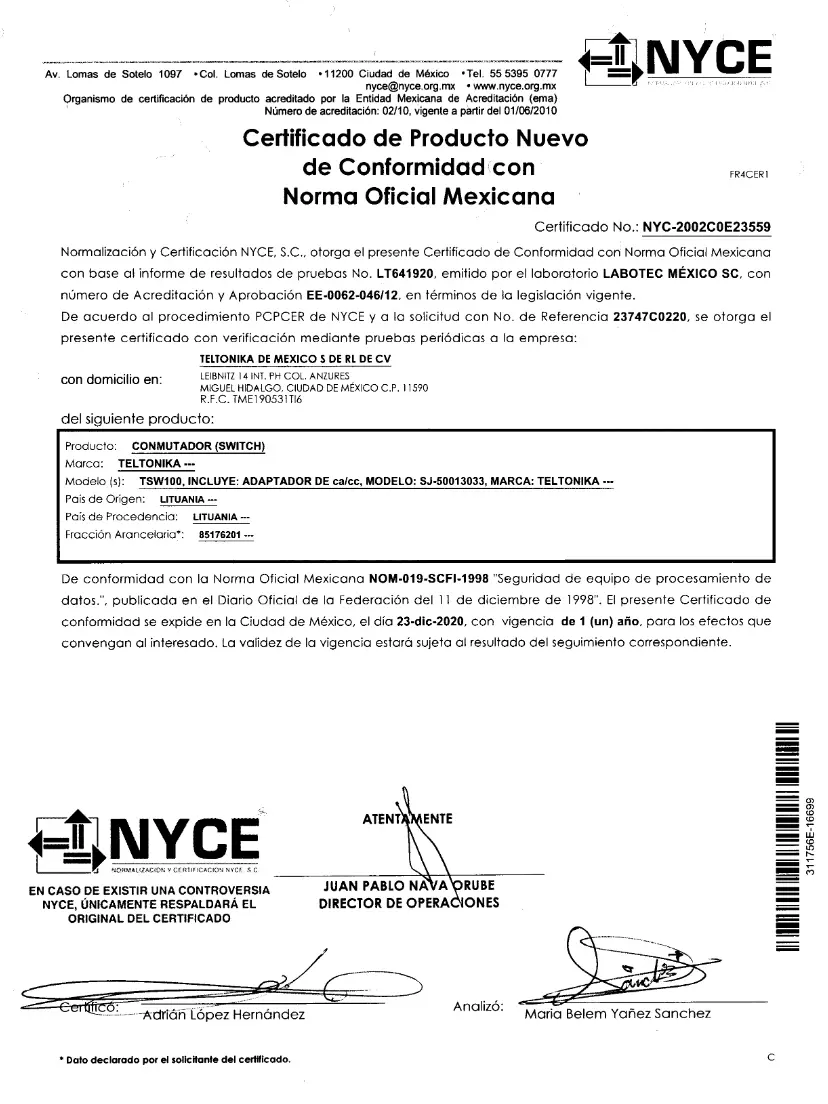
According to Mexican law, the holder of an NOM certificate must be a Mexican company. This means that for exporters and cross-border e-commerce sellers, the NOM certification for your products must be held by your Mexican importer or the Mexican company assisting with import clearance. This certificate can only be issued by laboratories recognized by the Mexican SECOFI. Only after the relevant laboratory tests and approvals can the NOM certificate be obtained.
The normal process involves the Mexican company applying for certification sending the products to a Mexican laboratory that collaborates with China's JJR laboratory for testing. Upon passing the tests, the NOM certificate is issued. The entire testing period takes approximately 5-6 weeks. The NOM certificate is usually valid for one year.
After the certificate expires, it must be renewed or samples must be retested. NOM standards apply to the entire product set, not individual components. As long as components are not sold separately, they do not need separate certification.
Mexican NOM Certification Fees:
China's JJR laboratory offers a Mexican NOM certification quote of $4,000.
mexico nom certification
Email:hello@jjrlab.com
Write your message here and send it to us
 What is UL 1642 Compliance Certification?
 What Is Amazon's UL 60335 Standard
 How to get a UL 60335 Test Report
 What is UL 60335 Certification Compliance?
 What is EN 61000 Certification Compliance?
 How to get an EN 61000 Test Report?
 What is the Amazon EN 55035 Standard?
 What is EN 55035 Certification Compliance?
Leave us a message
24-hour online customer service at any time to respond, so that you worry!