



Power Supply IPX7 Waterproof Testing Service
With the intensifying homogenization within the electronics industry, waterproof performance has gradually become a core marketing selling point for mainstream products. Especially in the categories of outdoor power supplies and portable chargers, the IPX7 waterproof rating has been heavily utilized by a large number of manufacturers.
However, many enterprises have not deeply investigated the standard connotations corresponding to this protection label: Does your product truly meet the requirements of the IPX7 specification?
Definition of the IPX7 Protection Rating
According to the GB/T 4208 (iec 60529) standard, IPX7 represents the requirements for protection against temporary immersion in water: under specified test conditions, the product enclosure is immersed in water for a continuous 30 minutes. After the test, there must be no harmful ingress of water inside the enclosure that could cause equipment failure.
Many people mistakenly believe that verification is complete simply by soaking the product in water for half an hour. In reality, IPX7 testing has strict constraints on test conditions, and a large number of risk points during practical operation are concentrated in detail management. The complete set of tests includes four core elements, none of which can be omitted:
1. Test Environmental Conditions Must Be Compliant
The ambient temperature must be controlled at 15°C~35°C, relative humidity at 25%~75%, and atmospheric pressure maintained at 86kPa~106kPa. It is not permitted to use simple containers to conduct tests in an uncontrolled environment.2. Test Equipment Must Meet Specification Requirements
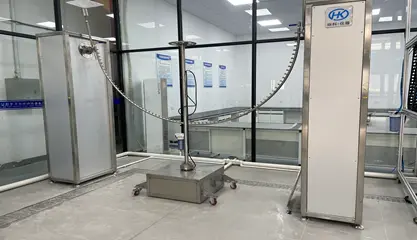
A standard immersion test chamber must be used for testing; ordinary water containers do not possess the validity required for compliant testing.3. Strict Control of Immersion Duration
The standard immersion duration is a continuous 30 minutes. If this duration is not met, the test result is invalid.4. Immersion Depth Dictated by Enclosure Dimensions
When the enclosure height is less than 850mm, the lowest point of the enclosure must be 1000mm below the water surface; when the enclosure height is ≥850mm, the highest point of the enclosure must be 150mm below the water surface.
In addition to this, if the applicable electrical safety standards for the product contain additional clauses (such as requiring immersion testing under energized conditions), the test plan must prioritize compliance with those safety standard requirements, ensuring coordination between different standards is completed in advance.
Top 3 High-Frequency Risk Misconceptions in IPX7 Testing
Misconception 1: Relying Solely on IP Protection Standards and Ignoring Additional Safety Requirements
Many R&D teams conduct tests based solely on the IP immersion process, overlooking the more stringent additional test conditions found in the product's corresponding electrical safety standards. This ultimately causes the test results to lack compliance validity.Misconception 2: Absence of a Sample Pre-treatment Process
If samples are moved directly from a low-temperature storage environment into a constant-temperature laboratory for testing, the temperature difference will cause condensation to form inside the enclosure, which can easily lead to distorted test data. Samples must be left to sit properly in the standard test environment, and testing should only commence after temperature equilibrium is reached.Misconception 3: Judging the Test Endpoint Based Only on Visual Water Ingress
Some testing personnel retrieve the sample, wipe it dry, and pass the test if no obvious water ingress is observed. This judgment method is incomplete. Immediately after the immersion test concludes, insulation resistance testing and dielectric strength testing must be conducted to verify that the equipment's electrical safety performance has not been compromised, thereby forming a complete closed-loop verification.
If you plan to conduct IPX7 protection rating testing for your products, you can consult JJR LAB. The laboratory is equipped with standardized testing equipment that complies with national standard requirements. A team of senior engineers controls the test process from start to finish, ensuring that the testing process is compliant and the data is authentic and valid.
Email:hello@jjrlab.com
Write your message here and send it to us
 How to get the EN 55035 Test Report?
 What is the Amazon EN 301 489 Standard?
 How to get an EN 301 489 Test Report?
 What is EN 301 489 Compliance Certification?
 Introduction to the EN 300 422 Standard
 How to get an EN 300 422 Test Report
 What is EN 300 422 Compliance Certification?
 How to get an EN 300 220 Test Report
Leave us a message
24-hour online customer service at any time to respond, so that you worry!