



UL 1598 Luminaire Safety Test Items and Procedures
The official title of ul 1598 is Standard for Safety for Luminaires. It is mainly applicable to fixed luminaires sold and used in the North American market (the United States and Canada), such as ceiling lights, wall sconces, chandeliers, recessed downlights, stage lights, etc. It does not apply to portable luminaires (e.g., table lamps, which fall under UL 153) or LED driver power supplies themselves (e.g., standalone drivers, which are governed by UL 8750).
UL 1598 testing is a comprehensive evaluation system designed to ensure the safety of luminaires in terms of structure, electrical performance, mechanics, and thermal properties. Its test items can be categorized into the following core groups:
Structural Inspection
This is the most fundamental and primary step to verify that the physical design of a luminaire complies with safety requirements.
1. Enclosure Strength and Materials
Inspect whether the enclosure provides adequate mechanical protection and electrical insulation. The materials must have sufficient heat resistance, flame retardancy, and impact resistance (e.g., polymer materials generally require a flame retardant rating of at least ul 94 V-2 or higher).
2. Clearances and Creepage Distances
Measure the air distance between live parts of different potentials (e.g., line and neutral conductors, live components and accessible metal parts) and the surface distance along insulators, so as to prevent short circuits and arcing.
3. Wiring and Termination
Check the specifications, insulation, securing methods, and protection measures of internal wires. The type, size, and fastening method of wire terminals must also meet the requirements.
4. Ground Continuity
For Class I (grounded) luminaires, ensure that all accessible metal parts have a permanent, reliable, and low-resistance grounding path.
Electrical Testing
These tests verify the electrical safety of luminaires.
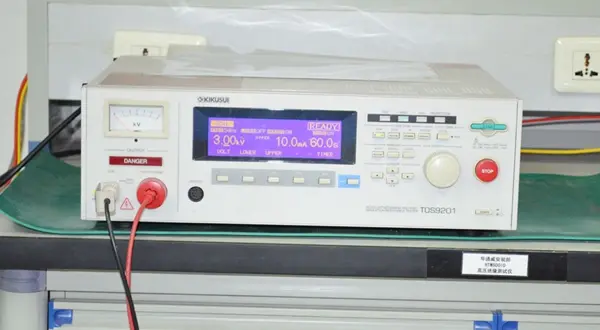
3. Dielectric Voltage-Withstand Test (Hi-Pot Test)
① Purpose: Verify that the luminaire's insulation system is robust enough to withstand transient high voltage without breakdown.
② Method: Apply an alternating high voltage (e.g., 1000V plus twice the rated voltage) between live parts and accessible metal parts for a specified duration (e.g., 1 minute). No breakdown or flashover shall occur during the test.
4. Leakage Current Test
① Purpose: Measure the current flowing from live parts to accessible metal parts under normal operating conditions, ensuring it stays within safe limits to prevent electric shock to users.
6. Power Cord Pull Test
① Purpose: Ensure that the power cord will not be pulled out or damaged when subjected to tension, and that its internal terminals will not loosen.
② Method: Apply the specified tension (repeatedly) and torque to the power cord. After the test, the displacement of the power cord shall not exceed the limit specified in the standard.
Thermal Testing
This is a core and critical part of UL 1598 testing, aiming to evaluate the temperature rise of luminaires during normal operation.
3. Normal Temperature Rise Test
① Purpose: Measure the steady-state temperature of various luminaire components (e.g., lamp holders, wires, enclosures, lenses, LED modules, driver power supplies) under the most severe operating conditions.
② Method: Operate the luminaire at rated voltage and maximum ambient temperature inside a test corner (a wooden structure simulating a room corner) until thermal stability is achieved. Use thermocouples to measure the temperature at various points.
③ Evaluation Criteria: All measured temperatures shall not exceed the rated temperature limits of the component materials (e.g., wire insulation, plastic enclosures, lamp holders). These limits are usually marked on the components or specified in relevant standards.
2. Abnormal Condition Test
① Purpose: Simulate the performance of luminaires under abnormal conditions, such as one-end starting failure of fluorescent tubes, poor heat dissipation, driver power supply malfunction, etc., and evaluate whether such conditions may cause hazards like fire, electric shock, or melting.
② Method: Artificially create faults and monitor the temperature and status of the luminaire.
Mechanical Testing
Evaluate the mechanical strength and stability of luminaires.
1. Impact Test
① Purpose: Verify that the luminaire enclosure can withstand a certain degree of external impact.
② Method: Use an impact hammer (typically with an energy of 2 joules) to strike the vulnerable parts of the luminaire (e.g., transparent covers). After the test, no fragments shall fall off, and no hazardous cracks shall be generated.
2. Suspension Load Test (for Suspended Luminaires)
① Purpose: Ensure that suspension devices such as chandeliers and suspension chains have sufficient mechanical strength.
② Method: Apply a load 4 times the weight of the luminaire to the suspension system for 1 hour. No permanent deformation or damage shall occur.
2. Stability Test (for Floor Lamps or Portable Luminaires)
① Purpose: Ensure that the luminaire will not tip over easily.
Other Specialized Tests
2. Photobiological Safety Test
Especially for LED luminaires, it is necessary to evaluate their blue light hazard classification and ensure they fall into the non-hazardous or low-hazard category (RG0 or RG1).
3. Humidity Treatment
For luminaires claimed to be suitable for damp or outdoor environments (e.g., bathroom lights, garden lights), humidity treatment shall be conducted before testing to verify their insulation performance under humid conditions.
4. Thread Engagement Test
Ensure that the engagement length and torque between screw-base lamp holders (e.g., E26) and bulbs meet the requirements, preventing poor contact or bulb detachment.
8. Strain Relief Test
Check whether there is an effective strain relief device at the point where the power cord enters the luminaire enclosure, preventing wire damage when the cord is pulled.
A complete UL 1598 test report will detail the test methods, test conditions, test data, and final conclusions of all the above-mentioned items. Only by passing all these tests can a fixed luminaire be deemed to comply with the safety requirements of UL 1598 standard, thereby qualifying for the UL Listing Mark and gaining access to the North American market.
Email:hello@jjrlab.com
Write your message here and send it to us
 How to get an EN 301 893 test report?
 What is EN 301 893 Certification Compliance
 What is the CSA 62368-1 Standard?
 Canadian Pacifier Compliance SOR/2016-184
 US Agent for FCC & EC REP for CE: Compliance R
 What is Recycling of WEEE
 What is PPWR Packaging Compliance
What is Extended Producer Responsibility
What is PPWR Packaging Compliance
What is Extended Producer Responsibility
Leave us a message
24-hour online customer service at any time to respond, so that you worry!