



Australia Electrical Equipment Safety EESS RCM Mark
1. Background
The Electrical Equipment Safety System (EESS) is a compliance regime aimed at ensuring that domestic electrical equipment meets statutory safety standards during design, manufacture, installation, and use. This system reduces potential electrical hazards through testing, certification, and regulatory measures, protecting consumers and the public from electrical harm. EESS adopts the Australian and New Zealand joint standard AS/NZS 3820 as part of its safety framework, and establishes Equipment Safety Rules (Safety Rules) governing compliance requirements for domestic electrical products and responsible suppliers. This ensures consistency in certification decisions, standard setting, and registration database information.
Currently, Queensland, Victoria, Western Australia, and Tasmania have signed intergovernmental agreements on the management of Electrical Equipment Safety System (EESS), fully implementing and applying EESS compliance regimes. Meanwhile, South Australia, Northern Territory, and Australian Capital Territory are gradually transitioning to join the EESS compliance system. New South Wales, while not formally part of EESS, recognizes and accepts this compliance system, maintaining its own declared/undisclosed product classifications and corresponding requirements parallel to the EESS system.
For specific requirements in New South Wales, please visit http://www.fairtrading.nsw.gov.au
2. Policy
Businesses must understand and comply with the Electrical Equipment Safety System (EESS) requirements for equipment safety and standard AS/NZS 3820 to ensure compliance of their products in the Australian market.
3. Compliance Guidelines
If you intend to sell domestic electrical equipment within the jurisdiction of the Electrical Equipment Safety System (EESS), you must meet the following basic requirements:
- The responsible supplier (manufacturer or importer) of the electrical equipment must be registered in the EESS national database.
- The responsible supplier must declare and ensure that their supplied electrical equipment complies with relevant safety standards and meets EESS and local electrical safety regulatory requirements.
- The responsible supplier must individually register each model of electrical equipment supplied in the EESS database and meet all registration requirements.
- Pay the applicable registration fees as required.
- Clearly label the product with the compliance mark RCM as per requirements of as/nzs 4417.1 and 4417.2 standards.
(1) Product Scope
1. Applicable Product Types
Safety Rules aim to enhance consumer safety by standardizing domestic electrical equipment. Electrical equipment within scope must meet all three of the following conditions:
- Rated voltage greater than 50V AC or 120V DC;
- Rated voltage less than 1000V AC or 1500V DC;
- Designed or sold for household, personal, or similar use.
2. Product Risk Levels
EESS categorizes equipment within scope into three risk levels:
- Level 1 equipment – classified as low risk or unknown risk, not categorized as Level 2 or 3 equipment.
- Level 2 equipment – classified as medium risk, defined in AS/NZS 4417.2 standard.
- Level 3 equipment – classified as high risk, defined in AS/NZS 4417.2 standard.
(2) Responsible Supplier and Registration
The Responsible Supplier is an individual or legal entity manufacturing or importing equipment in Australia or New Zealand. By law, the Responsible Supplier must be a legal entity in Australia or New Zealand and hold an Australian Business Number (ABN) or New Zealand Inland Revenue Department (IRD) number.
For registration processes and other related information regarding Responsible Supplier, refer to the "Responsible Supplier Registration" section. To verify the authenticity and validity of Responsible Supplier registration, queries can be made in the EESS registration database.
Additionally, Responsible Suppliers must register their equipment products in the EESS database, as outlined in the equipment scope. Registration is mandatory for Level 2 and Level 3 equipment, while voluntary for Level 1 equipment.
(3) Product Qualification Requirements
For detailed requirements, refer to:
Level 1 equipment: https://www.eess.gov.au/registration/registration-in-scope-electrical-equipment/level-1/
Level 2 equipment: https://www.eess.gov.au/registration/registration-in-scope-electrical-equipment/level-2/
Level 3 equipment: https://www.eess.gov.au/registration/registration-in-scope-electrical-equipment/level-3/
(4) rcm logo
1. EESS RCM Logo
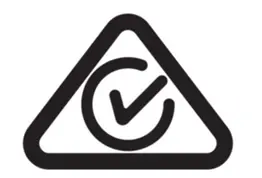
In accordance with AS/NZS 4417.1 and AS/NZS 4417.2 standards, businesses must label products with the compliance mark RCM, specifying location and size requirements. Only electrical equipment meeting EESS requirements may use the RCM logo. Responsible Suppliers receive a copy of AS/NZS 4417.1 standard detailing the usage specifications of the RCM logo upon registration in the EESS database. The RCM logo illustration is as follows:
*For more information on the EESS RCM logo, visit: https://www.eess.gov.au/rcm/regulatory-compliance-mark-rcm-general/
2. ACMA RCM Logo
The above RCM logo also applies to products regulated by the Australian Communications and Media Authority (ACMA), such as EMC, radio communications products, and telecommunications products. Note that ACMA and EESS are separate compliance systems with differing jurisdictional scopes.
Since 2016, the RCM logo has replaced the previous A-Tick and C-Tick compliance marks for telecommunications products. Compliant telecommunications products may use one of the following methods for labeling:
i. Direct use of the RCM logo as described above;
ii. Printing a QR code or other scannable symbol linking to a webpage displaying the RCM logo pattern.
*For more information on the ACMA RCM logo, visit: https://www.acma.gov.au/step-5-label-your-product
(5) Laboratory and Safety Certification
To meet EESS requirements, Responsible Suppliers must provide evidence that equipment complies with relevant standards, typically through test reports.
Level 3 equipment must be tested by accredited laboratories. Examples include the National Association of Testing Authorities, Australia (NATA), accredited bodies joining the International Laboratory Accreditation Cooperation (ILAC) Multilateral Recognition Arrangement (MRA), and laboratories under the iecee cb scheme for conformity assessment of electrical equipment and components. Businesses can verify certified laboratories through the NATA website. JJR Laboratory in China is an IEC 17025 accredited laboratory offering services with lower testing costs, potentially saving 30% on certification fees for you.
Level 1 and Level 2 equipment can accept test reports from non-accredited laboratories, though certified reports are more authoritative.
Email:hello@jjrlab.com
Write your message here and send it to us
 What is the Amazon UL 1642 Test Standard?
 How to get a UL 1642 Test Report?
 What is UL 1642 Compliance Certification?
 What Is Amazon's UL 60335 Standard
 How to get a UL 60335 Test Report
 What is UL 60335 Certification Compliance?
What is EN 61000 Certification Compliance?
What is UL 60335 Certification Compliance?
What is EN 61000 Certification Compliance?
 How to get an EN 61000 Test Report?
Leave us a message
24-hour online customer service at any time to respond, so that you worry!