



FCC Part 15.231 for Wireless Remote Controls and Sensors
Overview of fcc part 15.231
fcc Part 15.231 is a radio frequency emission regulation formulated by the Federal Communications Commission (FCC) for intermittent radiating devices. It aims to prevent interference with other radio services (such as aviation communications and public safety frequency bands) by restricting the transmission interval, duration, and duty cycle of the devices. It applies to products operating periodically in the frequency bands of 40.66-40.70 MHz and above 70 MHz (e.g., frequencies of 315 MHz and 433.92 MHz).
Appliable Products and Classification
Class 15.231(a) Products
1. Core: "Short-duration, discontinuous transmission of control commands", with transmission required to cease promptly after the control switch is released
2. Typical Products:
① Home appliance remote controls (infrared/radio frequency remote controls for TVs, air conditioners, and projectors)
② Garage door/access control remote controls
③ Trigger transmitters for alarm systems (e.g., wireless signal transmitters for smoke alarms)
④ Wireless controllers for industrial equipment (e.g., remote operation handles for cranes)
⑤ Remote controls for unmanned aerial vehicles (basic models only transmitting control commands, excluding video transmission)
8. Note: Continuous transmission (non-triggered sustained emission), voice, video, and radio-controlled toys are not permitted under this section.
Class 15.231(e) Products
2. Core: "Transmission at fixed cycles, with short single transmission duration and long interval periods"
3. Typical Products:
① Wireless temperature sensors (periodically sending temperature data to gateways, such as temperature sensors for cold chain containers)
② Smart electricity meters/water meters (periodically uploading metering data)
③ Environmental monitoring sensors (e.g., temperature and humidity sensors, PM2.5 sensors, returning data at fixed intervals)
④ Pet tracking collars (periodically sending location information, non-real-time continuous transmission)
⑤ Asset trackers (e.g., positioning tags for logistics containers, reporting location at fixed intervals)
• Note: Applicable to all types of operations, including continuous transmission, voice, video, and radio-controlled toys prohibited under Section 15.231(a).
Test Items
Test Item | Section | Test Method | Result |
Antenna Requirement | FCC Part 15.203 | ANSI C63.10: 2020 | Pass |
AC Conduction Emission | FCC Part 15.207 | ANSI C63.10: 2020 | Pass |
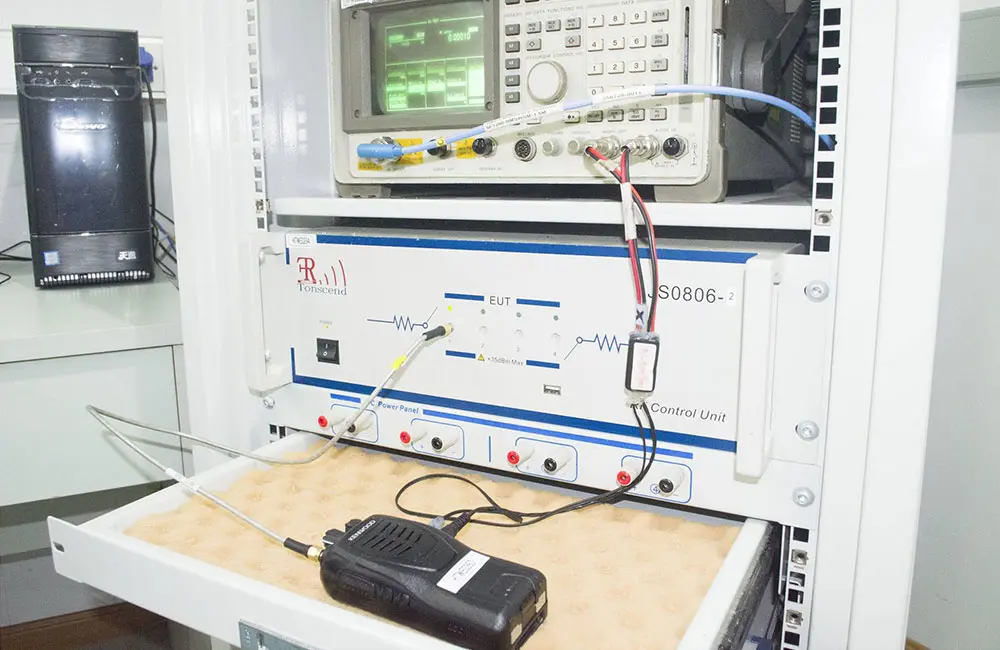
Radiated Emission | FCC Part 15.231(b) | ANSI C63.10: 2020 | Pass |
20dB Bandwidth | FCC Part 15.231(c) | ANSI C63.10: 2020 | Pass |
Release Time Measurement | FCC Part 15.231(a) | ANSI C63.10:2020 | Pass |
Duty Cycle | FCC Part 15.231 | ANSI C63.10 2020 | Pass |
Note: The AC conduction emission test item is not applicable to battery-powered products.
Detailed Requirements for Each Test Item
Antenna Requirement
1. A permanently attached antenna (such as a PCB printed antenna) must be used, and users shall not be allowed to replace it at will.
2. If used on an intentional radiator, a dedicated coupling antenna with a reverse-polarity SMA connector shall be equipped (to ensure matching between the antenna and the device and avoid abnormal signals).
1. In brief: The antenna must be non-detachable and non-replaceable, with fixed matching to the device, to prevent radio frequency indicators from exceeding limits after user antenna replacement.
AC Power Conduction Emission
Frequency of emission (MHz) | Quasi-peak (dBV) | Average (dBV) |
0.15-0.5 | 66 to 56* | 56 to 46* |
0.5-5 | 56 | 46 |
5-30 | 60 | 50 |
Radiated Emission
Test Range
For an intentional radiator, the spectrum shall be investigated from the lowest radio frequency signal generated in the device, without going below 9 kHz, up to at least the frequency shown in this paragraph:
(1) If the intentional radiator operates below 10 GHz: to the tenth harmonic of the highest fundamental frequency or to 40 GHz, whichever is lower.
(2) If the intentional radiator operates at or above 10 GHz and below 30 GHz: to the fifth harmonic of the highest fundamental frequency or to 100 GHz, whichever is lower.
(3) If the intentional radiator operates at or above 30 GHz: to the fifth harmonic of the highest fundamental frequency or to 200 GHz, whichever is lower, unless specified otherwise elsewhere in the rules. If the intentional radiator operates at or above 95 GHz: To the third harmonic of the highest fundamental frequency or to 750 GHz, whichever is lower, unless specified otherwise elsewhere in the rules.
(5) If the intentional radiator contains a digital device, regardless of whether this digital device controls the functions of the intentional radiator or the digital device is used for additional control or function purposes other than to enable the operation of the intentional radiator, the frequency range shall be investigated up to the range specified in paragraphs (a)(1) through (4) of this section or the range applicable to the digital device, as shown in paragraph (b)(1) of this section, whichever is the higher frequency range of investigation.
Limit Requirements
Frequency (MHz) | Field strength (microvolts/meter) | Measurement distance (meters) |
0.009-0.490 | 2400/F(kHz) | 300 |
0.490-1.705 | 24000/F(kHz) | 30 |
1.705-30.0 | 30 | 30 |
30-88 | 100** | 3 |
88-216 | 150** | 3 |
216-960 | 200** | 3 |
Above 960 | 500 | 3 |
Except as provided in paragraph (g), fundamental emissions from intentional radiators operating under this section shall not be located in the frequency bands 54-72 MHz, 76-88 MHz, 174-216 MHz or 470-806 MHz. However, operation within these frequency bands is permitted under other sections of this part e.g. §§ 15.231 and 15.241.
Unless otherwise specified in paragraph (g), the fundamental transmission frequency of intentional radiators governed by this section shall not fall within the frequency bands of 54-72 MHz, 76-88 MHz, 174-216 MHz, or 470-806 MHz. However, operation within the above frequency bands is permitted if the device falls under other specific sections of this part (e.g., §15.231 and §15.241).
Field strength of fundamental and harmonic emissions
FCC PART 15(a) Limits
Fundamental frequency (MHz) | Field strength of fundamental (microvolts/meter) | Field strength of spurious emissions (microvolts/meter) |
40.66-40.70 | 2,250 | 225 |
70-130 | 1,250 | 125 |
130-174 | 1250 to 3,750 | 125 to 375 |
174-260 | 3,750 | 375 |
260-470 | 3,750 to 12,500 | 375 to 1,250 |
Above 470 | 12,500 | 1,250 |
Note: 1 indicates a linear relationship.
Calculation example taking 433.9 MHz as an example:
2. Fundamental frequency limit:
• Spurious emission limit:
Tip: The limits for harmonic spurious emissions shall be used in conjunction with fcc part 15b, and the stricter limit shall apply.
FCC PART 15(e) Limits
Fundamental frequency (MHz) | Field strength of fundamental (microvolts/meter) | Field strength of spurious emissions (microvolts/meter) |
40.66-40.70 | 1,000 | 100 |
70-130 | 500 | 50 |
130-174 | 500 to 1,500¹ | 50 to 150¹ |
174-260 | 1,500 | 150 |
260-470 | 1,500 to 5,000¹ | 150 to 500¹ |
Above 470 | 5,000 | 500 |
Note: ¹ indicates linear interpolation.
Taking 433.9 MHz as an example: FCC 231(e) --- PK Limit = 92.87 dBuV/m; AV Limit = 72.87 dBuV/m
AV Value Calculation Methods
• Method 1: Readings obtained using the receiver's AV detection
• Method 2: The PK value is measured, while the AV value is calculated based on the Duty Cycle.
Interpretation of Test Data
Low-Frequency Spurious Emissions
No. | Frequency (MHz) | Reading (dBuV) | Factor (dB/m) | Level (dBuV/m) | Limit | Margin (dB) | Detector |
1 | 46.5519 | 30.32 | -15.00 | 15.32 | 40.00 | -24.68 | QP |
2 | 80.4038 | 39.54 | -19.00 | 20.50 | 40.00 | -19.46 | QP |
3 | 102.0729 | 36.82 | -17.69 | 19.13 | 43.50 | -24.37 | QP |
4 | 162.2400 | 33.00 | -14.10 | 18.90 | 43.50 | -24.60 | QP |
5 | 433.9128 | 83.34 | -11.45 | 71.89 | 100.80 | -28.91 | peak |
6 | 867.9120 | 51.69 | -4.01 | 47.68 | 80.80 | -33.12 | peak |
High-Frequency Spurious Emissions + Field Strength of The Fundamental Signal
Frequency (MHz) | Reading (dBμV/m) PEAK | Factor Corr. (dB) | Average Factor (dB) | Result (dBμV/m) | Limit (dBμV/m) | Margin (dB) | Polarization |
AV | PEAK | AV | PEAK | ||||
433.9128 | 84.84 | -11.45 | -7.88 | 65.51 | 73.39 | 80.80 | 100.80 |
433.9128 | 83.34 | -11.45 | -7.88 | 64.01 | 71.89 | 80.80 | 100.80 |
867.9120 | 52.69 | -4.01 | -7.88 | 40.80 | 48.68 | 60.80 | 80.80 |
867.9120 | 51.69 | -4.01 | -7.88 | 39.80 | 47.68 | 60.80 | 80.80 |
Above 1G
Frequency (MHz) | Read-Level (dBμV) | Polarization | Factor (dB/m) | Level (dBμV/m) | Limit | Margin(dB) | |
PK | AV | PK | AV | ||||
1239.876 | 60.22 | H | -25.20 | 35.02 | 74 | ||
1965.002 | 64.33 | H | -23.41 | 40.92 | 74 | ||
2580.133 | 57.89 | H | -21.94 | 35.95 | 74 | ||
3286.188 | 58.96 | H | -20.87 | 38.09 | 74 | ||
4081.772 | 54.22 | H | -20.80 | 33.42 | 74 | ||
4988.864 | 55.86 | H | -18.29 | 37.57 | 74 | ||
1301.332 | 59.06 | V | -25.20 | 33.86 | 74 | ||
1902.639 | 61.02 | V | -23.85 | 37.17 | 74 | ||
2304.722 | 57.23 | V | -22.56 | 34.67 | 74 | ||
2898.824 | 54.63 | V | -21.05 | 33.58 | 74 | ||
3256.879 | 53.59 | V | -20.86 | 32.73 | 74 | ||
4322.645 | 55.69 | V | -20.25 | 35.44 | 74 |
20dB Bandwidth
Limit Requirements
The bandwidth of the emission shall be no wider than 0.25% of the center frequency for devices operating above 70 MHz and below 900 MHz. For devices operating above 900 MHz, the emission shall be no wider than 0.5% of the center frequency. Bandwidth is determined at the points 20 dB down from the modulated carrier.
That is, the 20dB bandwidth range tested shall not exceed: (for ) or (for ).
Taking 433.92 MHz as an example:
Spectrum Analyzer Parameter Settings
• Span: 2 to 5 times the occupied bandwidth (OBW)
• RBW: 1% to 5% of the occupied bandwidth (OBW)
• VBW: 3 times the RBW
Transmit Time
15.231(a)
• Manually triggered devices (manually operated transmitters shall employ a switch): Transmission shall cease within 5 seconds after the switch is released.
• Automatically activated devices: Transmission shall cease within 5 seconds after activation.
• Note: Sweep time shall not be less than 8 seconds.
Release Time Measurement
15.231(e)
• Single transmission duration shall not exceed 1 second.
Silent Period
15.231(e)
• The silent period between transmissions shall be at least 30 times the transmission duration.
• In no case shall it be less than 10 seconds.
Duty Cycle
Calculate Formula
• Duty cycle factor = or
• Duty cycle = , whichever is less
Case Analysis
Product Information
433.92 MHz alarm sensor (belongs to Class 15.231(a))
Test Results
Test Item | Result |
Antenna Requirement | PASS |
AC Conduction Emission | N/A |
Radiated Emission | PASS |
20dB Bandwidth | PASS |
Time Measurement | PASS |
Duty Cycle | PASS |
Email:hello@jjrlab.com
Write your message here and send it to us
 FDA Requirements for Biocompatibility under ISO 10
 Amazon Spain WEEE Compliance Deadline: September 3
 What is the ASTM F2264 Certification Test?
 What is ASTM F2194 Certification Testing?
 What is the ASTM F2167 Certification Test?
 What is the ASTM F2050 Certification Test?
 What is ASTM F1967 Certification Testing? How to g
 What is the ASTM F1917 Certification Test?
Leave us a message
24-hour online customer service at any time to respond, so that you worry!