



What is LVD CE Marking?
Products exported to Europe and listed on European cross-border e-commerce stores must obtain CE certification and bear the ce mark. Passing CE certification signifies that the product complies with European directives and meets the safety, hygiene, and health requirements mandated by European standards.
Among these regulations, all electrical products with a voltage range of 50-1000V AC and 75-1500V DC must comply with the requirements of Directive 2014/35/EU, the low voltage directive, commonly referred to as ce-lvd marking. This certification is not limited to covering the electrical safety of the product; it also includes mechanical, chemical, energy, and other related hazards. The main objective of this directive is to enable the free movement of goods within the European Union by ensuring all products meet the same unified requirements, thereby facilitating trade.
Applied to the vast majority of electrical equipment in daily use, the Low Voltage Directive (LVD) declares that electrical equipment can only be placed on the market if it does not endanger the safety of persons, domestic animals, or other equipment and property. CE Mark products must fall within the scope of this directive and must be supported by the correct documentation.
Requirements for LVD ce marking
1.1 General Requirements
To ensure that electrical equipment is safe when used for its intended purpose, its essential characteristics, identification, and precautions for use should be marked on the electrical product. If this is difficult, they can be provided in the instruction manual.
The manufacturer's name and trademark must be clearly marked on the electrical product; if this is difficult, they can be printed on the packaging.
The electrical equipment and its components should be manufactured to ensure they can be safely and properly connected and assembled.
The design and manufacture of the electrical equipment must ensure compliance with the requirements of categories 1.2 and 1.3 below, provided the equipment is used and maintained within its intended purpose.
1.2 Prevention of Hazards Caused by Electrical Equipment
Persons and domestic animals must be protected from the danger of physical injury or other harm caused by direct or indirect electrical contact.
The equipment shall not produce temperatures, arcs, or radiation that may cause a hazard.
Persons, domestic animals, and property must be adequately protected against non-electrical hazards caused by electrical equipment, as revealed by experience.
The insulation must be suitable for all foreseeable conditions.
1.3 Prevention of Hazards Caused by External Influences on Electrical Equipment
The electrical product should meet the expected mechanical requirements so that persons, domestic animals, and property are protected from danger.
Under intended environmental conditions, the electrical product shall resist non-mechanical influences so that persons, domestic animals, and property are protected from danger.
In foreseeable overload conditions, the electrical product shall not endanger the safety of persons, domestic animals, and property.
In simple terms: lvd certification is designed to ensure the safety of products such as electronic appliances, luminaires, and machinery during use. The directive applies to electrical products with an operating voltage range between 50V and 1000V AC, and between 75V and 1500V DC.
Scope of Products for LVD Certification
The standard applies to products including, but not limited to:
Switching power supplies, LED luminaires, electronic and electrical equipment, audio and video products, information technology products, commercial office automation equipment not exceeding 600V, power supply products, servers, monitors, televisions, household appliances, laptops, personal computers, and computer peripherals.
General Live Products Must Comply with CE-LVD Certification Directive Requirements. What Are the Main Considerations?
The CE-LVD Certification Directive (Low Voltage Directive 2014/35/EU) refers to the directive that harmonizes the laws of Member States relating to electrical equipment designed for use within certain voltage limits. The goal of the LVD is to ensure the safety of low-voltage equipment during use.
The directive applies to electronic and electrical products operating at voltages between 50V-1500V AC and 75V-1500V DC. This directive contains all safety rules for this equipment, including protection against hazards caused by mechanical factors.
Hazards Evaluated Under the CE-LVD Marking Directive
The design and construction of the equipment shall ensure that no danger arises when used for its intended purpose under normal operating conditions or fault conditions. In particular, the following hazards are evaluated:
Electric Shock
Energy Hazard
Fire
Mechanic and Heat Hazard
Radiation Hazard
Chemical Hazard
What Are the Specific Test Items for the CE-LVD Certification Directive?
Input test
Heating test
Humidity test
Glow-wire test
Over Load test
Leakage current measurements
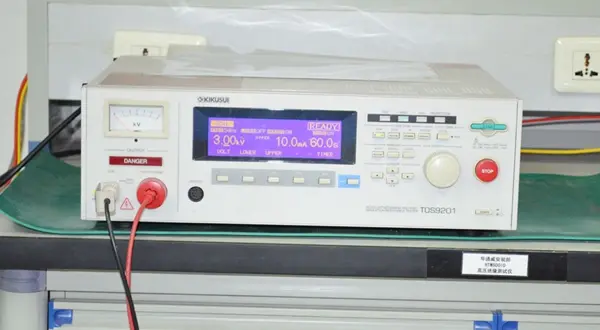
Electric Strength test
Earth continuity test
Cord anchorage test
Stability test
Plug torque test
Impact test
Capacitor discharge test at plug
Fault conditions test
Working voltage measurement
Motor lock-rotor test
Low and high temperature test
Tumbling test
Insulation resistance test
Ball pressure test
Screw Torque test
Needle flame test
Required Documentation for LVD CE Marking
A general description of the electrical equipment.
Conceptual design and manufacturing drawings, schemes of components, sub-assemblies, circuits, etc.
Descriptions and explanations necessary for the understanding of the aforementioned drawings and schemes, as well as the operation of the electrical equipment.
A list of the standards applied in full or in part, and descriptions of the solutions adopted to meet the safety requirements of this directive where those standards have not been applied.
Results of design calculations made, examinations carried out, etc.
Test reports.
Standards for LVD CE Marking
The directive specifies the standards that satisfy its stipulated safety requirements. These include:
Harmonized Standards:
Household appliances: EN 60335
Lighting products: EN 60598
Audio/Visual products: en 60065
Information technology products: en 60950
Measuring instruments: EN 61010
Electrical machinery: EN 60204
IECCEE Standards: Standards related to the safety of electrical equipment published by the IEC/CEE, as agreed upon by Member States.
National Standards: In the absence of the above standards, the national standards confirmed by Member States (the national standards of the Member State of origin of the electrical product).
Process for LVD Certification
The manufacturer submits an initial oral or written application to our company and signs a quotation contract.
The applicant fills out the application form and sends it to our company along with the product instruction manual and technical documents.
Our company determines the inspection standards and testing items, and provides a quotation.
The applicant confirms the quotation and sends the samples and relevant technical documents to the JJR Laboratory.
The applicant provides all necessary technical documentation.
The laboratory issues a payment notice to the applicant, and the applicant pays the certification fees as required.
The laboratory conducts product testing and issues the final test report and certificate.
Email:hello@jjrlab.com
Write your message here and send it to us
 EMC Testing Lab IEC 60601 Medical Electrical Safet
 What are the FCC Testing Requirements for Bluetoot
 Australia RCM Certification for Radio Devices
 RED Cybersecurity EN 18031 Standard
 Compliance Testing for EMC
 What is Amazon Toy Compliance?
 What is Cytotoxicity ISO 10993-5
 What is Hemocompatibility Testing ISO 10993?
Leave us a message
24-hour online customer service at any time to respond, so that you worry!