



2026 USA CPSC eFiling Guide
Starting July 8, 2026, all consumer products regulated by the CPSC must complete electronic filing when exported to the United States.
According to a recent official announcement by the U.S. CPSC: Starting July 8, 2026, all consumer products regulated by the CPSC must complete electronic filing (eFiling) at Customs when imported into the United States. The categories involved this time include clothing, children's toys, electronic products, and furniture.
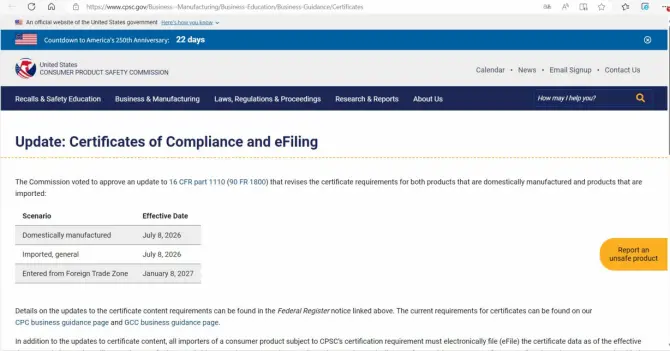
For detailed information, please see the website link:
https://www.cpsc.gov/Business--Manufacturing/Business-Education/Business-Guidance/Certificates
Verification and Confirmation
How do you check if your product is subject to CPSC regulation? The inquiry steps are as follows:
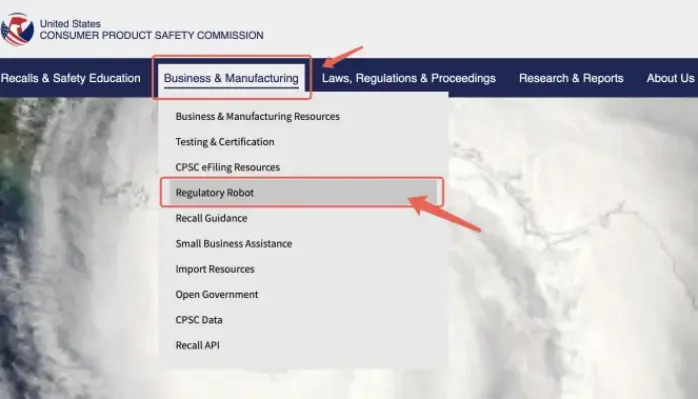
1. Enter the official website https://www.cpsc.gov/eFiling, find and click the "Regulatory Robot" tool portal;
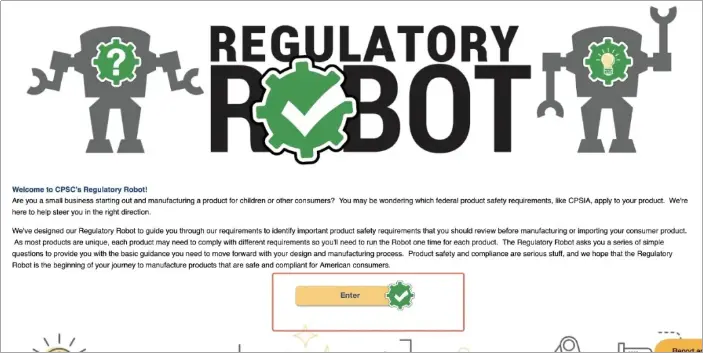
2. Click the "Enter" button;
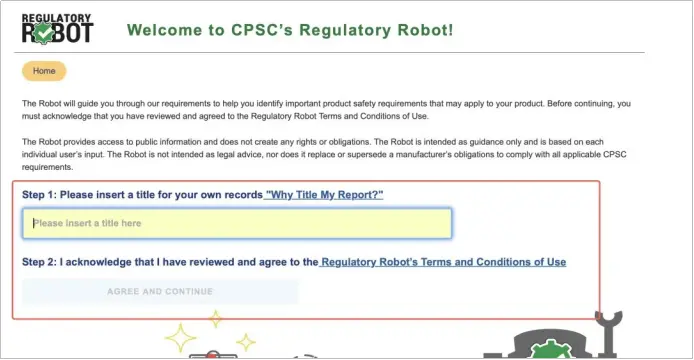
3. Customize a title for the current inquiry session (for internal archiving and subsequent identification), then click agree and continue to enter the inquiry page;
4. Enter your product name to get category suggestions, and then select the relevant content according to the tool's prompts;
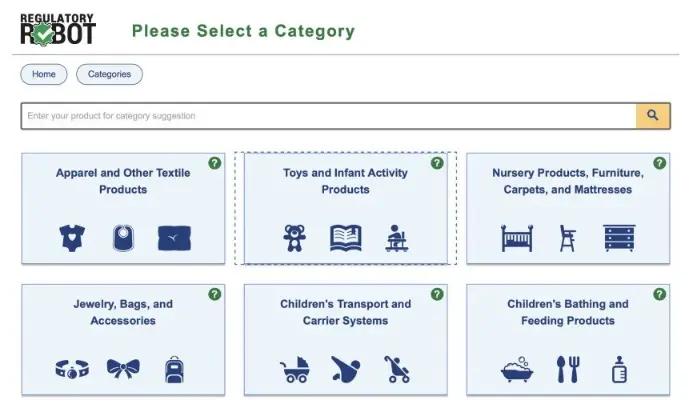
5. After filling out the information, the system will generate a complete report showing:
Whether the product is regulated by the CPSC
Whether a GCC (General Certificate of Conformity) or CPC (Children's Product Certificate) is required
Which regulations and standards are involved
Whether laboratory testing is required
Important Notes
1. Core Judgment Logic:
As long as the product originally requires a GCC or cpc certificate, then eFiling is required.
If your product falls under specific exemption circumstances, there are two other options available.
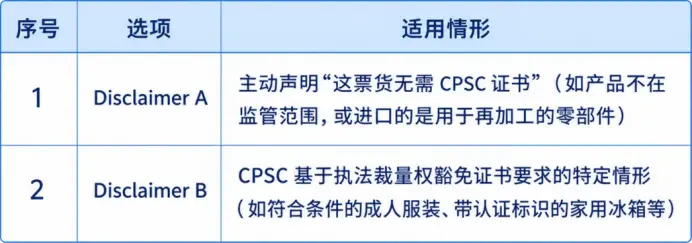
2. Confirm the Compliance certificate
Hold a valid GCC or CPC certificate.
The test reports are complete and all are within their validity period.
Children's products must be tested by a CPSC-accepted third-party laboratory.
Official channel for querying CPSC-accepted laboratories:
https://www.cpsc.gov/cgi-bin/LabSearch/Default.aspxReqId=AMg%2fmBA0CkxxThRBmkZrEg%3d%3d
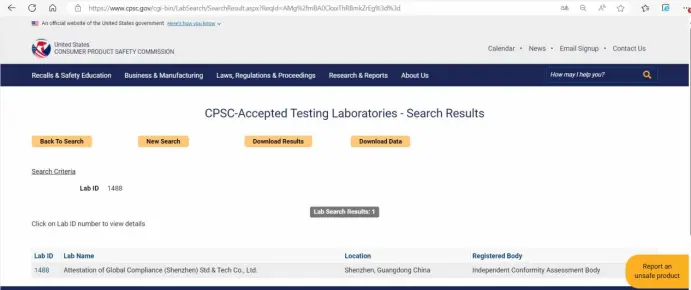
Filter by conditions such as "Testing Scope" and "Country" to find a local laboratory that meets the requirements. Or simply enter the laboratory ID number directly.
3. Confirm Product Information
Product ID
Citation Codes
Date of Manufacture
Place of Manufacture
Product Test Date
Testing Laboratory
Point of Contact
4. Choose the Filing Method
According to the official guide, the CPSC provides two parallel electronic filing methods:
1) Full PGA Message Set (Full Filing Method)
Operation Method: The importer submits the 7 pieces of product data information from the compliance certificate (CPC/GCC) to the customs broker; when the customs broker makes the import declaration in CBP's ACE system, they will manually enter the 7 required data elements into the PGA declaration field for the corresponding goods.
Target Audience: Suitable for importers with a low import frequency of CPSC-regulated products, and single-style items per import.
2) Reference PGA Message Set (Reference Filing Method)
Operation Method: First, register an account in the CPSC Product Registry system, set up a Certifier ID, and enter and record the product certificate data in advance;
(efiling.saferproducts.gov/efiling)
During customs clearance, you only need to submit three identifiers generated by the system to the customs broker: the Certifier ID, Product ID, and Version ID.Target Audience: Cross-border sellers deeply involved in the U.S. market, with multiple product SKUs and requiring repeated batch shipments of the same product.
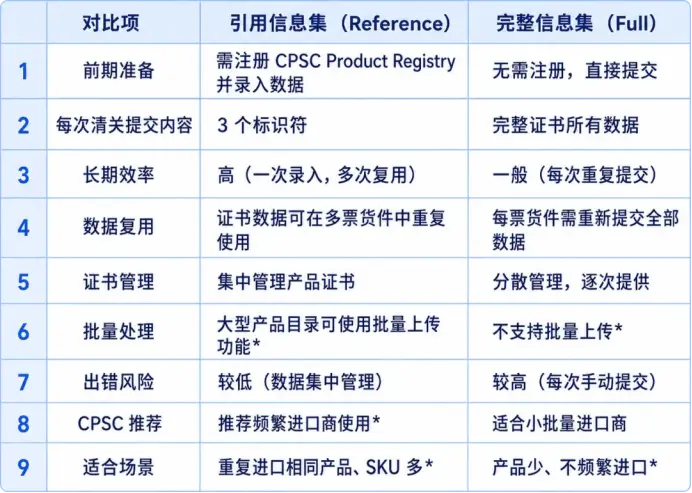
3) Comparison of the Two Modes:
The two modes can be mixed by category—the CPSC does not strictly require a single path. For example: mainly using Reference Filing for toys, while using Full Filing for occasionally imported furniture.
Understanding CPSC, CPC, and GCC
CPSC: Consumer Product Safety Commission
Responsible for enforcing various consumer product safety rules, bans, and standards. The commonly heard phrase in the market, "CPSC report or certificate," is usually a vague expression. It is necessary to confirm what type the product belongs to, which specific rules apply, what testing is required, and whether a CPC or GCC needs to be issued.
CPC: Children's Product Certificate
A mandatory complianCE certification document required by the CPSC for products primarily intended for children aged 12 and under. Children's products must complete compliance assessments based on applicable children's product safety rules. This typically requires passing test results provided by a CPSC-accepted third-party laboratory, after which the responsible party issues the CPC. The laboratory is responsible for testing and providing the results, but it is usually not the issuing entity of the CPC. For products manufactured overseas, it is typically issued by the importer; for products manufactured within the United States, it is typically issued by the domestic manufacturer.
GCC: General Certificate of Conformity
A mandatory statement of compliance proposed by the CPSC for non-children's general-use products. Issued by the U.S. importer or domestic manufacturer, it is a written certification confirming that the product complies with all applicable U.S. consumer product safety regulations and standards in terms of physical and mechanical safety, flammability, chemical hazards, etc. It covers a variety of daily commodities such as adult clothing, mattresses, bicycles, all-terrain vehicles (ATVs), carpets, bunk beds, lighters, etc. Manufacturers or importers can issue a GCC based on product testing or a reasonable testing program.
Email:hello@jjrlab.com
Write your message here and send it to us
 What is an EU SDS (Safety Data Sheet)?
 What is the CA Prop 65 Warning Label?
 2026 Amazon TIC Mandatory Audit Catalog
 Australian Electrical EESS and RCM Compliance
 How to get Vietnam CR Certification
 What is a UN 38.3 Battery Test Report
 What is the UN38.3 Certification Test?
 What is a Lithium Ion Battery Certification
Leave us a message
24-hour online customer service at any time to respond, so that you worry!