



Audio-Visual Equipment CE EN 62368 Testing Process
With the widespread application of audio-visual equipment in the global market, ensuring compliance with safety standards has become a critical task for manufacturers. EN 62368 is the core standard of the European Union for the safety of audio-visual, information technology equipment, and it also serves as the key basis for CE certification. This article details the EN 62368 testing process to help manufacturers efficiently achieve compliance certification.
Overview of the EN 62368 Standard
EN 62368-1 is a safety standard based on the Hazard-Based Engineering (HBE) concept, applicable to audio-visual, information technology and communication technology equipment. It replaces the traditional standards en 60065 and en 60950, with a greater focus on risk assessment and preventive design. The standard mandates that equipment shall not pose hazards to users or the environment under both normal operating conditions and fault conditions.
Relationship Between CE Certification and EN 62368
CE certification is a mandatory requirement for market access in the European Union. EN 62368 is one of the core standards to demonstrate that products comply with the low voltage directive (LVD) and the Radio Equipment Directive (RED). Passing the EN 62368 test indicates that the equipment meets EU regulations in terms of electrical safety, mechanical structure, fire resistance performance, etc., which is a necessary step to obtain the ce marking.
Detailed EN 62368 Testing Process
3.1 Preliminary Risk Assessment
Prior to testing, hazard identification and risk assessment shall be conducted to determine potential energy sources of the equipment (e.g., electrical, mechanical, thermal energy, etc.) and evaluate their potential hazard levels. Manufacturers are required to provide technical documentation, including circuit diagrams, bill of materials and design specifications.
3.2 Electrical Safety Testing
① Insulation Resistance Test: Verify the insulation strength between primary and secondary circuits to ensure no leakage risk.
② Earth Continuity Test: Check the reliability of the grounding conductor to prevent electric shock accidents.
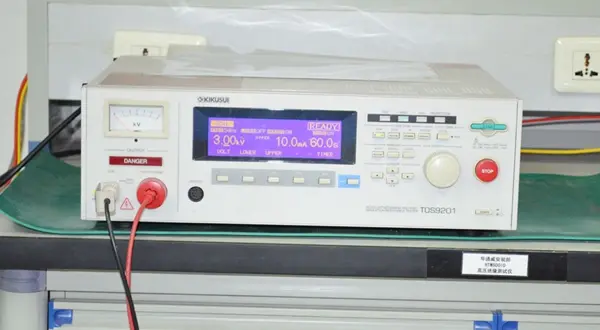
③ Dielectric Strength Test: Apply high voltage to detect the voltage withstand capacity of insulating materials.
3.3 Mechanical Safety Testing
Evaluate the enclosure strength, protection of moving parts and stability of the equipment, including but not limited to:
① Drop Test: Simulate the structural integrity of the equipment when dropped.
② Sharp Edge Test: Ensure there is no design that may scratch users.
3.4 Fire Resistance Performance testing
Testing shall be performed according to the flammability rating of equipment materials (e.g., UL 94 standard). The enclosure and internal components are required to be flame-retardant or able to delay the spread of fire.
3.5 Abnormal Condition Testing
Simulate fault scenarios such as short circuits and overloads to verify whether the equipment can automatically cut off the power supply or enter a safe state.
Compliance Documentation After Testing
After passing the test, manufacturers need to compile the following documents to apply for CE certification:
① Test report (issued by an EU Notified Body)
② Technical Construction File (TCF)
③ Declaration of Conformity (DoC)
④ User manual (including safety warning labels)
Common Issues and Optimization Suggestions
(1) Issue 1: Materials fail to meet fire resistance requirements.
Suggestion: Select materials complying with UL 94 V-0 or HB rating in advance.
(2) Issue 2: Insufficient insulation clearance.
Suggestion: Optimize PCB layout with reference to the creepage distance and clearance requirements specified in the standard.
Conclusion
The EN 62368 test is the technical cornerstone for audio-visual equipment to enter the EU market. Through systematic risk assessment and targeted testing, manufacturers can not only improve product safety, but also accelerate the ce certification process. It is recommended that enterprises engage in standard research at an early stage, or seek pre-testing services from third-party testing institutions during the design phase to reduce compliance risks.
Email:hello@jjrlab.com
Write your message here and send it to us
 What are the FCC Testing Requirements for Bluetoot
 Australia RCM Certification for Radio Devices
 RED Cybersecurity EN 18031 Standard
 Compliance Testing for EMC
 What is Amazon Toy Compliance?
 What is Cytotoxicity ISO 10993-5
 What is Hemocompatibility Testing ISO 10993?
 What is ISO 10993-5 Tests for In Vitro Cytotoxicit
Leave us a message
24-hour online customer service at any time to respond, so that you worry!