



What is Japan S-JET Certification?
What is S-JET Certification?
In the Japanese market, safety certification for electrical products serves as a critical pass to enter the consumer market. In addition to the mandatory pse certification, S-JET certification, as a voluntary safety certification, has become a preferred choice for more and more enterprises to enhance their product competitiveness.
S-JET is an electrical product safety certification launched by the Japan Electrical Safety & Environment Technology Laboratories (JET), a general incorporated foundation. Based on the Electrical Appliance and Material Safety Act, it provides third-party authoritative safety certification for Specified Electrical Appliances (Diamond PSE).
Core Values
1. Authoritative safety endorsement to strengthen consumer trust
2. Improve product market competitiveness
3. Meet the stringent requirements of high-end distributors
Which Products Require S-JET Certification?
Main Targets: Diamond PSE products (high-risk Specified Electrical Appliances)
• Large household appliances such as refrigerators, washing machines, and air conditioners
• Kitchen and bathroom appliances such as electric water heaters and microwave ovens
• Industrial equipment such as electric welding machines
• Photovoltaic cables, etc.
Note: This certification does not apply to Circular PSE products (low-risk products).
S-JET Certification Service System
JET adopts the Type Certification Method, conducting strict testing and factory inspections for each product model to ensure consistency from production to finished products.
Type Certification Method
This method applies to individual product models. JET tests whether a specific model complies with established standards, inspects whether the manufacturing factory of the model is properly maintained, and registers both the product model and its manufacturing factory. Each product will be affixed with the JET safety certification mark. Once registered, the factory must undergo regular inspections to maintain type certification eligibility.
Multiple product models can be classified into one series model and registered together on a single certificate.
The steps of the Type Certification Method are as follows:
1. For any model submitted for registration, JET conducts certification testing to ensure compliance with established standards. (Safety Certification Testing)
2. For any model submitted for registration, JET inspects whether the relevant factory manufactures and inspects the model with qualified equipment under an appropriate and established quality maintenance plan. (Initial Factory Inspection)
3. For models that pass Safety Certification Testing and Initial Factory Inspection, JET registers the product model and its manufacturing factory and issues a certificate.
4. Registered products may be affixed with the JET safety certification mark, which helps distributors and consumers identify safe products sold to the public.
1. After initial registration, JET conducts repeated factory inspections regularly to ensure the factory maintains production standards consistent with the Initial Factory Inspection. (Regular Factory Inspection)
2. During Regular Factory Inspections, JET samples products bearing the certification mark for follow-up certification testing. (Sampling Inspection)
Series Model
Under the Type Certification Method, customers applying to register multiple models as a series may adopt the following approach:
3. Series Integration: Integrate models into a series based on whether they share similar circuits and components and are manufactured under the same design scheme. JET will collaborate with customers applying for series registration to determine the series scope. This method applies to all product combinations submitted for registration.
S-JET Certification Application Process
1) Application
Fill in the application form in JET’s fixed format.
If multiple models are to be registered as a series on a single certificate, customers may apply for all models simultaneously or in phases.
Application Documents Checklist
4. Basic Documents: S-JET Certification Application Form, Model List, Technical Specification Statement, Manufacturer Qualification Documents, Declaration of Conformity
2. Factory Documents: Factory Route Map, Production Equipment List, ISO 9001 Certificate (if applicable), Quality Control System Documents (for first-time applicants)
3. Technical Documents: Product Specification, Bill of Materials (BOM)
2) Safety Certification Testing
In accordance with established testing standards, JET will conduct Safety Certification Testing on the same product model intended for shipment with the JET safety certification mark.
When adding a new model to a registered series, JET will only perform necessary testing based on differences between the new model and registered models.
When registering all models of a series simultaneously, JET will select a standard model to conduct all applicable tests. For other models, only necessary tests will be performed based on their differences from the standard model.
Currently, testing standards comply with technical standards under electrical appliance regulations. If testing standards are not applicable to a product, JET will negotiate with the customer to determine appropriate standards.
3) Factory Inspection
Factory inspections include Initial Factory Inspection (conducted concurrently with Safety Certification Testing) and Regular Factory Inspection. JET conducts Initial Factory Inspections to ensure the production system can stably supply registered products with high quality, and Regular Factory Inspections to provide ongoing assurance.
JET inspects all factories manufacturing registered products, and conducts systematic inspections for each factory based on product categories (JET’s product classification is similar to that under electrical appliance regulations).
4) Registration & Certification Issuance
Upon passing testing and inspections, the S-JET certification certificate will be issued, and products may be affixed with the S-JET mark.
5) Continuous Supervision
Regular factory inspections and product sampling inspections
Usage Specifications of the Certification Mark
The use of the JET certification mark is subject to strict regulations to ensure clear identification by consumers and resistance to removal.
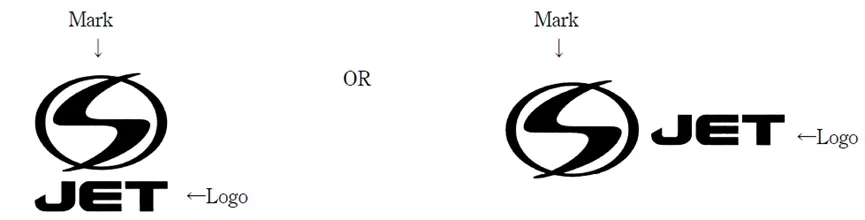
4. The JET certification mark (hereinafter referred to as “the Mark”) consists of the logo and mark pattern shown above.
5. The Mark is designed in a single color, with no specific color requirements, except for marks printed via molds.
3. JET recommends the logo be printed in blue (DIC color No. 222) and the mark pattern in gray (DIC color No. 544).
4. The Mark must be scaled based on the basic pattern provided by JET. When reduced, the height of the Mark shall be no less than 3 mm.
5. The Mark may be reduced to less than 3 mm in height only if it remains clearly legible and JET is notified in advance.
Display Requirements on Certified Products
1. The Mark must be displayed on the main body of the certified product, ensuring easy identification by purchasers and resistance to removal.
2. If the certified product is extremely small with limited surface space, or the Mark cannot be displayed without separating the logo and pattern, it may be displayed appropriately (e.g., on the minimum sales packaging unit or a label attached to the product). In such cases, the display location and method must be notified to JET in advance.
3. In addition to displaying the Mark on the product main body, it may also be displayed on product packaging, brochures, catalogs (including corporate manuals) as needed.
4. In the above cases, the Mark must be displayed as part of information related to certified products, and shall not mislead the public into regarding non-certified products as certified ones.
Additional Display Content Beyond the Mark
1. In addition to the Mark, the following content must be displayed on certified products. Duplication is not required if any content overlaps with Japanese legal and regulatory requirements:
A. Name or abbreviation of the certificate holder, or a registered trademark for identifying the certificate holder.
B. Product model or specification number.
C. Electrical ratings (rated voltage, rated frequency, rated power consumption, etc.).
2. If displaying the abbreviation or registered trademark of the certificate holder (corresponding to Clause 4(1)A above), JET must be notified in advance.
3. If the Mark is displayed on the minimum sales packaging unit or label per Clause 3(2), and part of the content in Clause 4(1) is already displayed on the product main body, such content may be omitted on the packaging or label.
Email:hello@jjrlab.com
Write your message here and send it to us
 What are the FCC Testing Requirements for Bluetoot
 Australia RCM Certification for Radio Devices
 RED Cybersecurity EN 18031 Standard
 Compliance Testing for EMC
 What is Amazon Toy Compliance?
 What is Cytotoxicity ISO 10993-5
 What is Hemocompatibility Testing ISO 10993?
 What is ISO 10993-5 Tests for In Vitro Cytotoxicit
Leave us a message
24-hour online customer service at any time to respond, so that you worry!