


German Battery Act (BattG) Fee
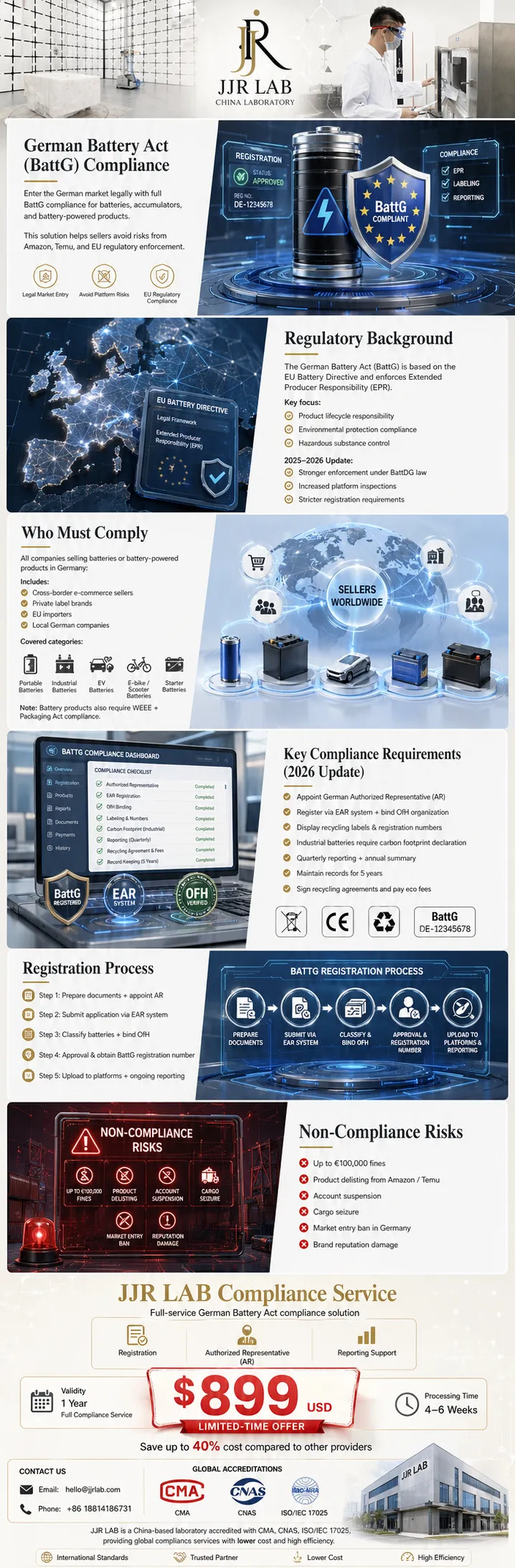
To enter the German market and sell batteries, accumulators, or products with built-in/external batteries, compliance with the German Battery Act (BattG) is mandatory.
Platforms including Amazon, Temu, etc., have stepped up strict inspections. Non-compliance will lead to product delisting, heavy fines, and other penalties.
This document simplifies key compliance points to help sellers avoid risks and achieve full compliance quickly.
Policy Background & Core Purpose
The German Battery Act (BattG) is derived from the EU Battery Directive (2006/66/EC) and officially entered into force in 2009.
Its core is the Extended Producer Responsibility (EPR) system, which obligates companies to take responsibility for the full lifecycle recycling and treatment of batteries, restrict hazardous substances, and reduce environmental pollution.
In 2026, supervision will be upgraded, focusing on three key areas: OfH registration, Authorized Representative, and data reporting.
On September 26, 2025 (German local time), the German Federal Council formally adopted the Battery Act Implementation Act (Batterierecht-Durchführungsgesetz, BattDG).
This law will take effect on October 7, 2025.
Applicable Entities & Scope
Applicable Entities
All entities placing batteries, accumulators, or battery-containing products on the German market, including:
• Chinese cross-border sellers (all platforms & sales models)
• German local companies
1. EU importers
Registration is limited to companies and must match the platform store entity.
Private brand sellers bear full compliance responsibility.
Controlled Scope (5 Categories)
2. Portable batteries: Small sealed batteries in mobile phones, power banks, electric toys, etc.
3. Industrial batteries: Large batteries for machinery and energy storage systems
4. EV batteries: Power batteries for new energy vehicles
5. Light transport batteries: Batteries for e-bikes, e-scooters, etc.
6. Start batteries: Batteries for ignition and lighting in traditional fuel vehicles
Note:
1. Battery-containing electronic devices must also register for BattG + WEEE.
2. Packaging requires Packaging Act registration.
Core Compliance Requirements (2026 Updated)
3. Non-EU sellers must appoint a German local Authorized Representative (AR) registered with EAR; self-registered accounts will be canceled.
• Starting 2026, bind an officially recognized OfH (Producer Responsibility Organization) and register accurately by 5 categories; multi-category / multi-brand requires separate registrations.
• Product packaging must display recycling symbols and registration numbers (≥ 3mm × 3mm); industrial batteries require an additional carbon footprint declaration.
• Report battery sales weight, chemical composition, etc., quarterly; complete annual summary in Q1 next year; renew before December each year.
• Sign contracts with approved recycling organizations, pay recycling fees and deposits; keep compliance documents for at least 5 years for inspection.
German Battery Act Registration Process
1. Prepare documents (business license, battery chemical composition, etc.) and appoint a qualified German AR.
2. AR assists in submitting applications via the EAR system, fills in battery & category info, and binds OfH.
3. After approval, pay authorization fee to obtain BattG registration number & certificate.
4. Upload registration number to platforms for verification; complete timely reporting, renewal, and recycling obligations.
German Battery Act Fee
JJR LAB provides one-stop German Battery Act compliance service:
1. Fee: $899
2. Validity: 1 calendar year (registration + reporting)
3. Processing time: 4–6 weeks
Penalties for Non-Compliance
4. Maximum fine: €100,000
5. Product delisting, account suspension, cargo seizure
1. Severe cases: banned from the German market
2. Required to pay back fees + late payment surcharges
3. Serious damage to brand reputation
Key Compliance Tips
• Classify categories accurately to avoid invalid registration; industrial batteries need carbon footprint declaration in advance.
• Choose a formal AR with EAR registration; avoid fake agents to prevent account cancellation.
• Report data truthfully and mark symbols properly; no false declaration or missing labels.
• Complete OfH binding & registration early to avoid peak-season delays.
5. Achieve triple compliance: BattG + WEEE + Packaging Act to avoid omissions.
In 2026, compliance thresholds for the German Battery Act have risen, and supervision under the new OfH system is stricter.
Compliance is a prerequisite for entering the German market.
Sellers are advised to organize battery products in advance, appoint a formal AR, complete full compliance procedures, avoid risks, and steadily develop the German market.
Email:hello@jjrlab.com
Related PRODUCTS
-

Italy EPR CONAI Registration
-

French WEEE Registration
-
French Packaging Law Leko
-
French Packaging EPR Citeo
-
German Battery Act (BattG) Fee
-

Germany WEEE Certification Fee
-
German Packaging Act VerpackG
-

Turkey Responsible Person Service
-

Amazon UK Responsible Person Service
-

Amazon EU Responsible Person Service