


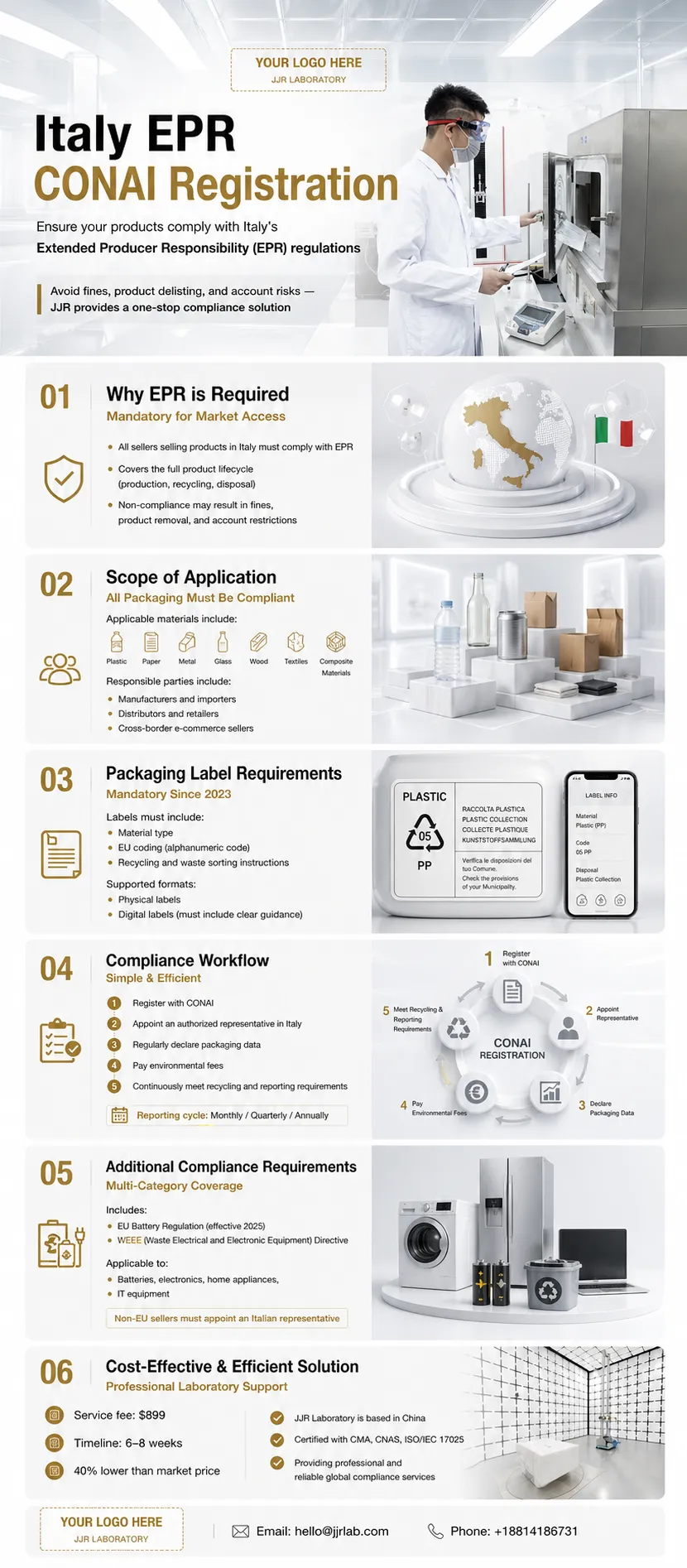
Italy EPR CONAI Registration
The Italian government has established EPR compliance policies to require producers to take greater responsibility throughout the product lifecycle, including waste treatment and recycling.
Sellers that place products on the Italian market are generally required to comply with EPR regulations.
Sellers must appoint an authorized representative based in Italy to fulfill EPR-related obligations on their behalf.
Italian Packaging Law
As of January 1, 2023, Italy has enforced mandatory labelling requirements.
Under the regulation, all products sold on the Italian market must meet specific packaging and labelling requirements.
Sellers using non-compliant packaging labels may face heavy fines.
Scope of Application
All product packaging sold in Italy (primary, secondary, and tertiary packaging) must bear an environmental label.
Packaging is defined as:
Products made of any material used to contain certain goods – from raw materials to finished products – to protect them, enable handling, deliver them from producers to consumers or users, and preserve their appearance, as well as disposable items used for the same purpose.
Including:
1. Plastics
2. Paper and fibreboard
3. Metals
4. Wood
5. Textiles
• Glass
• Composite materials
Responsible Parties
• Producers: Suppliers of packaging materials, manufacturers, processors, and importers of empty packaging and packaging materials.
• Traders, distributors, resellers, packaging users, and any business operators placing packaging on the market.
Label Content
Labels generally include four pieces of information:
• Type of packaging material
• Alphanumeric code for the packaging material
• Instructions for sorted collection and proper disposal of waste packaging
1. Waste separation recommendations
Labelling Requirements
2. Alphanumeric code for packaging material type
Reference codes are excerpted from the Annex to EU Decision No. 97/129/EC.
3. Instructions for sorted collection and disposal may be displayed in two ways:
4. “Raccolta” + material type (in Italian)
Example: For paper packaging → Raccolta carta (meaning “paper recycling”, instructing consumers to dispose of the packaging in paper recycling bins).
1. Material type + recycling instructions
Example: CARTA + Raccolta differenziata + Verifica le disposizioni del tuo Comune
(Main material is paper; separate collection required; consumers should check local municipal rules.)
2. Material composition consideration
If packaging consists of multiple materials, but secondary materials account for less than 5% of its weight, it is classified as single-material packaging and may be labelled according to the dominant material by weight.
3. Physical or electronic labels
If electronic labels are used, sellers must clearly inform buyers where to find information on packaging material type and waste sorting/disposal instructions.
Important Notes
4. Italy has strict requirements for packaging materials; detailed composition reports must be submitted.
1. Italian customs conduct strict inspections of EPR compliance. Sellers must ensure full regulatory conformity.
Compliance Steps for Italian Packaging Regulations
2. Register with CONAI
Before placing packaged products on the Italian market, businesses must register with CONAI, the national packaging consortium responsible for managing packaging waste and enforcing EPR obligations.
3. Appoint an authorized representative
Importers without a legal entity in Italy must designate a third-party representative in Italy to fulfill EPR compliance obligations.
• Participate in material recycling
Businesses are required to pay fees to CONAI to financially support the collection, sorting, and recycling of packaging waste.
Fees are determined by the type and volume of packaging placed on the market.
Italy uses a modulated fee system to encourage eco-friendly packaging design:
• Lower fees for easily recyclable packaging or packaging containing recycled materials
• Higher fees for less sustainable packaging
• Report packaging data
Businesses must regularly report the quantity and type of packaging placed on the Italian market to CONAI.
Accurate reporting ensures correct fee application and effective monitoring of recycling targets.
If precise data is unavailable, businesses may use estimates based on product specifications, supplier information, or industry benchmarks.
Reporting Frequency
Monthly, quarterly, or annual reporting depends on the total annual environmental contribution (EPR fees) declared for each material in the previous year, based on packaging type and volume.
All regular declarations must be submitted by the 20th day of the month following the reporting period.
• Q1 (Jan–Mar) report → due by April 20
• January monthly report → due by February 20
Failure to meet reporting deadlines may result in penalties.
Cost of Italy EPR CONAI Registration
JJR LAB provides Italy EPR CONAI Registration services at a cost of US$899, with processing completed in 6–8 weeks.
Italian Battery Law
The new EU Battery Regulation will enter into force by August 18, 2025.
Sellers must provide an EU Battery Law EPR registration number to Amazon before the deadline.
This regulation applies to EU member states including Italy, Germany, France, Spain, Poland, Austria, Sweden, etc.
Scope of Application
• Portable batteries
• Light transport batteries for e-bikes, e-mopeds, and other light electric vehicles
• SLI batteries (Starting, Lighting, Ignition) mainly for automobiles
a. Industrial batteries for industrial equipment and machinery, including backup power supplies
b. Electric vehicle batteries for battery electric vehicles (BEVs) and plug-in hybrid electric vehicles (PHEVs)
Note for Cross-Border Sellers
Most products sold fall under the portable battery category.
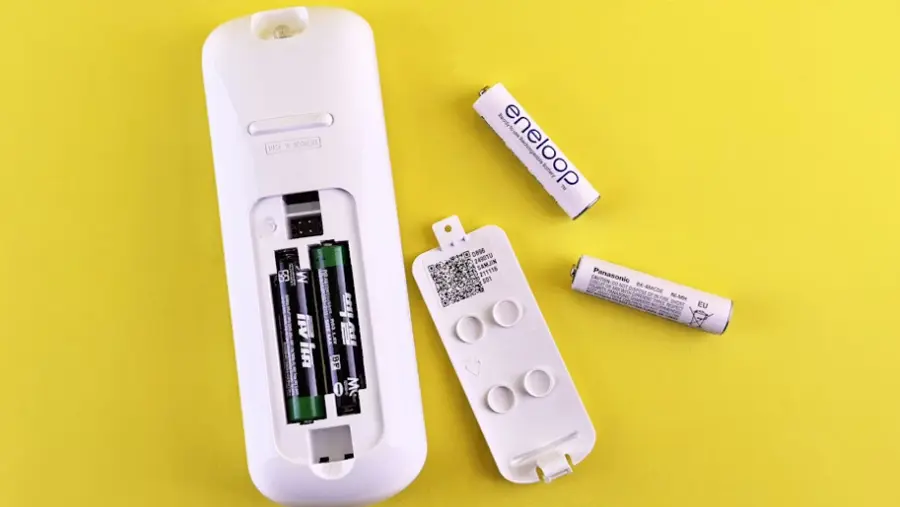
Under EU Battery Directive 2006/66/EC, portable batteries are sealed batteries weighing less than 5 kg, easily portable by hand:
c. Single cells (AA, AAA, etc.)
• Mobile phones, laptops, cordless power tools, toys
• Household appliances: electric toothbrushes, shavers, handheld vacuums, and other consumer batteries for daily household use
Italian WEEE
Italian Legislative Decree No. 49/2014 expanded the regulatory scope.
Producers, importers, and businesses selling electrical and electronic equipment (EEE) under their own brand must organize and finance the collection and recycling of Waste Electrical and Electronic Equipment (WEEE) from placed products.
Scope of Application
1. Temperature exchange equipment
2. Monitors and displays with a surface area over 100 cm²
3. Lamps and lighting equipment
4. Large equipment with at least one external dimension exceeding 50 cm
5. Small equipment with external dimensions no larger than 50 cm
6. Small IT and telecommunications equipment with external dimensions no larger than 50 cm
Important Note
Non-resident sellers placing EEE on the Italian market — including via distance selling — must appoint an authorized representative in Italy to fulfill environmental responsibilities.
The representative may be a legal or natural person in Italy, responsible for weee registration, reporting, and recycling obligations on behalf of the non-resident seller.
Q&A
Is the official CONAI template mandatory for the Italian Packaging Law in 2026?
Yes. Old templates are no longer accepted, and submissions using outdated templates will be rejected by the system.
Shazhixing Cross-Border can provide the latest official templates.
How is secondary packaging weight calculated under the Italian Packaging Law in 2026?
Weigh 10 typical courier boxes, calculate the average weight, then multiply by annual order volume.
The same method applies to bubble wrap and tape.
Shazhixing Cross-Border can assist in building an estimation model.
Where can I find material codes for packaging labels under the 2026 Italian Packaging Law?
The CONAI official website provides a PDF code list.
Shazhixing Cross-Border can supply vector source files ready for direct printing.
General EPR Compliance Process
1. Identify applicable EPR categories
Determine which EPR rules apply to your products: packaging waste, WEEE, batteries, vehicles, lighting, textiles, batteries, pharmaceuticals, etc.
2. Register with a Producer Responsibility Organization (PRO)
Each EPR category has designated PROs. Businesses must join the relevant PRO.
3. Submit annual reports and pay fees
After registration, submit timely annual reports and pay applicable fees.
4. Comply with marking and labelling rules
Ensure products and packaging meet labelling requirements for proper recycling and disposal.
5. Maintain ongoing compliance
Continuously monitor and uphold compliance obligations.
Platform Requirements
Major cross-border e-commerce platforms including Amazon, TEMU, AliExpress, etc., now require sellers to provide Italian EPR registration certificates and compliance documents.
Non-compliant sellers may face:
• Product delisting
• Sales restrictions
• Account suspension
Email:hello@jjrlab.com
Related PRODUCTS
-

Italy EPR CONAI Registration
-

French WEEE Registration
-
French Packaging Law Leko
-
French Packaging EPR Citeo
-
German Battery Act (BattG) Fee
-

Germany WEEE Certification Fee
-
German Packaging Act VerpackG
-

Turkey Responsible Person Service
-

Amazon UK Responsible Person Service
-

Amazon EU Responsible Person Service