


French WEEE Registration
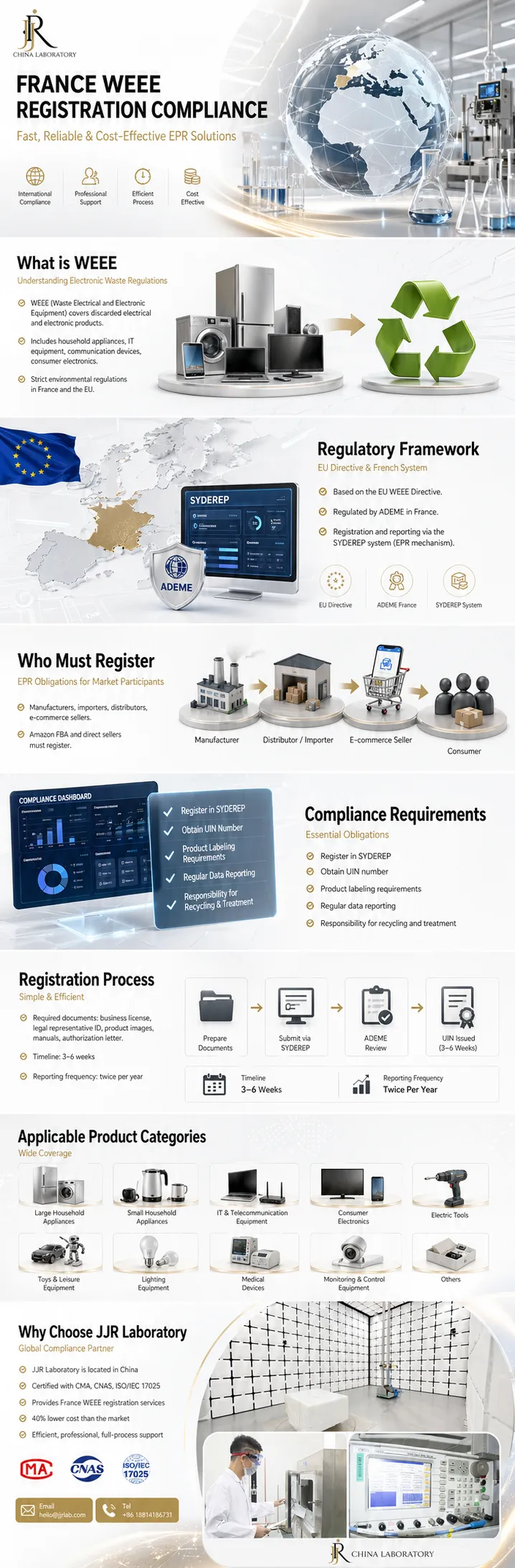
Worldwide, the management of Waste Electrical and Electronic Equipment (WEEE) has become one of the key issues for environmental protection and sustainable development. WEEE refers to waste electrical and electronic equipment, including but not limited to household appliances, computers, communications equipment, and consumer electronic products. To regulate the treatment and recycling of WEEE, countries have enacted corresponding laws and regulations. As one of Europe’s major economies, France also has strict rules and regulations for WEEE management.
The French Environment and Energy Management Agency (ADEME) is the competent authority for waste recycling. It has established the SYDEREP system (SYstème DEclaratif des filières REP, meaning the Extended Producer Responsibility Declaration System) to implement waste recycling, covering eight categories: waste furniture, waste electrical and electronic equipment (WEEE), household packaging, waste batteries and accumulators (PA), waste paper, fluorinated gases (GF), used tires (PU), and end-of-life vehicles (ELV).
What is French WEEE?
Legal Background
France’s WEEE management is mainly governed by the EU Waste Electrical and Electronic Equipment Directive (weee directive). This directive aims to regulate the collection, treatment, and disposal of waste electronic products to reduce negative impacts on the environment and human health, and to promote the circular use of resources.
Regulatory Requirements
Under French law, manufacturers, importers, and distributors are responsible for ensuring that electronic products placed on the market comply with the WEEE Directive and bear related recycling and treatment obligations. Specific requirements include:
1. Registration: Relevant enterprises must register with French environmental authorities and submit reports to prove compliance with WEEE management regulations.
2. Responsibility Sharing: Manufacturers, importers, and distributors must undertake WEEE recycling and treatment, including providing collection bins, collecting, and transporting waste products.
3. Labeling Requirements: WEEE must bear specific markings for identification and proper recycling.
4. Data Reporting: Enterprises must regularly submit WEEE management data reports to the French government to demonstrate compliance.
Competent Authorities
French WEEE management involves multiple organizations, mainly:
5. ADEME (French Environment and Energy Management Agency): Formulates and implements WEEE management policies, and provides guidance and support.
• Ecologic (WEEE Treatment Organization): Organizes and coordinates the collection, treatment, and disposal of WEEE.
• Local governments: Supervise and manage local WEEE treatment to ensure regulatory compliance.
Ecologic France is an organization dedicated to managing waste electrical and electronic equipment (WEEE). Its mission is to promote the recycling, treatment, and circular reuse of waste electronic products to reduce environmental harm.
Definition of WEEE
The French Environmental Code defines electrical and electronic equipment as:
“equipment that operates on electric current or electromagnetic fields, as well as equipment for the generation, transmission, and measurement of such currents and fields, designed for alternating voltage not exceeding 1,000 volts and direct current not exceeding 1,500 volts.”
Who Needs to Register for WEEE?
As a producer or marketer, you must comply with the Extended Producer Responsibility (EPR) scheme.
Anyone who manufactures, distributes, or imports products is responsible for their entire lifecycle: they must fund and organize waste management, including waste collection and disposal, as well as reuse and recycling solutions suitable for the products they make and place on the market.
Under French regulations on WEEE — Article R. 543‑174 of the Environmental Code — a “producer” means any company that places EEE on the French market (mainland France, DROM, and COM).
Under French equipment marketing rules, you may qualify as one or more types of marketer:
• Manufacturer: Producing within the territory of an EEA member state.
• Importer: Introducing EEE from countries outside the EU.
• Introducer: Introducing EEE from other EU member states.
• Distributor: If equipment is sold under your own brand.
• Distance seller: Selling remotely to household or non-household users directly from abroad.
For cross-border e-commerce sellers:
1. Using Amazon FBA or overseas warehouses qualifies you as an importer.
2. Using direct shipping qualifies you as a distance seller.
Both categories are required to register for French WEEE.
Producer Responsibilities
Producers are responsible for their products throughout their lifecycle and must fulfill legal obligations. This can be done in two ways: joining an approved eco-organization or setting up an individual system.
In both cases, producers are required to:
3. Register on ADEME’s national producer register: SYDEREP.
4. Declare annually the total quantity and weight of EEE/ASL/ABJ placed on the French market, as well as the recycled material incorporation rate per device.
1. Inform end-users of the equipment.
2. Finance the collection and treatment of equipment, and support repair and reuse.
3. Ensure collection and treatment, and promote repair and reuse.
4. Submit annual collection and treatment reports to public authorities.
Product Categories
WEEE EPR Categories include:
1. Large household appliances
2. Small household appliances
3. IT and telecommunications equipment
• Consumer equipment
• Electrical and electronic tools
• Toys, sports, and leisure equipment
• ATMs
• Medical devices
• Monitoring and control instruments
UIN (Unique Identification Number)
The Unique Identification Number (IDU) certifies that a producer/marketer is registered in the eco-organization’s register and has updated their eco-contributions in accordance with legal requirements (Articles L541‑10 to L541‑10‑17 of the Environmental Code).
The UIN is used to monitor and enforce compliance with EPR obligations. It is valid for 1 year and must be renewed annually. It must appear in your General Sales Conditions (CGV) and all contractual documents.
Registration Process & Timeline
Required Documents for weee registration
• WEEE registration application form
• Scanned business license
• Scanned legal representative ID
a. Product photos (preferably with logo)
b. Product manual (if available)
c. Power of attorney
Timeline & Reporting
• Processing time: 3–6 weeks
• Reporting frequency: Twice a year (once per quarter)
Sorting Labels
French WEEE and battery law sorting labels were introduced and implemented on 1 January 2022. Producers were required to adopt and use them by 15 December 2022, with an additional 6‑month clearance period until 15 June 2023.
French WEEE Registration Fee
China JJR provides French WEEE registration services starting from €599, with registration completed within 2 months.
Email:hello@jjrlab.com
Related PRODUCTS
-
Italy EPR CONAI Registration
-
French WEEE Registration
-
French Packaging Law Leko
-
French Packaging EPR Citeo
-
German Battery Act (BattG) Fee
-
Germany WEEE Certification Fee
-
German Packaging Act VerpackG
-
Turkey Responsible Person Service
-
Amazon UK Responsible Person Service
-
Amazon EU Responsible Person Service